
A cultural extravaganza or a damp squib?

The three-day World Culture Festival leaves behind a stinking mess

GN Bureau | March 16, 2016

#Yamuna   #NGT   #Environment   #Art of Living   #World Culture Festival   #Sri Sri Ravi Shankar  
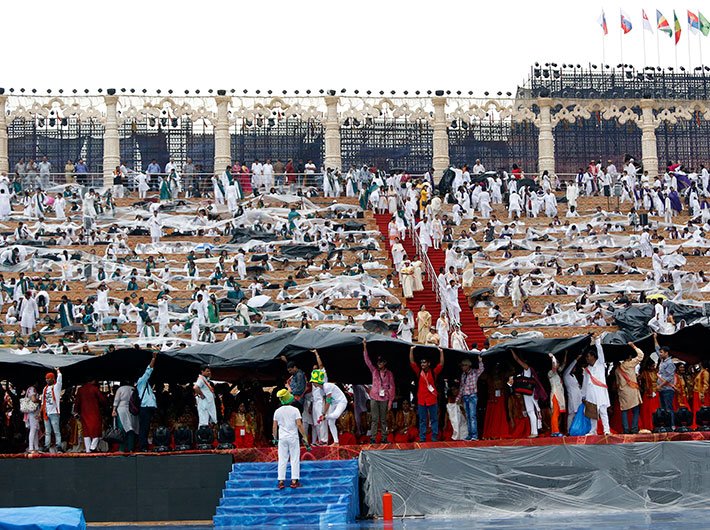
People taking shelter from rain at the World Culture Festival

Unpredictable rains, “unsafe stage”, and environment activists could not dampen the spirits of Sri Sri Ravishankar’s three-day mega event, World Culture Festival. Dubbed as a “cultural olympics” by the Art of Living (AoL) founder, the event concluded on Sunday amidst various controversies. 

 
Riding high on the success of the three-day extravaganza, the spiritual guru addressed the media on the last day of the event. He accused media of being “harsh” on him and said that “party politics should be kept aside” when such events are organised. He even informed that AoL has received invitations from countries like Australia and Mexico to host such events.
 
But the culmination of the event was not a happy one after all. Many media reports highlighted the damage done to the floodplains, mismanagement of the performances and the garbage mess left behind. 
According to a report by Hindustan Times, piles of trash littered were around the venue. Despite private agencies been appointed to collect and clean the garbage, a handful of volunteers and ragpickers were seen cleaning the mess. Also, the floodplain with porous sand forming its top layer was covered with mud and flattened by road rollers over several days before the festival began. Clay and compacted mud do not allow water to seep in, which is essential to replenish the groundwater.
 
A story carried out by The Quint claimed that the garbage mess was left to be cleaned by rag-pickers and contracted agencies. Spokespersons for the foundation said that more than one thousand volunteers would return to the festival grounds to assist in the clean-up process but very few volunteers were found. The report also said that executives from contracting companies charged with the clean-up say they are only responsible for the festival grounds, and not for any of the damage done outside of the event premises, such as garbage scattered on the fields and thrown in the river.
 
The festival started with the organisers boasting about a never-before participation of 35,973 artistes from across the country and the world. But, after speaking to a few artists that performed at the event, some newspapers claimed that as the first day of the festival ended; many of the artistes opted out, claiming it to be a nightmarish experience for them.
 
In a Facebook post, Olga Chepelianskia, a Kathak dancer from France, wrote why she cancelled her performance at the last day of the event. She says that they could have been provided with better human conditions, “That means better than children sitting in water for an hour and lying down with fever today, hours of standing in the mud in wet shoes waiting to somehow get out of the place, buses stuck in the middle of a sewage floodplain, malaria bearing mosquitoes in countless numbers, girls reaching home alone past midnight and so on.”
 
 
Days ahead of the event, organisers and banners claimed a footfall of 35 lakh of the three-day event. Though no actual figures have been declared as to how many people attended it, it was clear from the live broadcasts that many seats were left unoccupied. 
 
According to an Indian Express report, gangs from across the country targeted visitors and amid high security and made away with valuable articles like laptops, jewellery and cash, leading to over 70 FIRs and about 30 persons being apprehended.

Comments


Other News

India faces critical shortage of skin donors amid rising burn cases

India reports nearly 70 lakh burn injury cases every year, resulting in approximately 1.4 lakh deaths annually. Experts estimate that up to 50% of these lives could be saved with adequate access to skin donations.   A significant concern is that around 70% of burn victims fall wi

Not just politics, let`s discuss policies too

Why public policy matters Most days, India`s loudest debates stop at the ballot box. We can name every major leader and recall every campaign slogan. Still, far fewer of us can explain why a widow`s pension is delayed or how a government school`s budget is actually approved. That

When algorithms decide and children die

The images have not left me, of dead and wounded children being carried in the arms of the medics and relatives to the ambulances and hospitals. On February 28, at the start of Operation Epic Fury, cruise missiles struck the Shajareh Tayyebeh school – officially named a girls’ school, in Minab,

The economics of representation: Why women in power matter

India’s democracy has grown in scale, but not quite in balance. Women today are active participants in elections, influencing outcomes in ways that were not as visible earlier. Yet their presence in legislative institutions continues to lag behind. The Nari Shakti Vandan Adhiniyam was meant to addres

India will be powerful, not aggressive: Bhaiyyaji

India is poised to emerge as a global power but will remain rooted in its civilisational ethos of non-aggression and harmony, former RSS General Secretary Suresh `Bhaiyyaji` Joshi has said.   He was speaking at the launch of “Rashtrabhav,” a book by Ravindra Sathe

AI: Code, Control, Conquer

India today stands at a critical juncture in the area of artificial intelligence. While the country is among the fastest adopters of AI in the world, it remains heavily reliant on technologies developed elsewhere. This paradox, experts warn, cannot persist if India seeks technological sovereignty.


Archives

Current Issue

Opinion

Facebook Twitter Google Plus Linkedin Subscribe Newsletter

Twitter







