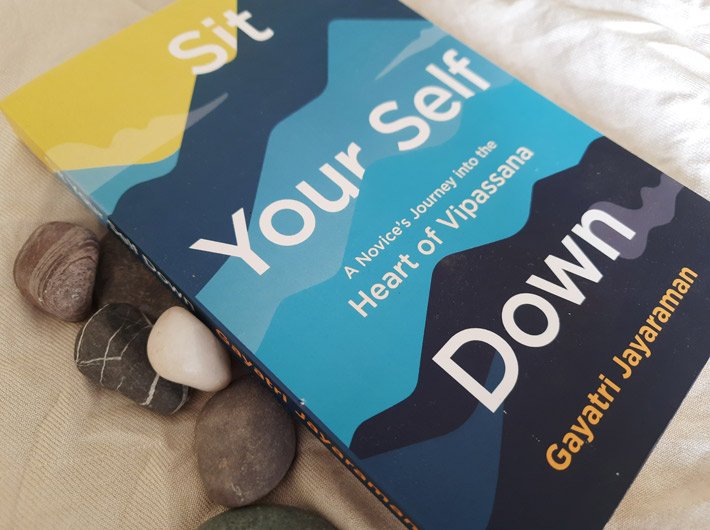
Sit Your Self Down
A Novice’s Journey into the Heart of Vipassana
By Gayatri Jayaraman
Hachette India, 212 pages, Rs 399
As stress and strife increase in daily life, more and more people are turning to meditation as an all-purpose antidote. There are hundreds of wildly different ways to meditate. In the last couple of decades, one of them, mindfulness meditation, has attracted a lot of attention, replacing Zen of the 1970s as a cultural keyword. There are hundreds of books introducing the subject – mindfulness in the board room, at the dinner table and elsewhere. There was a ‘Time’ magazine cover story too.
Mindfulness translates the Pali term ‘Sati’ (Sanskrit: Smriti), as understood in the Buddhist tradition. Another related word is Vipassana (Sanskrit: Vipashyana: to see in a special way), which gives the alternative term, insight meditation. This meditation is based on two discourses of the Buddha as collected in the Pali canon of Tipitaka.
The technique had gone missing from public domain for a long time, practised only by diehard monks in mountain caves. It made a comeback in 20th century, in Myanmar. Satya Narayan Goenka, a young businessman there, learned it in the 1950s from Sayagi U Ba Khin. To spread the good word, he came to India in 1969 and offered a retreat in Mumbai. Over the half century, a large number of Vipassana centres have come up across India and abroad. It has been taught successfully to jail inmates too.
The trouble with Vipassana is the trouble with all systems that refuse the supernatural factor. One has to bear one’s responsibility of walking the path, and there is no recourse to god, guru or grace that can help along. There is no help to be had here from idols and incense sticks and the other paraphernalia of the cults. The approach is on doing one’s job oneself, rather than laying it at the feet of a master.
The Buddha, according to the Pali scriptures, says he achieved what he achieved ‘within this six-foot body’, that is, without any external aid. When nearly all spiritual leaders and founders of religious sects make a pitch of being chosen or sent from above and thus of being an authority unlike you and me, the Buddha stands nearly alone in saying that he is exactly like you and me and thus we can achieve what he achieved provided we put in effort diligently. Of course, once his message became a religion, stories of miracles came to be added to his biography. Still, his way of meditation remains the farthest from the denominational, ritualistic ways of others. It is closer rather to psychotherapy, with morality added.
Another trouble with Vipassana is that one should learn it only through a shivir, or retreat, of ten days (with half a day added at the start). There are short cuts offered by others. Young seekers from the West came to India, Nepal and Myanmar in the days of Flower Power, and returned home with the learning of Vipassana. They have simplified it to an extent and even made it more ‘secular’, putting it to very effective use in hospitals (as pioneered by Dr Jon Kabat-Zinn). Not surprisingly, there are apps too. But the organisation founded by Goenka insists on ten days – and this is in concession to the contemporary lifestyles, traditionally it was meant to be 45 days.
When we try to discipline the mind, restrict it from ceaseless chatter and bring it back to focus on itself, the first thing to do is to stop the chatter outside. Thus, there is no communication for ten days. No talking, no gesturing, no reading (not even Vipassana literature), no writing (not even diary) and certainly no smartphones. Minimal talk is of course allowed, with the local teacher and the volunteer-servers, only for solving practical issues. Another challenge is not only to start the day at 4 a.m., but to work on till 9.30 a.m. with no break sufficient to cure sleep deprivation. And once in, there’s no option to quit; it is indeed not advisable to quit midway.
It turns out to be the most intense and most unforgettable experience for many. Practitioners come, as it were, face to face with themselves. As this inner pilgrimage proceeds, they get to see the mind at work, step by step, as in a flowchart. The journey, full of highs and lows, is cathartic. (A practitioner crying for no reason is not unusual.) The process is difficult to describe in words, and there are few travelogues of this inner pilgrimage of the first Vipassana shivir beyond some blog-length entries. In ‘Sit Your Self Down’, Gayatri Jayaraman gifts us one, and she writes with a sense of wonder about the joys and tribulations of her voyage within.
In the daily diary format, she shares the basics of Vipassana as well as larger life lessons distilled from them, quotidian life in the company of fellow practitioners at an old centre in the lap of the Himalayas as well as memories and misgivings that well up from deep inside. Her heartfelt words flow smoothly with a witty voice and infectious enthusiasm.
Any such book runs the risk of turning into an uncritical adulatory work. It is to Jayaraman’s credit that it remains true to the spirit of inquiry. As the Buddha urges us to ‘come and see for yourself’ (“Ehi Passiko”), she does not gloss over doubts and disagreements, making it an open inquiry.
Any transformative technique that claims to work on the self at the deepest possible level is bound to have the same story structure for all, and yet the narrative may unfold differently for each one of us from one hour to the next, from one day to the next. What is described here in this inspiring and joyful book is the experience of one practitioner. Those yet to go through this life-changing initiation should refrain from building specific expectations; for them the book should serve the same function as a friend sharing anecdotes from a trip to an exotic destination. For old-timers, it will be an exchange of notes with another practitioner, which remains a rather rare opportunity in the non-cultish world of Vipassana.