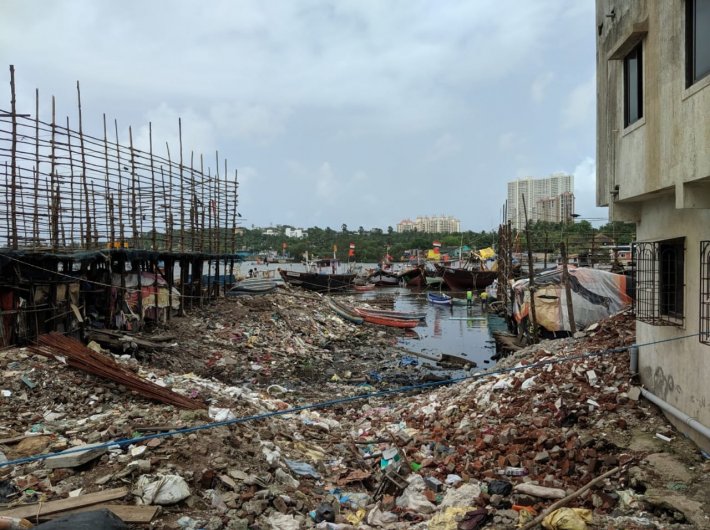
Traditional fishermen or Kolis; synonymous with feasting, song and dance; are the original inhabitants of Mumbai. For generations, they have loved their vocation and prided in it. But their work and lifestyle are facing threats from reclamation, land acquisition by builders, lack of sustainable fishing practices, pollution and ocean health due to dumping of waste. Most of their housing structures are unplanned semi-pucca, pucca and kutcha houses.
In a unique experiment, a group of experts in the area of open spaces and sustainable transport are working on a pilot project to transform a centuries-old Versova fishing village, known as Versova Koliwada or gaothan, in Mumbai North into an organized and beautiful community. The project, called ‘Majjhi Versova’, is an exercise for collaborative place-making interventions in the village by providing practical interventions within the available physical space through garbage management, improving and beautifying its open spaces and community areas like kattas and wells, providing accessibility and sustainable mobility not only within its own periphery but also with larger public areas.
The studio project by stakeholders, Smart Commute Foundation, IBI Group, Abraham John Architects, Love Your Parks Mumbai and Thrivingreen along with 4th-year BArch students of LS Raheja School of Architecture is based on the Mumbai Development Plan 2034.
“We are trying to get the fishing and gaothan community involved in the whole project for rethinking and re-planning spaces with only pedestrian accesses and others with cycles and other modes of transport, sewage disposal, garbage management and composting. Currently, with debris and garbage all over the area and also on the Versova beach, open spaces are defunct. The village does not have amenities to recycle, compost or manage garbage which is a major issue. There are auto-rickshaws everywhere and no footpaths. We need to rethink everything from footpaths to the way they travel,” says Anca Abraham of Love Your Parks Mumbai, an advocacy and programming group in open spaces in Mumbai.
Zohra Mutabanna from IBI Group, a mentor and advisor on the project, says that their brief to the 72 students involved in the survey was to have holistic, long-term sustainable interventions, taking care of the environment and also to come out with immediate interventions with sponsorships for tactical interventions.
To increase bicycle ridership in the community, lanes and roads within the gaothan were identified so that a maximum number of people can use it as a safe and sustainable transport means. The main route to gaothan was separated from an alternate route for smaller vehicles like bicycles and bikes and to provide passage of ambulances. For beautification of lanes and passages, colour-coding has been introduced on the lines of the Jakarta model of Medelin where blue lines lead towards water bodies like the jetty and green colour demarcates open spaces. In the next step, colour-coding will be done on separate spaces for dry and wet waste.
Refurbished bicycles are being provided to each family at Rs 999. For last-mile connectivity with Versova metro, shared bicycle service will be provided to and fro with cycle stands under the metro provided by donors. These bicycle stands will be inaugurated on Car Free Day on September 22.
“With bicycle being the most affordable means of transport for most delivery services and now even for app-based delivery services like Swiggy and Zomato etc, we realized it is the cycle parking that these urban poor and app-based food delivery services require but look for poles, railings and trees etc, to park their cycles,” says Firoza Suresh, of Smart Commute Foundation that is also working in the area of skills development and vocational training for bike trainers and bike mechanics in slums.
“For proper implementation of the programme holistically it is important to give these people livelihood, so we are giving them vocational training,” she adds. The foundation’s ‘Me Cycle Rider’ programme with slum children aims to increase cycle ridership to one lakh by 2023.
The interventions have been designed with the active participation of local representatives of the community as per their comfort level. Care has been taken to preserve the community’s original structure and its tourism tag, B&B facilities for foreigners and different religious spots. Besides, the community also wants to bring back film shooting on the Versova beach that had decades ago shifted out to Madh Island. The villagers also take pride in having a big ice factory and cold storage in the area.
“The community is keen to have pedestrian walkways, cycles and willing to give up rickshaws. They need education and awareness for better quality of life but right now very used to things as they are. They are not even aware of alternative possibilities,” adds Anca.
Yogesh Motilal Fokacha, chairman, Versova Gaothan Trust, says that being a small community they did not want to compromise on existing infrastructure and members were open to go along for beautification and improvement of their village if its originality was not disturbed. “We are happy with their survey and proposals on roads, waste management, beautification, traffic control and cycling tracks,” he adds.
“In the first phase this will serve as our pilot project for Mumbai city and can be replicated in other places,” says Firoza of the densely populated community of 15,000- 20,000 fishermen and an equal number of migrant population.
Mandar Parab, principal, LS Raheja School of Architecture, says that this first-of-its-kind exercise could become a model to be followed in the following semesters for more sites and also to be promoted by MMRDA and other authorities for smart commute across the city.
“While many people have studied informality and urban villages and looked at issues like sanitation and waste, no thought has been given to integrated planning. One of the strengths of the project is its integration and holistic planning together with urban spaces, public transport and public places,” says Priya Kanchan of Thrivingreen and faculty, LS Raheja School of architecture.
The team is now working to come up with design solutions like street furniture for the road connecting Versova metro station to Versova Gaothan and give the same to the municipal corporation for greater Mumbai (MCGM), the concerned authority, for approval.