Hundred years of Kodaikanal Solar Observatory records will throw light on the change in solar activity over time
Artificial Intelligence has been used to trace the shift in magnetically active patches on the Sun from 1916 to 2007 by scanning 100 years of hand-drawn Sun records from the Kodaikanal Solar Observatory (KoSO). This could give a much longer view of how solar activity changes over time.
For more than a hundred years, scientists have been trying to understand how the Sun’s magnetic activity rises and falls in rhythmic cycles. These cycles affect sunspots, flares, and eruptions, which can disrupt satellites, navigation, and power on Earth. However, older observations are often incomplete and inconsistent, making long-term study difficult. That’s why historical records are very valuable, explained an official release on Wednesday.
In a new study (Publication link:
https://doi.org/10.3847/1538-4365/ae381e), researchers led by Dibya Kirti Mishra from the Aryabhatta Research Institute of Observational Sciences (ARIES), an autonomous institute under Department of Science and Technology (DST), Govt. of India, along with the collaborators from Indian Institute of Space Science and Technology, Thiruvananthapuram; Southwest Research Institute, Boulder, USA; Indian Institute of Astrophysics (IIA), Bangalore shows that 100 years of hand-drawn Sun records from the Kodaikanal Solar Observatory (KoSO) can be turned into useful data using modern machine learning techniques. The observatory has a unique collection of observations, including daily ‘suncharts’ from 1904 to 2022, where features like sunspots, plages, filaments, and prominences were carefully drawn on a standard grid.
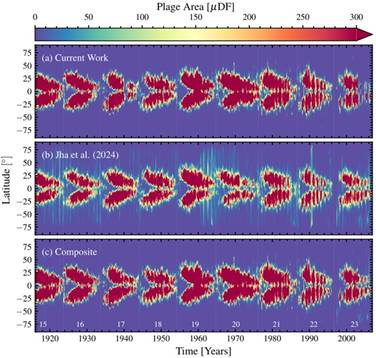
Fig: Time–latitude “butterfly” map of solar plage area (in μDF) measured in 1° latitude bands for each day. (a) Plage distribution derived in this work using U-Net–based detection on KoSO suncharts. (b) Butterfly diagram from KoSO Ca II K plage detections (B. K. Jha et al. 2024). (c) A combined record that merges both datasets, using the Ca II K results to fill gaps in the sunchart series. Colors show plage area, revealing how magnetic activity shifts with latitude and solar-cycle phase from 1916–2007 (Solar Cycles 15–23).
Before digital tools, scientists relied on careful drawings to record what they saw. KoSO’s suncharts are valuable because they show solar activity over many cycles and include different features marked in specific ways. However, differences in drawing styles, paper aging, and scan quality make it difficult to create a clean and consistent dataset using traditional methods.
To address the problem of messy, hand-drawn historical records, the research published in the Astrophysical Journal used a supervised machine learning approach (U-Net) in two main steps. First, the model automatically found the Sun’s disk in each scanned drawing, pinpointing the center, size, and tilt, so every feature could be placed in the correct location on the Sun. Next, it identified and traced plages (butterfly, magnetically active patches on the Sun) across drawings covering nine solar cycles from 1916 to 2007. This is important because plages are a reliable “fingerprint” of the Sun’s magnetism, and extracting them from old archives helps scientists connect today’s space-age measurements with what the Sun was doing decades earlier.
By turning drawings into machine-readable data, the researchers led by Dibya Kirti Mishra were able to track how plage activity shifts over time, creating a ‘butterfly diagram’ that shows the solar cycle. They also found that the plage areas from these drawings match well with those derived from KoSO’s Ca II K full-disk observations, proving that the suncharts can help fill gaps and improve long-term solar data
Long-term, consistent records of the Sun’s magnetic activity are crucial because they let scientists compare how different solar cycles vary in strength and structure, improve reconstructions of how the Sun’s energy output and magnetic influence have changed in the past, and helps society better understand long-term space weather risks that can affect technology on Earth. The study shows that old, uneven historical records can be improved using machine learning to create consistent data over many decades, something traditional methods struggle to do.