
Amid pandemic, Mumbai had a quiet Eid

Environmentalist hopes responsible celebrations across religions and cultural celebrations will continue

geetanjali

Geetanjali Minhas | November 1, 2020 | Mumbai

#Covid-19   #Novel Coronavirus   #healthcare   #environment   #noise pollution   #Sumaira Abdulalai  
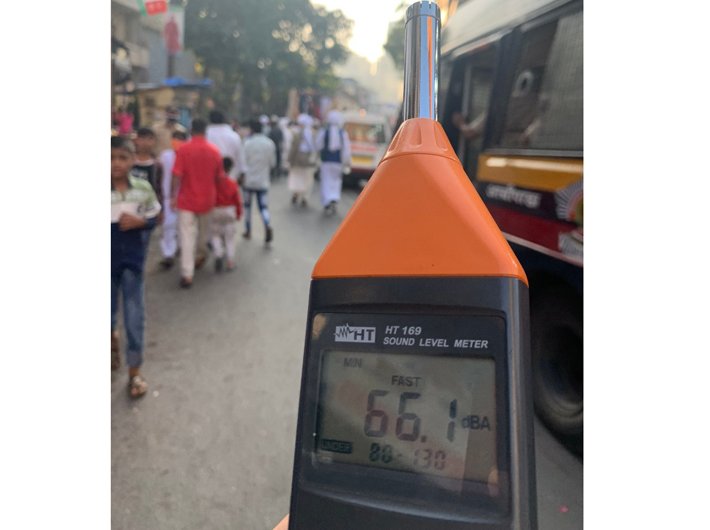
(Photo courtesy: Awaaz Foundation)

Mumbai had a quiet Eid-e-Milad this year, with the maximum noise decibel level of 66.1 dB, thanks to restrictions in place due to the Covid-19 pandemic, which has made people celebrate various festivals more responsibly.
 
Submitting her findings on noise pollution levels during Eid-e-Milad, which was on Friday, Sumaira Abdulalai, environmentalist and founder of Awaaz Foundation, in her letter to Maharashtra chief minister Uddhav Thackeray, environment minister Aditya Thackeray and Mumbai police commissioner Parambir Singh has hoped that the “silver lining of the pandemic which has demonstrated new ways to celebrate responsibly without loudspeakers across all religious and cultural celebrations will be continued in the years to come.”
   
The government had permitted only a single procession in Byculla this year, and there were no loudspeakers.
 
Abdulali followed the procession on foot as it passed through areas between Byculla and Nagpada. With all vehicular traffic (except for police vehicles) blocked along the route, there was no traffic noise. Some areas had crowds but there was no shouting.
 
According to her ‘report on noise pollution during Eid-e-Milad 2020’, there were no loudspeakers in the area next to JJ Hospital. Between 4.15 and 4.38 pm on Mohamedali Road, between JJ Hospital and Crawford Market, pandals were without loudspeakers. Between 4.45 pm and 5.18 pm at Mazgaon between Byculla Bridge Junction and Nagpada circle, the noise level was 66.1 dB max and procession was without loudspeakers. This was the lowest ever recorded on Eid-e-Milad.
 
Year 2016 had the maximum noise level of 111.5dBm followed by 105.02 dB in 2017. The highest noise level recorded was in 2018 – at 105.3 dB.
 
In accordance with the supreme court and Bombay high court orders, maximum zone-wise permissible decibel levels are required to be maintained at all times and religious practice is no ground for exemption. The low noise levels during Eid-e-Milad this year follow the trend observed in other festivals including the Ganapati festival compared to the last several years.
 
“Noise pollution is a serious health hazard which has adverse effects on the human body. It can cause or worsen hearing loss, stress related diseases such as hypertension and heart disease, mental illness, irritation and sleep deprivation,” Abdulali wrote in her letter of Saturday.

“In the interest of controlling noise pollution and eliminating its consequent health hazards for all citizens on Mumbai, I request that the examples of this year, the silver lining of the pandemic which has demonstrated new ways to celebrate responsibly without loudspeakers across all religious and cultural celebrations will be continued in the years to come,” she added.

Comments


Other News

How toll policies are redefining the highway journeys

With the phenomenal growth in National Highways, queues at toll plazas used to affect commuters. However, over the last decade, tolling has undergone a major technological transformation, bringing faster movement and significant ease for road users. Building on this progress, year 2025 saw further people-c

From vulnerabilities to empowerment: Building resilience for small and marginal farmers

India’s small and marginal farmers are at the centre of a paradox in agrarian economy. They are the backbone of the food economy, but they are the most vulnerable stakeholders within agricultural economy. Among the 126 million farmers in India today, nearly makes 86% operate on small and marginal hol

Concerns over Mumbai air pollution ahead of Marathon

Environmental organisation Awaaz Foundation has flagged serious concerns over deteriorating air quality in Mumbai and the potential health risks it poses to participants of the Tata Mumbai Marathon scheduled for January 18. It has urged civic and pollution control authorities to conduct advance air quality

From darkness to demand: India’s power sector at a policy crossroads

India’s progress in electricity access over the past two decades represents one of the most consequential public infrastructure transformations globally. Yet, as policymakers now confront issues of reliability, financial sustainability, and grid stability, experts argue that the next phase of reform

2026: How AI is transforming everyday life and work in India

Artificial Intelligence is driving a new wave of innovation that touches every part of daily life, from healthcare and farming to education, governance, and climate prediction. It helps doctors diagnose diseases faster, assists farmers in making data-driven decisions, improves learning outcomes for student

Charting the contours of India’s Africa outreach

Prime minister Narendra Modi’s state visit at the end of the year 2025 to Ethiopia represented a notable point in the development of India-Africa relations. At a time of escalated geopolitical contest, renewed commitment to South-South cooperation and Africa’s expanding strategic prominence, th


Archives

Current Issue

Opinion

Facebook Twitter Google Plus Linkedin Subscribe Newsletter

Twitter






