India’s engagement with African nations is steadily moving from the political to the strategic
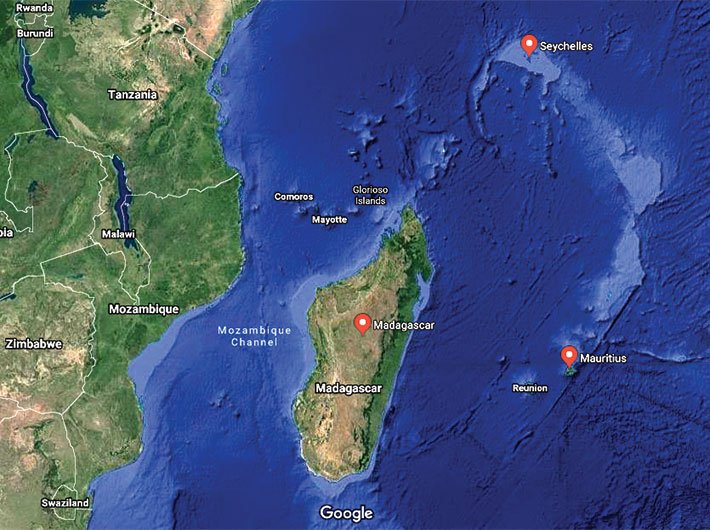
To counter Beijing’s aggressive agenda in the Indian Ocean, New Delhi is seeking to create strategic bastions in Mauritius, Seychelles and Madagascar. The immediate provocation was China’s inauguration of its first overseas military base in Djibouti, in the Horn of Africa.
Only recently, New Delhi had extended a $100 million line of credit to Mauritius for buying a multipurpose offshore patrol vehicle, a deal signed when president Ram Nath Kovind was visiting the island nation mid-March. Following up, it is continuing work on a naval base in the Agalega Islands, a Mauritian territory lying some 1,000 km north of the main island. According to Sanjay Panda, a joint secretary on the Indian Ocean region desk at the ministry of external affairs, the base should be completed by 2021.
Indian diplomats are also confident that a naval base on Assumption Island, a Seychelles territory, will also come through. Two rounds of talks between the two countries have already taken place: the first was on the sidelines of the International Solar Alliance summit in Delhi on March 11, the second on the sidelines of the Commonwealth Heads of Government meet in London on April 19-20. But there is a hitch. The Seychellois parliament is yet to ratify a revised pact between New Delhi and Victoria.
In the first week of April, the Seychelles News Agency quoted vice-president Vincent Meriton saying, “A declaration will be made very soon to find a feasible way to build this (naval) facility.” And MEA officials say clarity about the base on Assumption Island would emerge when Seychelles president Danny Faure arrives in India for a two-day state visit on June 25.
In Madagascar, India has a monitoring station since 2003. Neena Malhotra, a joint secretary at the MEA, says, “Madagascar is important for India’s security outreach.” The monitoring station keeps an eye on ship movements in the Indian Ocean. Of late, India has offered surveillance technology to many nations in eastern and southern Africa. Participating in an informal dialogue at the Institute of Defence Studies and Analyses (IDSA) on March 27, Shambhu S Kumaran, joint secretary (policy) at the ministry of defence, said, “With the bulk of the east and southern African countries, we now have enabling agreements in place. We have offered them some of our specialised maritime capabilities. In this regard, I would like to mention coastal surveillance radar systems.” Besides Mauritius, Seychelles and Madagascar, defence agreements exist with Tanzania, Mozambique, Kenya, Ethiopia and Zambia in eastern Africa, and the southern African countries Lesotho, Botswana and South Africa. TS Tirumurti, secretary (economic relations) at the MEA, says these relationships have been established in view of a “complex set of security challenges” in the African countries. Apart from supplying defence technologies, India trains military personnel of these countries.
An Indo-French maritime agreement signed on March 11 adds to India’s ties with African nations, for it allows Indian ships to use French naval facilities in Djibouti, the UAE, and Reunion Island (a French territory in the Indian Ocean, lying to the southwest of Mauritius). Says Tirumurti, “Our defence engagement with Africa has deepened in the last few years, thanks no doubt to our political engagement, which has gone to an unprecedented level.”
The president, vice-president, and prime minister have altogether visited 21 countries from May 2016 to April 2018. President Kovind has just concluded a visit to Equatorial Guinea, Zambia, and Swaziland (which, interestingly, maintains diplomatic ties with Taiwan and not China). Continuing the process, vice-president M Venkaiah Naidu will visit the southern African countries of Botswana and Malawi in October.
Another indication of India’s increasing engagement with Africa is New Delhi’s engagement with the 15-member Southern African Development Community (SADC), on the sidelines of the first ever India-South Africa business summit in Johannesburg on April 29-30. The two-day business summit was themed ‘United by legacy, united for prosperity’. The SADC comprises Angola, Botswana, Congo, Lesotho, Madagascar, Malawi, Mauritius, Mozambique, Namibia, Seychelles, South Africa, Swaziland, Tanzania, Zambia and Zimbabwe.
India was represented by union minister for commerce and industry Suresh Prabhu at the summit, which focused on healthcare and pharma, agriculture, automatives, mining, startups and women in business. Overall thrust of the summit was to increase business interaction and increase volume of trade between India and southern African region. According to the ministry, India’s total trade with SADC countries witnessed nearly 10-fold increase from $3.7 billion in 2004 to around $31 billion in 2017.
Indian investors have preferred Africa. According to the ministry of finance, India’s approved cumulative investment in the SADC countries from April 1996 to March 2017 amounted to over $52 billion. South Africa, Mauritius and Mozambique were top destinations. In fact, SADC countries accounted for nearly 93 percent of India’s total investment in Africa. ONGC Videsh has a stake in oil and gas assets in Mozambique. Recently, Mozambique approved an ONGC Videsh-led development plan for Golfinho-Atum natural gas field in the Area 1 block of the Rovuma offshore basin. To ship extracted gas to India, ONGC Videsh will set up a liquefaction plant with a total capacity of 12.88 MMTPA in this east African nation. India has invested $6 billion in the Rovuma gas field; it will invest another $6 billion by 2019-20, a senior official of the ministry of petroleum and natural gas said.
African nations have also received significant financial assistance from India. As of March 31, 2017, India’s EXIM Bank had extended 52 lines of credit worth $3.1 billion to SADC nations, mostly for roads, bridges, flyovers, power transmission lines and other infrastructure.
Under the new political dispensation, Zimbabwe wants good relations with India. Its vice-president Constantino Chiwenga met the Indian president in Delhi on March 23. Besides seeking India’s assistance in capacity building and human resource development, Chiwenga also sought India’s support in the agriculture sector. Zimbabwe government, under president Emmerson Mnangagwa, has chosen India over China, Brazil and Belarus for the supply of 500 tractors and agricultural equipment. New Delhi had agreed to provide them under a government-to-government agreement at a minimal interest rate. According to sources, the delivery of tractors will start June onwards. Zimbabwe has also sought increased investment from India in coking coal, gold, iron and other minerals.
In Lesotho, the India-funded Advanced Information Technology Centre was recently inaugurated in the capital Maseru. In November last year, India had sent 500 tonnes of rice to Lesotho, which was facing a famine. Talks are on for developing farming and agriculture in the land-locked southern Africa country. It has asked for over 200 tractors and other farming equipment from India, and sources say delivery should begin soon.
Lesotho’s King Letsie III and Queen Masenate Mohato Seeiso visited India in January. Diplomats who have served in Africa say India never put so much effort in increasing its presence in Africa as now. On May 21, the cabinet approved the setting up of new missions in 18 African countries between 2018 to 2021. Full-fledged missions will be opened Burkina Faso, Cameroon, Cape Verde, Chad, Republic of Congo, Djibouti, Equatorial Guinea, Eritrea, Guinea, Guinea Bissau, Liberia, Mauritania, Rwanda, São Tomé and Príncipe, Sierra Leone, Somalia, Swaziland and Togo, thereby, increasing the number of Indian missions in Africa from 29 to 47.
[email protected]
(The article appears in the May 31, 2018)