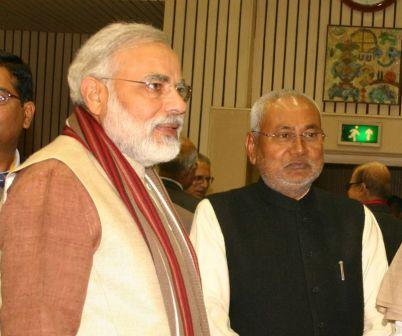
Secularism and coalition ally dharma is fine, but Bihar CM is looking far beyond 2014
Amid the rise and rise of Narendra Modi, the only challenge ironically comes from an ally, Nitish Kumar of Janata Dal (United). After the hat-trick in Gujarat, the clamour for Modi as PM is only growing and he has acknowledged the same, making address-to-the-nation style speeches in the national capital. From the UPA camp, Rahul Gandhi, is turning out to be a lame rival. Add to that the findings of voters’ opinion polls and it would seem it’s only a matter of time before Modi takes oath for the top post. And then his party’s strongest ally stands up to challenge him.
During the JD(U) national executive meeting in Delhi on April 14, Bihar chief minister Nitish Kumar finally made his stance amply clear. Here are his one-liners targeting Modi: “All of us want to develop; growth must be inclusive”, “This country cannot be run by force... This country can be run with peace and love”. Here is a stronger hint: “To run this country, we need Atal Bihari Vajpayee's vision… He would take everyone along, he would always say follow Rajdharma.” The reference was to Vajpayee’s remarks addressed to Modi when he visited the riot-hit Ahmedabad in 2002.
How to make sense of Nitish’s outbursts? Is he projecting himself as a PM candidate, of some third front of regional parties? Not likely, as he himself made it clear in the same speech: “We don't harbour any illusions that we can become PM. We can't on our numbers. (But) we have a role to play and we will. We have never divided society; we have been able to garner support (even) from those sections who did not expect anything from us.”
Then is it secularism, with or without quote marks – what Modi calls “vote bank politics” when applied to the Congress? Seemingly so, because Nitish further said, “We have some fundamental principles on which we can't compromise ... we cannot give up on secularism to stay in power.”
Of course, Nitish’s critics point out (as BJP did the next day) that he was very much part of the NDA government at the time of Gujarat riots. But his party was then led by inimitable George Fernandes and Nitish was not going to stick his neck out, and moreover the BJP itself was internally far stronger to counter any criticism – as it did when N Chandrababu Naidu tried. Once in charge of Bihar, Nitish has stuck to this secular principle and refused to let Modi campaign in Bihar – in 2005 as well as in 2010.
With that background, Nitish’s remarks can be seen as an early warning to the BJP: better name the Pm candidate now and let allies take their stance rather than force them to take their position at the nth hour. Now that the campaign for 2014 is virtually on, the NDA constituents need to know who will be the big boss in case of victory.
That’s Nitish’s immediate message – to BJP. The larger message is for his constituency back home. He knows well he cannot aim for the top post. He does not want to become no 2 in NDA and if Modi is going to be the no 1 of the coalition he will not even have that option. The only pragmatic way out for him in the current political scenario is to consolidate his base in Bihar and by extension in the Hindi heartland. Secularism can help him do so.
That of course is a risky gamble, challenging a rising star can prove costly for Nitish when the star becomes a PM and he remains a mere CM. If he is sticking to this gambit, count on the shrewd Hindi heartland politician to know a thing or two about caste politics that the Vikas Purush from Gujarat does not know. If – and it is certainly a big if today – Modi’s charm does not extend beyond TV studios and urban centres and BJP’s internal factions too come in the way, Nitish will emerge with a larger-than-life persona of a chariot-stopper, of the kind that Lalu Prasad acquired in 1990 and lived off it for 15 years.