Why people in the border state are unhappy with the proposed dam project on the Siang
In Arunachal Pradesh, the Siang is not just a river. For many of us, especially the Adi people, it is part of our family. Our grandparents fished in it. Children learned to swim in it. Our farms drink from it. When someone says a huge dam will be built on it, we do not hear the word "project". We hear the word "goodbye".
The plan is called the Siang Upper Multipurpose Project (SUMP). It would produce about 11,200 megawatts of power. On paper, the numbers look big and shiny. But numbers do not tell you about a village that may go under water, a graveyard where someone's mother rests, or a field that fed four generations.
Why we are afraid?
We are afraid of losing our land. Many families have no papers that a big company will care about. We only have the soil our elders worked on, and our stories about it.
We are afraid for the river. Our land also shakes. It sits in an earthquake zone, and everyone here knows how the mountains can move.
And we are afraid of being ignored. For over a year, villagers have peacefully blocked the survey work. They asked a simple thing: talk to us first. Instead, they say security forces came into our villages, and activists got notices and summons. When you feel unheard for so long, your heart becomes heavy.
When pain turns into anger
On October 23, the anger in Pasighat spilled over. Government offices and police vehicles were allegedly set on fire after a 12-hour bandh. Many of us were sad to see this. Violence is not our culture, and it hurts our own cause. Even the chief minister, Pema Khandu, condemned the vandalism.
But look at what happened a few days later. On October 29, more than 1,000 people gathered peacefully in Itanagar and asked for the release of the detainees. This is the real voice of our people: loud, peaceful, and full of love for our land.
The voice reaches Delhi
Our students did not stay silent either. On October 26, student and community groups called a 12-hour shutdown, and a public hearing on the project could not go ahead. Many young people, including Gen Z youth, have joined the rallies in Pasighat and Itanagar.
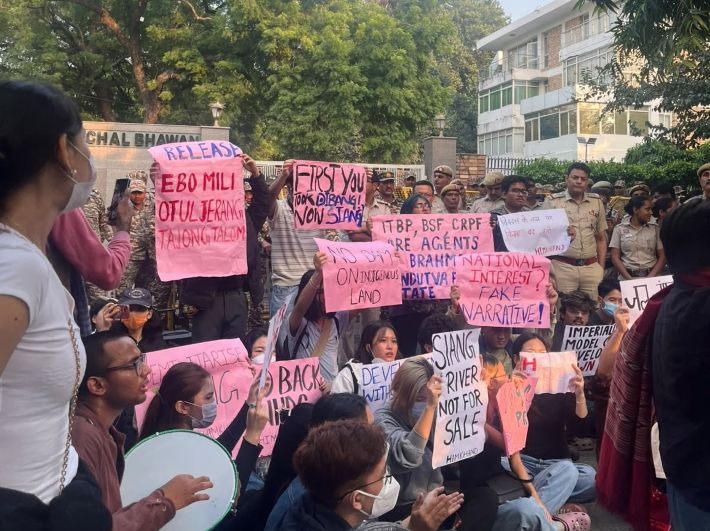
Then the protest travelled all the way to New Delhi. On Saturday, October 31, hundreds of students and activists gathered at Arunachal Bhawan, our state's house in the capital, and surrounded it. They asked for the release of all detainees and for the project to be withdrawn.
Delhi Police detained several of the protesters. One of them was Katon Moyong, known to many as Aborman, a well-known voice against the Siang dam. A heavy police force stood outside the building.
Think about this for a moment. Young people far from their homes walked to the doorstep of their own state's house to say that the Siang is calling them. They want the whole country to hear what this river means to us.
What the Government of India says
The centre sees this as a big national project. It believes the dam can protect India from the huge hydropower project China plans on the Yarlung Tsangpo, the upper part of the Brahmaputra. Early studies by NHPC and the state suggest water flowing into India could fall by up to 80 percent because of China's project. The government also says the project is only at the study stage, there has not been a final decision to build.
To win people's trust, the centre and the state announced a Rs 350 crore development and livelihood programme. Our people were not moved by it.
What the Arunachal government says
The chief minister says this is not only about making power, but about keeping the Siang flowing and reducing flood risk if China suddenly releases water. He has said the project is important for national security, flood control and protecting downstream communities. He warned that China's plans could reduce the river's winter flow so much that people might cross it on foot.
He has also made promises. He said the pre-feasibility stage does not mean final approval, and that land acquisition and rehabilitation are separate matters. After the unrest, he agreed in principle to reduce security deployment and withdraw FIRs, though this had not yet been confirmed as done. He has also claimed that about 70 percent of villagers in some areas signed MoUs for the study. Protesters say the people have not given their real consent.
What we are asking for
We are not against development. We want roads, schools, hospitals and jobs like everyone else. We also understand that China's dams worry the whole country. But protecting the nation should not mean breaking the hearts of the people who live on the border.
If this project is truly for us, then let us be part of the decision. Be honest with us, listen to us, and respect our right to say yes or no about our own home.
If the river is taken from us, no money can bring it back.
Sartam Mercy is a student of Sharda University, pursuing a Master’s degree in Ad, PR & CC in the department of SSMF.