Congress plans Rs 100 crore social media war chest

Sibal stresses on need to take on BJP in the new arena to woo middle class

bhavdeepkang

Bhavdeep Kang | January 19, 2013


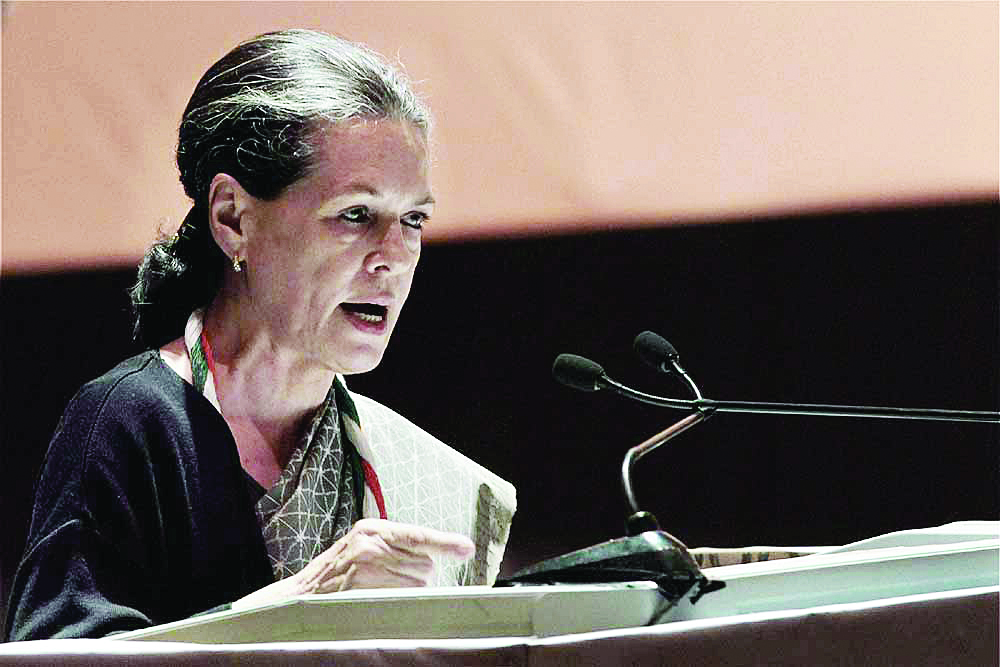
Sonia Gandhi addressing a party chintan shivir session in Jaipur

The Congress party would require Rs 100 crore during the next 18 months - till the Lok Sabha elections - to counter the main opposition BJP in the field of social media, telecom minister Kapil Sibal said at the session on emerging political challenges at the party's Chintan Shivir at Jaipur on Saturday.

The BJP, he said, had a hundred people tweeting against the Congress in the morning. By afternoon, the tweets would become news on TV channels and by the next day, they became headlines in the print media.

Sibal made a strong case for a pro-active approach to the social media. He pointed out that the BJP made extensive use of the social media to reach out to the middle class. He referred to the anti-government blitz on social networking sites following the brutal bus rape case and earlier during the Anna Hazare-led agitation for a Jan Lokpal Bill, which snowballed into street protests.

Also read: A lot left unsaid in Sonia's address

With the increasing penetration of the internet across social classes, the Congress should not be squeezed out of that space, Sibal said. He pointed out that elections in nine states and the Lok Sabha polls were imminent, so the party would have to undertake a strong counter-offensive on a war footing.

Digvijay Singh, who heads the committee on communications strategy, said the party was concerned about the march the BJP had stolen in terms of the social media. "Narendra Modi has a sanchar kendra near Ahmedabad for tracking the social media," he said, adding that a report on a counter-strategy would be submitted to Rahul Gandhi in the next ten days.

Congress president Sonia Gandhi spent almost two hours at the session on emerging political challenges at the Congress chintan shivir in Jaipur, in the course which the three Cs were discussed: communalism, corruption and coalition. She maintained a studious silence throughout.

Science and technology minister S Jaipal Reddy made two significant points. He said the Congress would have to undertake an exercise in social engineering in Uttar Pradesh and Bihar in order to establish itself in those states. He said that OBCs should be actively wooed. He also expressed the view that the Congress should not be on the defensive on the corruption issue. It should not appear in the public mind as being the source of corruption but should take the issue head on. Among others who spoke was information and broadcasting minister Manish Tewari. 

In the session on socio-economic issues, delegates strongly felt that the government's repeated doses of economic reforms should be tempered with welfare measures before going to polls. Congress leader Vayalar Ravi said there was no need to be wary of UPA II being seen as a pro-subsidy regime, because the US and OECD countries too disbursed heavy subsidies to farmers.

On Friday, the first day of the three-day conclave, the Congress president attended the session on the party organization and on women's empowerment, spending 45 minutes at each venue.

Comments


Other News

How Rafi, Raj Kapoor helped pave the way for a great uranium deal

There`s a certain moment in diplomacy that`s too personal to be captured in a communiqué, too small to make the front page, but more revealing than the front page. This week, prime minister Narendra Modi reached Tashkent and, amid the pomp of state visits, managed to evoke the old Bollywood tunes

Distinguishing Fish 1 and Fish 2: The pragmatism behind India’s WTO ratification

 India became the 123rd WTO member to ratify the multilateral Agreement on Fisheries subsidies (AoFS) when it deposited the Instrument of Acceptance for Phase 1 on July 20, 2026. The ratification is restricted to disciplining Illegal, Unreported and Unregulated fishing (IUU), protection for overfished

The 7% growth problem: Why the next 7% will be harder

India has become accustomed to hearing the 7% growth number. It is now less a milestone than an expectation. Yet the paradox is becoming clearer: maintaining 7% growth may be considerably harder than achieving it once. India’s real GDP grew 7.7% in FY2025–26, following growth of 6.5% in FY202

The Constitution cannot be altered: Justice Abhay Oka

Justice Abhay Oka, who retired from the Supreme Court in May 2025, has said that the Constitution of India cannot be altered. Explaining the landmark Kesavananda Bharati judgment (1973) on the basic structure of the Constitution, he said, “This is one judgment that has saved democracy in India.&rdq

How the flora and fauna evolved in the Indian subcontinent

Mammals of India  By A.J.T. Johnsingh and P.O. Nameer HarperCollins India in association with Bombay Natural History Society  

India`s renewable race is moving beyond megawatts

When Shell bought Sprng Energy in 2022, India`s renewable energy market appeared to offer precisely what global energy majors were seeking: scale, growth and a place in one of the world`s largest energy transitions. Four years later, Shell is selling the same business to Aditya Birla Group for an enterpris

Upcoming Conferences


-->

Archives

Current Issue

Opinion

Facebook Twitter Google Plus Linkedin Subscribe Newsletter

Twitter