Delhi gangrape & murder: hail the fast-track court

From the first day of trial till sentencing, fast-track court took 7 months and about as many days – no mean achievement but it needs to spread to other cases as well, say legal experts

jasleen

Jasleen Kaur | September 12, 2013


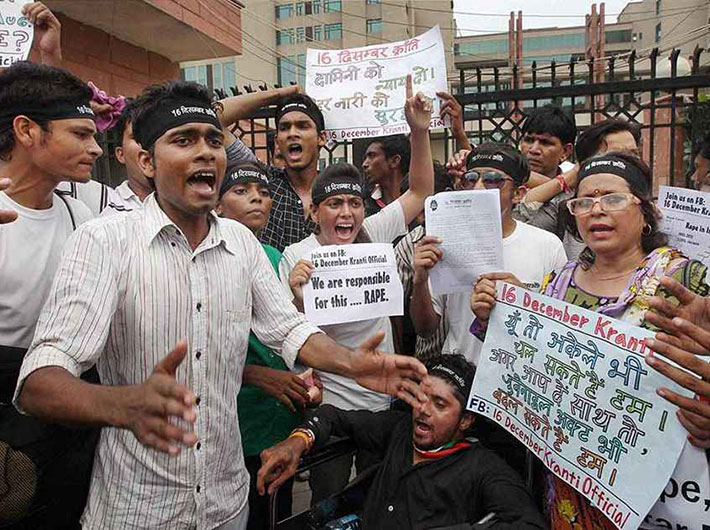
Protestors call for death for the December 16 rapists outside Saket district court, where four of the six were convicted on September 10.

Despite what the critics and naysayers will say – and say they must, most of them critically – the judgment in the December 16 Delhi gangrape case is an eye opener in more senses than one.

First, cases can be cracked, as they ought to, if the police step on the gas.

Second, conviction of rapists and/or murderers can happen, as they ought to, in the Indian legal system.

And third, they can happen within a decent period of time, before moss grows on the case files in some corner of the court premises.

While the social media, and indeed some sections of the media, have been critical of the time it took for the case to be decided, additional sessions judge Yogesh Khanna at the fast-track court in Saket district courts deserves kudos for once. This, in fact, was the first rape case he has heard in five years in which he convicted the accused.

Look at the numbers: from the day the fast-track was set up by the Delhi high court (December 23, 2012) to the first day of the trial (February 5, 2013) and announcement of the quantum of punishment (scheduled for September 13), it was less than nine months. In the seven months and nearly as many days since the trial began, the court heard 85 prosecution witnesses and 17 defence witnesses in over 130 hearings. Not an insignificant figure by any stretch of imagination, as lawyers and legal experts point out.

While a fast-track court is supposed to hold hearings every day, it practically isn’t so, says Barnali Basak, a senior supreme court lawyer.

Among questions raised by the critics is the fact that ASJ Khanna took three days between saying the four men, accused of raping and battering a 23-year-old physiotherapy student in a Delhi bus on December 16 last year, are guilty of rape and murder, among others, and pronouncing the quantum of sentence. Legal experts say that may be the emotional demand of the time but not practical, as courts have to write voluminous reports that take time. Ergo, judgments cannot be pronounced pat – like they show in Bollywood.

According to Basak, even a fast-track court has to follow the code of criminal procedures (CrPC). “We need to understand that it was a complicated case, and 89 witnesses were examined. It has to be a fair trial. A regular court would have taken three or four years to announce the verdict,” she said.
Stressing that the judgment in this case was delivered at a fair clip, with many matters pending for over 10 years, Basak, however, said there is scope for improvement even here. The Delhi gangrape verdict, she said, could have come “faster but that depends on the court. A criminal case is built entirely on evidences at hand. So it does take time”.

She pointed out that Rajasthan had set a precedent by convicting a rape accused in less than a month. Two days after a German tourist was raped in Jodhpur in May 2005, the high court had ordered that the probe be completed in a month. The result: a fast-track court in Jodhpur delivered the verdict in 21 days.

Anant Asthana, a senior lawyer with Human Rights Law Network, said a lot more needs to be done to ensure litigation in such cases is not an unending affair. “The December 16 case had a lot of significance and media attention. But it does not mean that the verdict would come out soon in other cases of sexual abuse or rape that do not grab media attention,” he said.

He also emphasised that in ensuring speedy justice, the rights of victims and accused cannot be compromised. As legal experts say, a trial in a criminal case – especially one that has death sentence or life imprisonment as punishment – cannot be hurried unduly at the expense of being a fair trial.
But what the Delhi gangrape case has done is show the country that there’s hope – when the police get up lace up their boots and when the legal system dusts the files and gets active.

Comments


Other News

Borrowing troubles: How small loans are quietly trapping youth

A silent crisis is playing out in the pocket of young India, not in stock markets or government treasuries, but in smartphones of college students and first-jobbers who clicked on the Apply Now button without reading the small print.  A decade ago, to take a loan, you had to do some paperwor

A 19th-century pilgrim’s progress

The Travels of a Sadhu in the Himalayas By Jaladhar Sen (Translated by Somdatta Mandal) Speaking Tiger Books, 259 pages, ₹499.00  

India faces critical shortage of skin donors amid rising burn cases

India reports nearly 70 lakh burn injury cases every year, resulting in approximately 1.4 lakh deaths annually. Experts estimate that up to 50% of these lives could be saved with adequate access to skin donations.   A significant concern is that around 70% of burn victims fall wi

Not just politics, let`s discuss policies too

Why public policy matters Most days, India`s loudest debates stop at the ballot box. We can name every major leader and recall every campaign slogan. Still, far fewer of us can explain why a widow`s pension is delayed or how a government school`s budget is actually approved. That

When algorithms decide and children die

The images have not left me, of dead and wounded children being carried in the arms of the medics and relatives to the ambulances and hospitals. On February 28, at the start of Operation Epic Fury, cruise missiles struck the Shajareh Tayyebeh school – officially named a girls’ school, in Minab,

The economics of representation: Why women in power matter

India’s democracy has grown in scale, but not quite in balance. Women today are active participants in elections, influencing outcomes in ways that were not as visible earlier. Yet their presence in legislative institutions continues to lag behind. The Nari Shakti Vandan Adhiniyam was meant to addres


Archives

Current Issue

Opinion

Facebook Twitter Google Plus Linkedin Subscribe Newsletter

Twitter