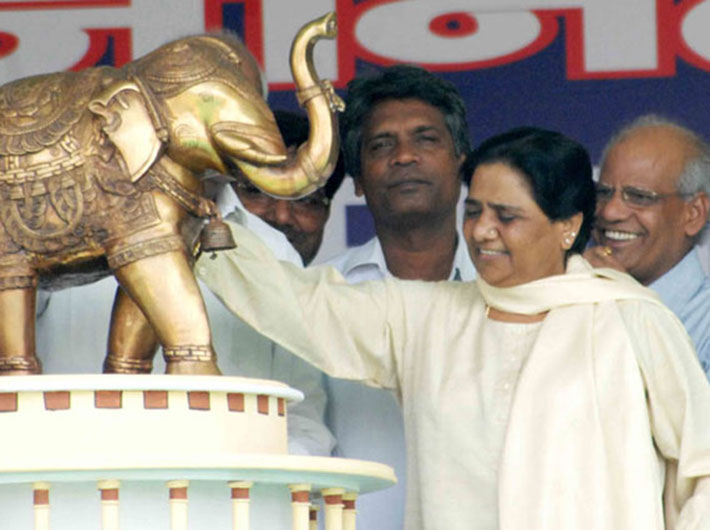
EC elephant order: From behind the veil, a louder trumpet!

EC order to cover statues of Maya and elephants ends up playing into the hands of the BSP supremo

brajesh

Brajesh Kumar | January 9, 2012


The election commission’s order to have all statues of UP chief minister Mayawati and that of her party symbol, the elephant, covered ahead of the polls in the state may have brought cheers to the opposition parties.

After all, they have been complaining to the EC that the numerous statues of the Bahujan Samaj Party (BSP) supremo and her party symbol were clearly aimed at promoting her party, for some time now.

However, they failed to realise that the EC, by issuing this directive, has inadvertently become party to BSP’s poll campaign.

As Bollywood actor Anupam Kher rightly pointed out in one of his tweets, "A covered Mayawati statue will get more attention than an uncovered one. People will say, 'Oh that is Mayawati's statue covered’.”

Meanwhile, BSP has already turned this seemingly adverse condition to its advantage telling its core Dalit votebank that the party's opponents are once again targeting them and not Mayawati or her monuments.

While the order per se could be centered on a precedent when in the 2004 general election the EC ensured that the pictures of the former prime minister, Atal Bihari Vajpayee, on hoardings on the national highway were covered, extending it to cover the elephants is certainly following it to a T.

Going by EC’s logic of providing level playing field to all parties as rationale behind the order, it then would have to also ensure, no elephant walked the street during BSP’s election campaign or for that matter, cycle, the party symbol of BSP’s arch-rival Samajwadi party be banned too.

Also, if symbols were so significant to election results, the Republican Party of India formed by the grandson of BR Ambedkar, Prakash Ambedkar would still be in business. After Babasaheb’s death hundreds of his statues came up all over the country. This could have easily been taken advantage of by his grandson and his party in fighting elections. But this did not happen and while the ideals of Ambedkar have lived on, RPI has been decimated.

Then, there is also the question of impracticality of the order, which, if not impossible, is a humongous task for UP officials.  It entails covering of about 11 statues of Mayawati (nine at Lucknow park and two at Noida) and 77 elephants (25 at Lucknow and 52 at Noida).

While UP officials could still handle the difficult task of covering all the statues by January 11 deadline, the EC will find it hard to handle some unsavoury questions its directive has generated.

Comments


Other News

The economics of representation: Why women in power matter

India’s democracy has grown in scale, but not quite in balance. Women today are active participants in elections, influencing outcomes in ways that were not as visible earlier. Yet their presence in legislative institutions continues to lag behind. The Nari Shakti Vandan Adhiniyam was meant to addres

India will be powerful, not aggressive: Bhaiyyaji

India is poised to emerge as a global power but will remain rooted in its civilisational ethos of non-aggression and harmony, former RSS General Secretary Suresh `Bhaiyyaji` Joshi has said.   He was speaking at the launch of “Rashtrabhav,” a book by Ravindra Sathe

AI: Code, Control, Conquer

India today stands at a critical juncture in the area of artificial intelligence. While the country is among the fastest adopters of AI in the world, it remains heavily reliant on technologies developed elsewhere. This paradox, experts warn, cannot persist if India seeks technological sovereignty.

RBI pauses to assess inflation risks, policy transmission

The Reserve Bank of India (RBI) has begun the new fiscal year with a calibrated pause, keeping the repo rate unchanged at 5.25 per cent in its April Monetary Policy Committee (MPC) meeting. The decision, taken unanimously, reflects a shift from aggressive policy action to cautious observation after a signi

New pathways for tourism growth

Traditionally, India’s tourism policy has been based on three main components: the number of visitors, building tourist attractions and providing facilities for tourists. Due to the increase in climate-related issues and environmental destruction that occurred over previous years, policymakers have b

Is the US a superpower anymore?

On April 8, hours after warning that “a whole civilisation will die tonight,” US president Donald Trump, exhibiting his unique style of retreating from high-voltage brinkmanship, announced that he agreed to a two-week ceasefire with Iran. The weekend talks in Islamabad have failed and the futur


Archives

Current Issue

Opinion

Facebook Twitter Google Plus Linkedin Subscribe Newsletter

Twitter