
Expected revenue loss for companies: $5 trillion!

Covid-19: Fitch Ratings expect recovery to be slow and halting

GN Bureau | June 10, 2020

#Covid-19   #Coronavirus   #economy   #corporate sector   #energy   #oil and gas  
(Illustration: Ashish Asthana)

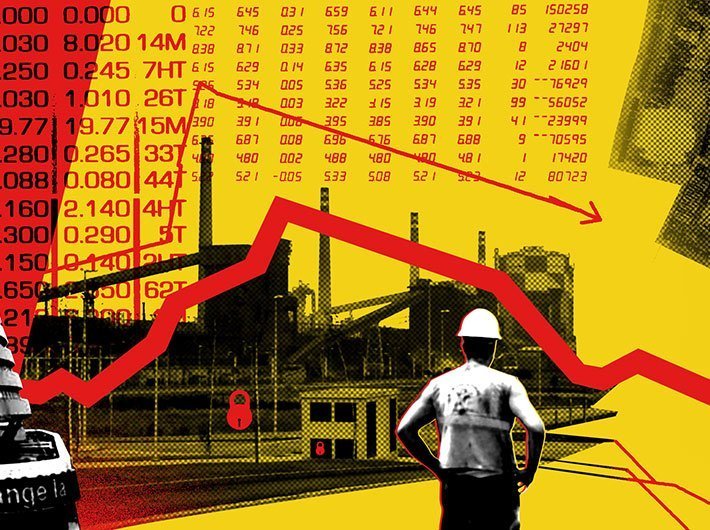
 The corporate sector around the world is expected to suffer losses in revenue worth USD 5 trillion, according to a report prepared by Fitch Ratings. 

 
“The most stringent period of lockdown is over for many jurisdictions, signalling the start of a challenging period of reopening,” Fitch Ratings said in a release issued in London Tuesday. It has published a sector-by-sector analysis of its assumptions for the road to recovery, for more than 80 corporate sectors and sub-sectors globally.
 
“Our projected revenue-recovery curves for corporate sectors, using our baseline scenario, confirm a slow and halting recovery process for many sectors. Our recovery narratives suggest revenue destruction of more than USD5 trillion in 2020, compared to the USD26 trillion of revenue reported by our corporate portfolio in 2019, extending to more than USD8.5 trillion of revenue destruction by end-2021,” the release said. “This estimate only covers our corporate rated portfolio, which in turn represents USD14 trillion of the estimated USD74 trillion corporate debt globally.”
 
The oil and gas sector accounts for the most revenue destruction in dollar terms, representing 40% of the aggregate revenue fall, it said. While the oil price has recovered from historic lows, pricing is still well inside Fitch’s price-deck estimates and it expects economic sentiment to remain subdued after the initial post-lockdown euphoria dissipates.
 
It projects a decline in car sales of about 20% globally in 2020 (followed by a recovery of around 15% in 2021), making the automotive segment – a critical element of the global manufacturing base – the second-largest revenue victim after oil and gas, albeit by a large distance. Further downside revision is possible if demand for big-ticket items weakens further, the release added.
 
The most severe relative declines for any sector occur in the leisure and transport sectors, Fitch said, projecting for it revenue losses of 40%-60% in 2020. Although the underlying segments account for a relatively minor share (just 3%) of the aggregated global corporate revenue in the Fitch portfolio, they have a disproportionate contribution to employment in the wider economy. 
 
The report also identifies a range of sectors and sub-sectors that Fitch expects to prove resilient post-lockdown, including telecoms and individual segments within technology, healthcare and even retail.
 
“The range of region-specific variations we analyse in our report do not meaningfully change the shape of the global recovery curve, with all regions generally adhering to a global pattern of a slow recovery from a traumatic 1H20,” it said.
 
More detail on the regional distinctions and the full narrative for all 87 sector curves are included in the report ‘The Road Back: Post-Lockdown Assumptions for Global Corporates’, available at fitchratings.com.
 

Comments


Other News

Distinguishing Fish 1 and Fish 2: The pragmatism behind India’s WTO ratification

 India became the 123rd WTO member to ratify the multilateral Agreement on Fisheries subsidies (AoFS) when it deposited the Instrument of Acceptance for Phase 1 on July 20, 2026. The ratification is restricted to disciplining Illegal, Unreported and Unregulated fishing (IUU), protection for overfished

The 7% growth problem: Why the next 7% will be harder

India has become accustomed to hearing the 7% growth number. It is now less a milestone than an expectation. Yet the paradox is becoming clearer: maintaining 7% growth may be considerably harder than achieving it once. India’s real GDP grew 7.7% in FY2025–26, following growth of 6.5% in FY202

The Constitution cannot be altered: Justice Abhay Oka

Justice Abhay Oka, who retired from the Supreme Court in May 2025, has said that the Constitution of India cannot be altered. Explaining the landmark Kesavananda Bharati judgment (1973) on the basic structure of the Constitution, he said, “This is one judgment that has saved democracy in India.&rdq

How the flora and fauna evolved in the Indian subcontinent

Mammals of India  By A.J.T. Johnsingh and P.O. Nameer HarperCollins India in association with Bombay Natural History Society  

India`s renewable race is moving beyond megawatts

When Shell bought Sprng Energy in 2022, India`s renewable energy market appeared to offer precisely what global energy majors were seeking: scale, growth and a place in one of the world`s largest energy transitions. Four years later, Shell is selling the same business to Aditya Birla Group for an enterpris

Nepal Floods: India keeps close watch on the situation

India`s central government has been keeping a close watch on the situation arising out of the flash flood in Nepal on Wednesday. Union home minister Amit Shah spoke with the chief ministers of Bihar and Uttar Pradesh, the two states that share the border with Nepal, regarding the disaster

Upcoming Conferences


-->

Archives

Current Issue

Opinion

Facebook Twitter Google Plus Linkedin Subscribe Newsletter

Twitter






