
FM concludes pre-budget consultations

110 invitees representing seven stakeholder groups participated in eight meetings

GN Bureau | November 28, 2022

#Finance Ministry   #Nirmala Sitharaman   #Union Budget   #Economy  


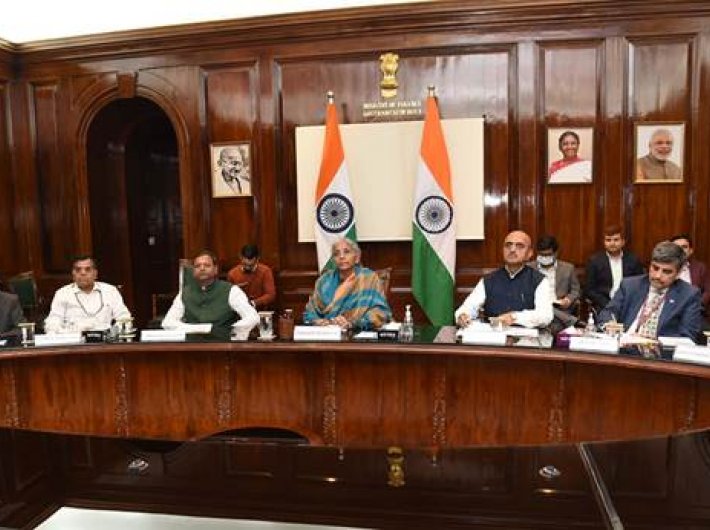
Union minister for finance and corporate affairs Nirmala Sitharaman has concluded the pre-budget consultation meetings for Budget 2023-24 that were held from November 21 to 28 in the virtual mode.

More than 110 invitees representing seven stakeholder groups participated in eight meetings scheduled during this period. The stakeholder groups include representatives and experts from agriculture and agro processing industry; industry, infrastructure and climate change; financial sector and capital markets; services and trade; social sector; trade unions and labour organisations and economists, an official release said Monday.

Union ministers of state for finance Pankaj Chaudhary and Dr. Bhagwat Kishanrao Karad, finance secretary T.V. Somanathan; DEA secretary Ajay Seth, chief economic advisor Dr. V. Anantha Nageswaran, DIPAM secretary Tuhin Kanta Pandey, financial services secretary Vivek Joshi, corporate affairs secretary Manoj Govil; OSD, Revenue, Sanjay Malhotra, and senior officers from the ministry of finance were also present during the meetings. The secretaries of other ministries/departments concerned participated through online mode.

The representatives of the stakeholder groups made a number of suggestions for the forthcoming budget that included mechanism for green certification to help MSMEs , urban employment guarantee programme to boost employment generation in urban areas, rationalisation of income tax, creation of innovation clusters, schemes for  improving domestic supply chains,  reduction of taxes on electric vehicle, introduction of EV policy,  measures to promote India as a hub for Green Hydrogen, Social Sector Entrepreneurship Fund for Social Impact Companies, Training and Accreditation of Care Economy Workers, portable social benefit for children, National Regulatory Authority for Water and Sanitation, coverage of unorganised workers under ESIC, continuation of Public Capex, fiscal consolidation and lower customs duties, among others.

The finance minister thanked the participants for sharing their valuable suggestions and assured that suggestions would be carefully considered while preparing the Budget 2023-24.


Comments


Other News

Not just politics, let`s discuss policies too

Why public policy matters Most days, India`s loudest debates stop at the ballot box. We can name every major leader and recall every campaign slogan. Still, far fewer of us can explain why a widow`s pension is delayed or how a government school`s budget is actually approved. That

When algorithms decide and children die

The images have not left me, of dead and wounded children being carried in the arms of the medics and relatives to the ambulances and hospitals. On February 28, at the start of Operation Epic Fury, cruise missiles struck the Shajareh Tayyebeh school – officially named a girls’ school, in Minab,

The economics of representation: Why women in power matter

India’s democracy has grown in scale, but not quite in balance. Women today are active participants in elections, influencing outcomes in ways that were not as visible earlier. Yet their presence in legislative institutions continues to lag behind. The Nari Shakti Vandan Adhiniyam was meant to addres

India will be powerful, not aggressive: Bhaiyyaji

India is poised to emerge as a global power but will remain rooted in its civilisational ethos of non-aggression and harmony, former RSS General Secretary Suresh `Bhaiyyaji` Joshi has said.   He was speaking at the launch of “Rashtrabhav,” a book by Ravindra Sathe

AI: Code, Control, Conquer

India today stands at a critical juncture in the area of artificial intelligence. While the country is among the fastest adopters of AI in the world, it remains heavily reliant on technologies developed elsewhere. This paradox, experts warn, cannot persist if India seeks technological sovereignty.

RBI pauses to assess inflation risks, policy transmission

The Reserve Bank of India (RBI) has begun the new fiscal year with a calibrated pause, keeping the repo rate unchanged at 5.25 per cent in its April Monetary Policy Committee (MPC) meeting. The decision, taken unanimously, reflects a shift from aggressive policy action to cautious observation after a signi


Archives

Current Issue

Opinion

Facebook Twitter Google Plus Linkedin Subscribe Newsletter

Twitter






