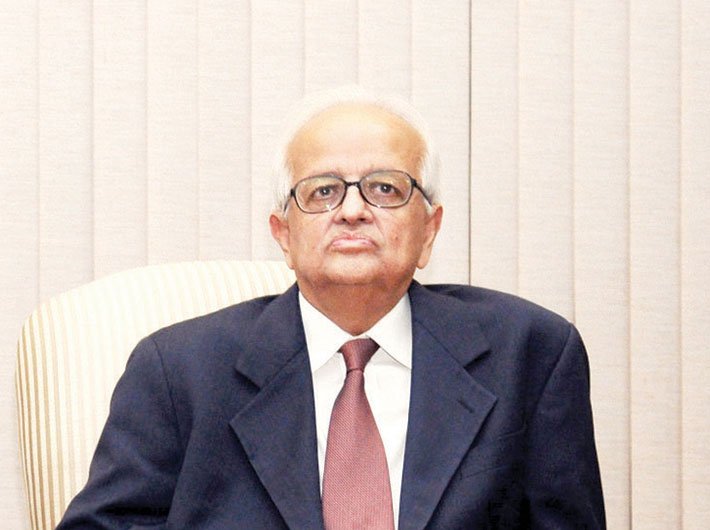
Bimal Jalan, a former RBI governor, feels that PMJDY is a very “good idea” and with the intelligent use of technology it can be a useful instrument for financial inclusion. In a telephonic interview with Shishir Tripathi, Jalan says he does not see any “fault lines” that can challenge the implementation of Modi’s ambitious plan. Excerpts from the interview:
Under PMJDY almost 100 percent household coverage has been achieved. But how can we ensure that these accounts are used in a manner that can really lead to financial inclusion?
The major change is really technology and the DBT. At the moment we may not be able to reach 100 percent of people since some people are in tribal areas and some do not even have access to post offices directly, but over a period of time this can be done and it would require two things. First is the use of technology and second is that you bring in channels like post offices into the network. Third thing, equally important, would be identity. There, we have the great advantage of Aadhaar and the presence of a huge mobile phone network. If you combine the two, then identity would also be established. It may take some time but it can be done.
Many experts doubt if financial inclusion can be ensured without compromising the stability of the financial system.
No, that is not an issue. Money creation is different from money transfer.
Is there an effective regulatory framework to ensure that financial stability is not compromised by schemes like PMJDY?
Absolutely. This is done by RBI in consultation with the government. The government is also responsible. For example, if you take the fiscal deficit part, they have a fiscal target and there is the FRBM Act that gives your fiscal target. RBI takes the fiscal deficit into account.
Banks have asked for a credit guarantee fund, because they are apprehensive about the overdraft facility under PMJDY. How do you think the government can deal with this issue?
You see, the major difference is that these transfers are from the government to the people. It is not from people to people where the credit-worthiness becomes more important. There is cooperation between RBI and the government.
Do you think small banks are better suited for the implementation of schemes like PMJDY?
Small banks or large banks – that does not matter. It is the branch network of the bank that matters. Take State Bank of India, for example. It is much more expanded than any other private bank and is easily accessible to the public.
Since PMJDY’s launch, 12.5 crore accounts have been opened without increasing banking infrastructure, be it the number of employees or branches. Will this put considerable strain on the banking sector?
Any transaction on this scale would put a certain amount of burden on the banking system – even with the access to technology for the clients as well as the banking system in transferring money today. But over a period of time, this can be handled without too much difficulty.
Can payments banks help in financial inclusion?
A payments bank is a simplified form of banking through which you pay and do not take credit from it. It can certainly go a long way in achieving financial inclusion.
Do you think linking bank accounts with Aadhaar cards would create a consolidated identity database of individuals?
There are two aspects to it. In India, there are around 800 million mobile connections. This is much more than the bank accounts per se. If you add the post offices to this network, then over a period of time it is possible to use all these channels to transfer funds. But, as I said, this would require technological infusion and tremendous amount of literacy and access to information by the recipient. Moreover, technology would need to be used in a manner that it reaches to people for whom it is intended. But all this can be done over a period of time. We have to be just a little patient.
Do you see any fault lines in the implementation of PMJDY – in terms of economic stability or any other aspect?
I don’t think so. We have today 66 major subsidies, 1,000 different schemes for subsidies. The Jan-Dhan Yojana is a transfer mechanism and if we can do it through better technology then I think it is a very good idea and it would not create any problems.
There is a fear that excessive stress on PMJDY can lead to a situation like the subprime crisis in the US.
In the subprime crisis, people were buying houses on mortgage, then using those mortgages to buy more houses and the expansion was circular. There is no comparison between the US crisis and PMJDY. We are not rushing for results.
How do you analyse the business correspondent model in ensuring financial inclusion?
At the moment, the business correspondents (BCs) report to bank branches. There are certain supervisory and regulatory mechanisms in place to ensure smooth functioning. In a vast network, over a period of time BCs can be used to spread the network for transfer of funds from the present scale to the scale meant for a billion people. It can be done, but we have to be patient. I do not see any intrinsic problem in expanding the BC model.
[email protected]
(The interview appears in the June 1-15, 2015 issue)