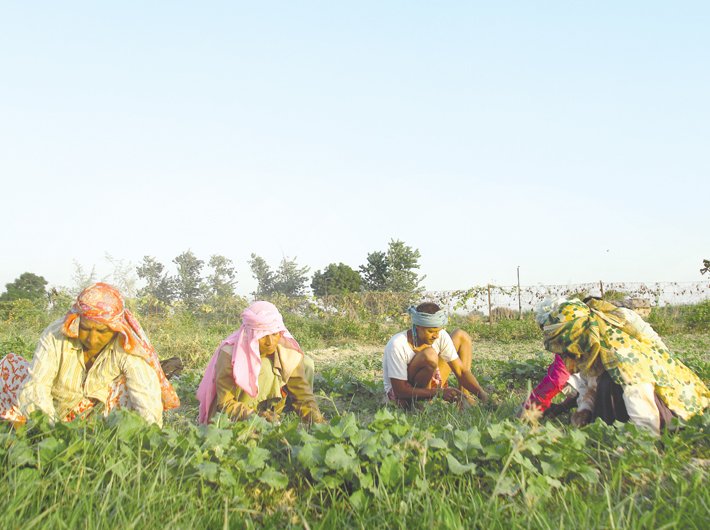
Even as India aims to climb ranks in world development indicators, it fails miserably in the area of social protection, where it is just as weak as Sub-Saharan Africa
A total of 2,96,438 farmers have committed suicide since 1995, when the National Crime Records Bureau (NCRB) started recording data under ‘Accidental Deaths and Suicides in India’. While the malaise shows no sign of abating, some of the solutions and cited causes have, indeed, been ingenious bordering on the bizarre: a senior bureaucrat of Maharashtra, one of the worst-affected states, has taken to singing kirtans to wean farmers off suicidal thoughts, while the central agriculture minister has said (hold your breath) that impotency and love affairs are some of the causes for farmer suicides, while many other politicians seem to be content with conscientious film stars doling out the moolah to help acutely debt-ridden farmers of the country.
We seem remarkably complacent for a country where more than 60 percent of the country’s population lives on less than $2 a day, where the share of total labour force in agriculture is more than 50 percent and share of people, whose farm size is less than one hectare, is nearly 63 percent — the statistics are more or less some of the worst in Southeast Asia and comparable only with Sub-Saharan Africa. For instance, in Sub-Saharan Africa the average of the share of population with less than a hectare of landholding is 61.8 percent.
According to 2014 estimates, 375 million family farms in the developing world had less than one hectare of land. The African Development Bank, recognising the urgency of the situation, unveiled an ambitious plan on October 26 to modernise agriculture and boost agri-business. We have not yet exhibited any such sense of urgency despite farmer suicides consistently hitting the headlines this year.
The UN Food and Agriculture Organization (FAO) has released a State of Food and Agriculture report 2015 which focuses specifically on the need for innovative forms of social protection to break the cycle of rural poverty and urgently urges governments to come up with a national (emphasis added) vision of how agriculture and social protection can gradually move people out of hunger and poverty. The findings are particularly relevant for India.
The report goes against some of the arguments that are traditionally foisted against social protection – that it fosters dependency, reduces work effort and is a waste of investment.
In 2013, according to World Food Programme (WFP), FAO and World Bank estimates, social protection helped lift up to 150 million people out of extreme poverty.
‘Social protection’ was a response – particularly to shocks and inadequacy of robust social security system especially in developing countries – to the dominant discourse of the 1980s and the 1990s of “social safety nets”. Social protection includes in its ambit ways to address chronic poverty over a period of time rather than merely responding to external shocks. Though there is no singular definition of social protection, Devereux and Sabates-Wheeler (2004) defines social protection as “all public and private initiatives that provide income or consumption transfers to the poor, protect the vulnerable against livelihood risks, and enhance the social status and rights of the marginalised; with the overall objective of reducing the economic and social vulnerability of poor, vulnerable and marginalised groups”.
According to the FAO report, “social protection instruments are frequently interpreted as being preventive, protective, promotive and transformative.” Social protection can provide means to access food whether in the form of cash or kind, can mitigate the impact of shocks, increase resilience for future shocks, have a transformative function by shifting the focus from immediate concerns of survival to the future, and shifting power relations within households. Social protection, according to the UN and the World Bank, includes three broad components: social assistance, social insurance and labour market protection.
Social assistance programmes are tax-financed, that is, publicly financed. “If transfers are guaranteed and predictable (Devereux, 2002), they perform a ‘social insurance’ function, by smoothening consumption and preventing destitution following a temporary shock (Devereux, 2001; Lichand, 2010),” the report argues. The most common programmes are: (1) “unconditional transfers, i.e. programmes that distribute cash or vouchers, or are in-kind (such as food), without anything required of the recipient” (in 2014, 130 countries ran this programme); (2) conditional transfers, which may otherwise be identical to unconditional transfers except in that they require recipients to meet some specified conditions, typically to improve the human resources of their children (in 2014, 63 countries had this programme); (3) “public works programmes, also referred to as cash- or food-for-work, or guaranteed employment programmes, which require beneficiaries to work to create or maintain household or community assets” (in 2014, 94 countries were running such programmes with school feeding being the most popular type).
Finally, labour market programmes “provide unemployment benefits, build skills and enhance workers’ productivity and employability”.
About one-third of the world’s population or 2.1 billion people receive some kind of social protection in the developing world though there is wide variation between regions and countries.
So how does India compare on the social protection front? Not very well. Our total population covered by social assistance is 17.2 percent, rural population covered by social assistance is 28.4 percent, urban population covered by social assistance is 11.1 percent, the poorest quintile covered by social assistance is 28 percent, the richest quintile covered by social assistance is 17.9 percent, urban poorest by income quintile is 19.8 percent and urban richest by income quintile is 2.9 percent. We are comparable on average to (again) Sub-Saharan Africa.
The report shows that agricultural households have a basket of income options and that the dependence on own production varies “inversely with farm size”. This should not lead us to the conclusion that agricultural production is unimportant to small farm holders – on the contrary, the report shows that, “crop and livestock production contributes 40 percent or more of total household income for the smallest farm size category in most countries for which data are available”. Own production also contributes substantially towards food consumption for small farm holders.
The FAO estimates that pushing the incomes of the rural poor above the extreme poverty line of $1.25 a day requires an average increase of at least 60 percent in investment in social protection in Sub-Saharan Africa and at least 30 percent of the same in Asia, particularly, China and India. These estimates have been made from the average incomes of the poor estimated in 2010 (World Bank, 2015).
“Natural and human-induced shocks push households into poverty, or more deeply into poverty, often forcing them to liquidate assets… The uncertainties of weather, particularly with accelerating climate change, and the lack of affordable insurance are at the heart of the vulnerabilities of households dependent on agricultural livelihoods,” FAO warns.
The tendency to liquidate assets to tide over immediate shortages like a sudden health emergency is many times at the heart of sinking into chronic hunger and deprivation. In countries such as India, physical and financial assets are built up very slowly partly because they adopt livelihood strategies that are low-risk, low-return, agricultural and other income-generating strategies. “For example, Carter (1997) found that households were willing to give up 20 percent of their income to ensure food availability. This trade-off between food security and higher incomes is greater for poorer households (Alderman and Paxson, 1992; Rosenzweig and Binswanger, 1993),” says the UN organisation.
However, the findings of the study show that when transfers are “regular and predictable”, they can enable recipients to undertake investments that may otherwise be too risky. “Formal social protection measures can relieve pressure on informal insurance mechanisms and social reciprocal networks under stress.”
The report concludes that core to reforms in the agriculture sector vis-à-vis social protection are three key issues: “(i) the effectiveness of social protection measures in alleviating deprivation and food insecurity among the poor, (ii) the extent to which social protection enhances the productive potential of poor agricultural households, and (iii) the extent to which the benefits received by programme participants generates incomes that can ‘spill over’ into the local economy and community.”
A glance over these statistics will highlight the urgent but neglected condition of the agriculture sector in India: The share of value added from agriculture in India is 17.5 percent, the share of total labour force in agriculture is 52.5 percent, the fertiliser use intensity (kg/ha) is 161.3, the share of holdings less than one hectare is 62.9 percent, between 1 and 2 ha is 18.9 percent, between 2 and 5 hectares is 13.9 percent, more than 5 ha is only 4.3 percent, the share of agricultural labour force that is female is 32.5 percent and the share of female labour force in agriculture is 59.0 percent.
Increased risk-taking behaviour of farm holders and intensive investment in agriculture is imperative not only for addressing severe forms of rural deprivation but also for a growing economy like India with an urgent need for an efficient agricultural sector to respond to changes in demand that go with rising incomes and ensuing changes in lifestyles.
[email protected]
(The article appears in the November 1-15, 2015 issue)