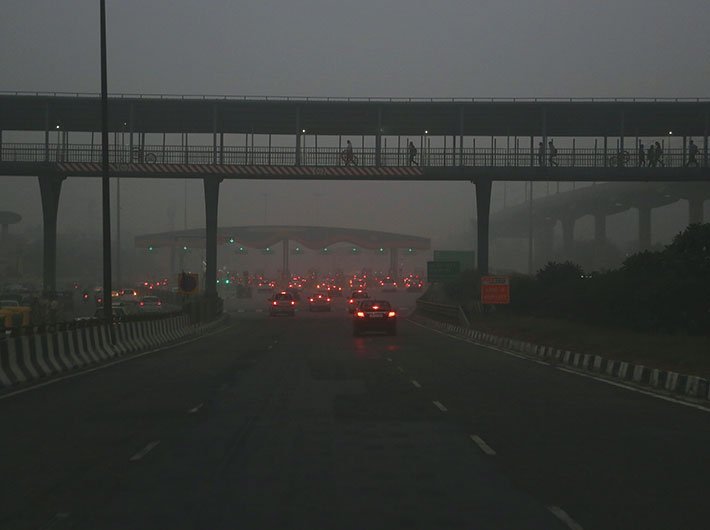
Only 15% population lives within 10 km of a continuous monitor, says the latest State of India’s Environment report
In India, a country of 1.4 billion people where both emissions and exposures vary dramatically across a vast and diverse geography, the monitoring network for air pollution has not kept pace with either the scale or complexity of the problem, says the 2026 State of India’s Environment report.
“According to our (CSE’s) analysis, only 15% of India’s population – about 200 million people – live within 10 km of a continuous monitor. The remaining 85%, more than 1.2 billion people, breathe outside any measurable range,” Sharanjeet Kaur, deputy programme manager at CSE’s Urban Lab and one of the writers of the report, was quoted as saying in a release.
How does India monitor its air pollution?
India has two main sets of infrastructure for monitoring. The National Air Quality Monitoring Programme, launched in 1984-85, relies on manual stations that measure air quality twice a week. They offer long-term averages for a limited set of pollutants. More recently, the country has set up Continuous Air Quality Monitoring Stations, which offer real-time, hourly data across multiple pollutants.
Today, India has 562 real-time monitors across 294 cities and 966 manual stations in 419 cities and towns. Kaur points out that these impressive numbers hide the fact that monitoring is concentrated in a limited set of large cities. “Entire districts, industrial belts, and fast-growing peri-urban centres remain outside the monitoring grid,” she says.
Anumita Roychowdhury, executive director-research and advocacy in CSE and head of CSE’s sustainable urbanisation programmes, says: “This gap in monitoring is not just about missing information, but also about the structural inequity in environmental governance in India. Cities with multiple monitors can demonstrate progress, claim clean air funding, and frame their action plans. But hundreds of smaller towns, many of which experience comparable or even higher levels of particulate pollution, have no real-time data at all.”
How do the states and UTs fare?
In Chandigarh, every resident lives within 10-km of a real-time monitor. Delhi comes a close second, where only 3.5% of the population is outside the measurable range. Puducherry is third best, with almost 50% of its area covered.
Maharashtra has one of India’s largest monitoring networks, but the stations are concentrated around Mumbai, Pune and Nagpur, leaving vast areas unrepresented. In Bihar, only 13% of residents leave within a 10-km radius of a monitor; Uttar Pradesh fares worse, with just 9% of its population covered in that radius. West Bengal monitors only 19% of its population. Densely populated districts like Hooghly, Murshidabad etc do not have a single real-time monitor.
In the northeast, only Assam boasts of a few stations. The rest of the states have only one-two stations each.
Kaur says that “more than 64% of India’s 742 districts have no continuous monitoring at all.”
Roychowdhury sums it all up: “This means that the country’s daily AQI updates, policy assessments and performance-linked grants are based on data from a small, urbanised slice of India. For the rest, pollution is a lived reality, but not a recorded one.”
The way ahead
Roychowdhury says the next phase of monitoring in India must move “beyond a one-size-fits-all approach toward a hybrid network design”. This design should combine regulatory-grade monitors with validated low-cost sensors and satellite-driven datasets, ensuring both accuracy and spatial reach.
Roychowdhury adds: “Equally important is an exposure-based siting strategy that prioritises high risk zones such as schools, hospitals etc. As cities expand and emission sources shift, the monitoring grid should also take to dynamic relocation of stations and reassess sites regularly to reflect new patterns of pollution and land use.” She also points out that what India needs most is a unified and open data ecosystem, integrating data sets from various agencies into an accessible national portal.