
Initiate probe against CJI: CJAR

CJAR levels four charges of 'misconduct' against chief justice Dipak Misra

GN Bureau | January 17, 2018

#J Chelameswar   #Prashant Bhushan   #CJAR   #Dipak Misra   #chief justice   #Supreme Court   #R Gogoi   #MB Lokur   #K Joseph  
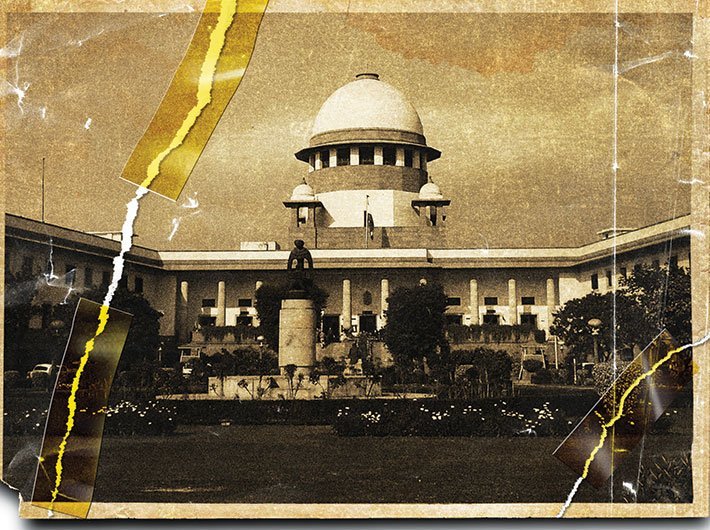
Illustration: Ashish Asthana

The Campaign for judicial accountability and judicial reforms (CJAR) has written to five senior supreme court judges over alleged misconduct by chief justice of India Dipak Misra. 

The CJAR has appealed to the judges -- justices J Chelameswar, R Gogoi, MB Lokur, K  Joseph, AK Sikri -- to conduct an inquiry under the 'in-house procedure for investigating complaints against judges of the high courts and the supreme court’, which is an official procedure laid out for internal enquiries against all judges of the higher judiciary, excluding the CJI.   
   
Senior supreme court lawyer Prashant Bhushan, a member of the CJAR's executive committee, in a press conference, said that there are four major grounds highlighting alleged misconduct by CJI Misra. 
 
He said that first and foremost is the case related to Prasad Education Trust, wherein CBI is probing a graft involving judges in higher judiciary. 
 
“The facts and circumstances relating to the Prasad Education Trust case, show prima facie evidence the chief justice of India, justice Dipak Misra may have been involved in the conspiracy of paying illegal gratification in the case, which at least warrants a thorough investigation,” the CJAR said in its complaint. 
 
Second, the CJI has dealt with the administrative and judicial sides of a writ petition which sought an investigation in a case in which justice Misra himself is likely to be within the scope of investigation as he presided over benches which dealt with this case and passed orders in the care of Prasad Education Trust, and this violated the first principle of code of conduct for judges, the CJAR said.
 
The third charge relates to antedating of an administrative order dated November 6, 2017, which, the CJAR said, amounts to a serious act of forgery / fabrication.
 
The civil society organisation said that “the CJI acquired land while he was an advocate, by giving an affidavit that was found to be false and despite the orders of the ADM cancelling the allotment in 1985, surrendered the said land only in 2012 after he was elevated to the supreme court”.  
 
According to the ‘in house procedure’, complaints against SC judges are sent to the CJI, who then depending in the merit of the case, decide to constitute a committee of three judges of the SC to examine. 
 
“Though this procedure is silent with respect to complaints against CJI himself, it is obvious that complaints against the CJI cannot be examined by the chief justice himself and therefore must be examined by the next judge in seniority or by a collegium of senior judges,” the CJAR said, citing previous judgements of the SC including ‘K Veeraswami v UOI and other (1991 SCC (3) 655)’, ‘Addl District & Session Judge ‘X’ v High Court of MP (2015 4 SCC 91’.
 
The CJAR also made public transcripts of telephonic conversation between retired Odisha high court judge IM Qudussi, middleman Vishwanath Agarwala and BP Yadav of the Prasad Education Trust taped by the CBI. 
 
The complaint copy can be accessed here
 

Comments


Other News

India faces critical shortage of skin donors amid rising burn cases

India reports nearly 70 lakh burn injury cases every year, resulting in approximately 1.4 lakh deaths annually. Experts estimate that up to 50% of these lives could be saved with adequate access to skin donations.   A significant concern is that around 70% of burn victims fall wi

Not just politics, let`s discuss policies too

Why public policy matters Most days, India`s loudest debates stop at the ballot box. We can name every major leader and recall every campaign slogan. Still, far fewer of us can explain why a widow`s pension is delayed or how a government school`s budget is actually approved. That

When algorithms decide and children die

The images have not left me, of dead and wounded children being carried in the arms of the medics and relatives to the ambulances and hospitals. On February 28, at the start of Operation Epic Fury, cruise missiles struck the Shajareh Tayyebeh school – officially named a girls’ school, in Minab,

The economics of representation: Why women in power matter

India’s democracy has grown in scale, but not quite in balance. Women today are active participants in elections, influencing outcomes in ways that were not as visible earlier. Yet their presence in legislative institutions continues to lag behind. The Nari Shakti Vandan Adhiniyam was meant to addres

India will be powerful, not aggressive: Bhaiyyaji

India is poised to emerge as a global power but will remain rooted in its civilisational ethos of non-aggression and harmony, former RSS General Secretary Suresh `Bhaiyyaji` Joshi has said.   He was speaking at the launch of “Rashtrabhav,” a book by Ravindra Sathe

AI: Code, Control, Conquer

India today stands at a critical juncture in the area of artificial intelligence. While the country is among the fastest adopters of AI in the world, it remains heavily reliant on technologies developed elsewhere. This paradox, experts warn, cannot persist if India seeks technological sovereignty.


Archives

Current Issue

Opinion

Facebook Twitter Google Plus Linkedin Subscribe Newsletter

Twitter






