
Judicial appointment panel case goes to constitutional bench

Plea had questioned the process adopted in passing the act that would replace judges’ collegiums

GN Bureau | April 7, 2015

#Supreme Court   #judges appointment   #National Judicial Appointment Commission act   #Fali Nariman   #Anil Dave   #Mukul Rohatgi   #constitutional bench  


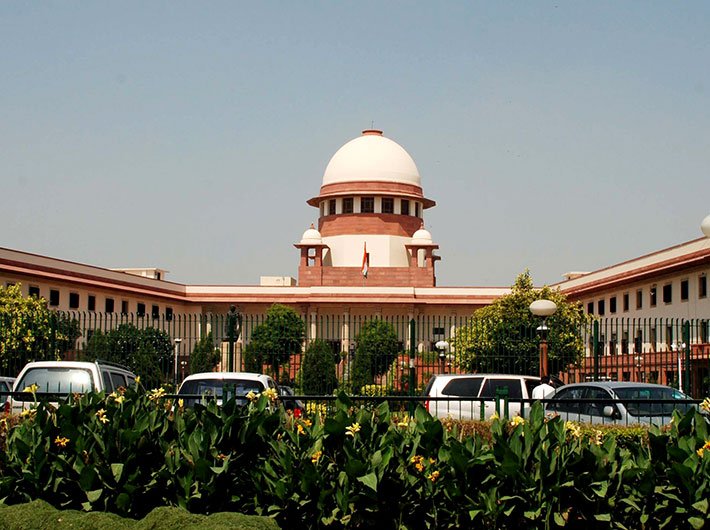
A three-judge bench of justices A R Dave, J Chelameswar and Madan B Lokur, which had reserved its judgement on the National Judicial Appointment Commission act (NJAC) and constitutional amendment of Article 124 A, has referred the matter to a five-judges constitutional bench.

The court also refused to stay operation of NJAC Act meant to replace collegium system of judges appointing judges.

The verdict was reserved on March 24 after Attorney General (AG) Mukul Rohatgi, appearing for the Centre, wrapped up his arguments saying that the pleas be dismissed as they were "premature" and "academic" in nature.

The Supreme Court Advocates on Record Association (SCAORA)and Bar Association of India (BAI), represented by Fali Nariman and Anil Divan respectively, had opposed the two Acts and sought that direction be passed to maintain status quo, saying the entire process would otherwise become irreversible.

However, the Supreme Court Bar Association (SCBA) had strongly favoured the government on laws on appointment of judges in higher judiciary, saying there has been "unanimity" that the present mechanism has "serious pitfalls".

There is unanimity in the view that there are serious pitfalls in the collegium system," SCBA president and senior advocate Dushyant Dave had submitted.

Those opposing the new law had submitted that the issue should be referred to a Constitution Bench of five judges. Nariman and Divan had contended that as per constitutional scheme, the NJAC Act should not have been passed ahead of enabling constitutional amendment. "Where was the authority to pass the NJAC Act," Nariman had asked. According to him the Act should have been passed after the constitutional amendment.

However, the AG had argued that the power of Parliament to make law is "plenary" and hence, the methodology adopted by the legislature in clearing the law on the floor of the House cannot be "tested" by the court. Rohatgi submitted that "Only end product can be examined by the courts and it is irrelevant that this Act was passed earlier and that Act was passed later."

"Only an Act, after notification, can be tested in the court of law and not the procedures adopted by the Parliament," the Attorney General had submitted.

The apex court had said it could proceed on the merits of the matter only after deciding whether the petitions challenging the validity of the act and the NJAC act were maintainable or not.

Comments


Other News

Why civilization is a precarious thing

The Decline of Hindu Civilization: Lessons from the Past By Shashi Ranjan Kumar Rupa Publications, 416 pages, Rs 995

End of an era: BJP poised to rule Mumbai after 25 years

The BJP-led Mahayuti alliance was set for a decisive victory in the Maharashtra municipal corporation elections, consolidating its dominance across Maharashtra’s urban landscape. As per the latest trends from the vote counting on Friday afternoon, the state`s ruling coalition was leading in 19 of the

Startup India initiative: A decade of building India’s innovation backbone

* With over 2 lakh DPIIT-recognised startups as of December 2025, India stands firmly as one of the world’s largest startup ecosystems. * A decade of Startup India has built a full-lifecycle support system spanning ideation, funding, mentorship, and scale-up. * Around 50% of DPIIT-r

How toll policies are redefining the highway journeys

With the phenomenal growth in National Highways, queues at toll plazas used to affect commuters. However, over the last decade, tolling has undergone a major technological transformation, bringing faster movement and significant ease for road users. Building on this progress, year 2025 saw further people-c

From vulnerabilities to empowerment: Building resilience for small and marginal farmers

India’s small and marginal farmers are at the centre of a paradox in agrarian economy. They are the backbone of the food economy, but they are the most vulnerable stakeholders within agricultural economy. Among the 126 million farmers in India today, nearly makes 86% operate on small and marginal hol

Concerns over Mumbai air pollution ahead of Marathon

Environmental organisation Awaaz Foundation has flagged serious concerns over deteriorating air quality in Mumbai and the potential health risks it poses to participants of the Tata Mumbai Marathon scheduled for January 18. It has urged civic and pollution control authorities to conduct advance air quality


Archives

Current Issue

Opinion

Facebook Twitter Google Plus Linkedin Subscribe Newsletter

Twitter







