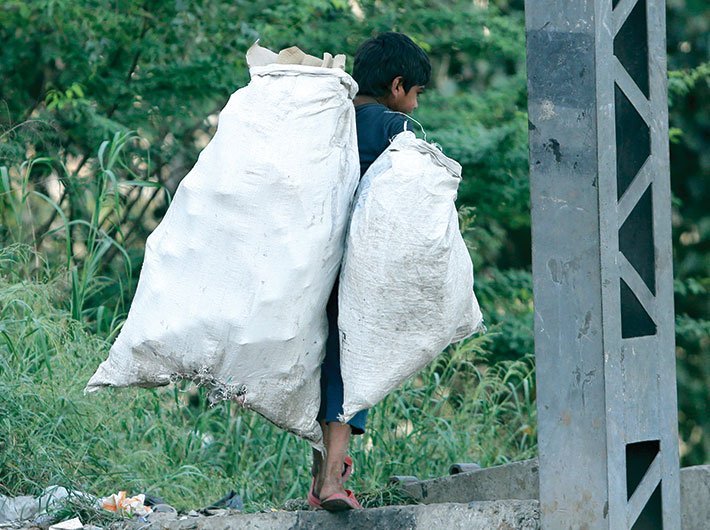
Among one of the blatant signs of economic inequality, just eight men own the same wealth as the poorest half of the world. In a report titled,
‘An economy for the 99%’, Oxfam International has quoted several studies and sources which point out at many cases of global inequality. One of them estimates that “over the next 20 years, 500 people will hand over $2.1 trillion to their heirs – a sum larger than the GDP of India, a country of 1.3 billion people”.
Here are some of the other important observations collated by Oxfam:
- Since 2015, the richest 1% has owned more wealth than the rest of the planet.
- The incomes of the poorest 10% of people increased by less than $3 a year between 1988 and 2011, while the incomes of the richest 1% increased 182 times as much.
- A FTSE-100 CEO earns as much in a year as 10,000 people in working in garment factories in Bangladesh.
- In the US, new research by economist Thomas Piketty shows that over the last 30 years the growth in the incomes of the bottom 50% has been zero, whereas incomes of the top 1% have grown 300%.
- In Vietnam, the country’s richest man earns more in a day than the poorest person earns in 10 years.
The international organisation says that “from Brexit to the success of Donald Trump’s presidential campaign, a worrying rise in racism and the widespread disillusionment with mainstream politics, there are increasing signs that more and more people in rich countries are no longer willing to tolerate the status quo”.
Oxfam lists down some of the reasons for inequality quoting various reports:
Corporations are working for those at the top: The world’s 10 biggest corporations together have revenue greater than the government revenue of 180 countries combined.
Squeezing workers and producers: The incomes of many chief executives have skyrocketed while wages for ordinary workers and producers have been barely increased, and in some cases gotten worse. The CEO of India’s top information firm earns 416 times the salary of a typical employee in his company, for one. The International Labour Organization estimates that 21 million people are forced labourers, generating an estimated $150bn in profits each year. The world’s largest garment companies have all been linked to cotton-spinning mills in India, which routinely use the forced labour of girls.
Dodging tax: Corporations maximize profit in part by paying as little tax as possible. They do this by using tax havens or by making countries compete to provide tax breaks, exemptions and lower rates. Apple allegedly paid 0.005% of tax on its European profits in 2014. Developing countries lose $100bn every year to tax dodging. It is the poorest people who lose out the most. Kenya is losing $1.1bn every year in tax exemptions for corporations, nearly twice its budget for health – this in a country where women have a 1 in 40 chance of dying in childbirth.
Super-charged shareholder capitalism: In many parts of the world, corporations are increasingly driven by a single goal: to maximize returns to their shareholders. This means not only maximizing short-term profits, but paying out an ever-greater share of these profits to the people who own them. In the UK, 10% of profits were returned to shareholders in 1970; this figure is now 70%. In India, the figure is lower but is growing rapidly, and for many corporations it is now higher than 50%.
Crony capitalism: As documented by Oxfam in ‘An Economy for the 1%’, corporations from many sectors use their huge power and influence to ensure that regulations and national and international policies are shaped in ways that enable continued profitability. For example, oil corporations in Nigeria have managed to secure generous tax breaks. Alphabet, the parent company of Google, has become one of the biggest lobbyists in Washington and is in constant negotiations in Europe over anti-trust rules and tax.
The role of the super-rich in the inequality crisis: The 1,810 dollar billionaires on the 2016 Forbes list, 89% of whom are men, own $6.5 trillion – as much wealth as the bottom 70% of humanity. While some billionaires owe their fortunes predominantly to hard work and talent, Oxfam’s analysis of this group finds that one-third of the world’s billionaire wealth is derived from inherited wealth, while 43% can be linked to cronyism.
Avoiding tax, buying politics: Paying as little tax as possible is a key strategy for many of the super-rich. To do this they make active use of the secretive global network of tax havens, as revealed by the Panama Papers and other exposés. Countries compete to attract the super-rich, selling their sovereignty. Super-rich tax exiles have a wide choice of destinations worldwide. For an investment of at least £2m, you can buy the right to live, work and buy property in the UK and benefit from generous tax breaks. In Malta, a major tax haven, you can buy full citizenship for $650,000. Africa alone loses $14bn in tax revenues due to the super-rich using tax havens – Oxfam has calculated this would be enough to pay for the healthcare that could save the lives of four million children and to employ enough teachers to get every African child into school.