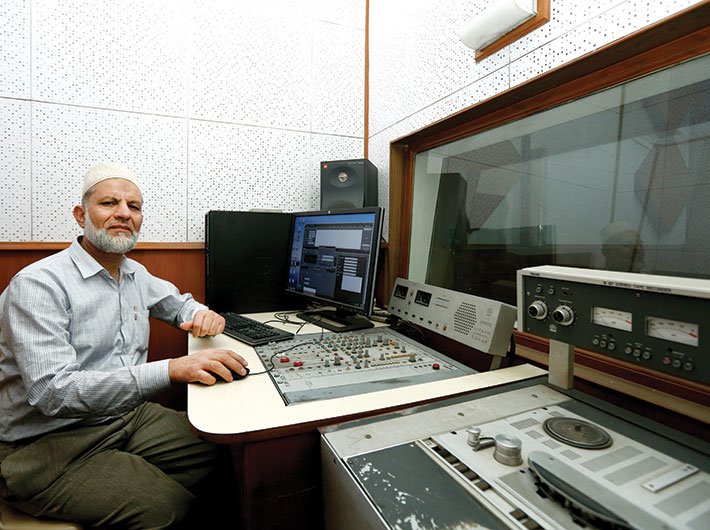
At a time when the government had collapsed, the secretariat was under water and the chief minister without aides, radio broadcast became a lifeline for the people of Kashmir
What would you do if you see your house under water; city deluged and it raining heavily? Most of us would, probably, scream for help or start praying.
However, some gutsy people do things differently. This is the story of one such person.
On September 4, 2014, Shamshad Kralwari had just returned home after reporting a grim flood situation in Srinagar for All India Radio (AIR), Srinagar. What he saw was beyond his imagination – water was gushing into his house from all sides and the first floor was half submerged. He looked around and Natipora, his neighbourhood on the outskirts of Srinagar, had turned into a murky water body.
Kralwari heads the commercial broadcasting services (CBS) of AIR, Srinagar (known as Radio Kashmir, Srinagar). Instinctively, he switched on a transistor to know more about the flood. There was a deafening silence on the air waves.
He was not aware that in the AIR studio, his colleague Talha Jahangir had sounded the last post to listeners. One of the first breeches of a swollen Jhelum happened right behind the AIR building. In no time water had flooded the first floor of the station – drowning studios and costly machinery. Jahangir had to interrupt a programme to announce the suspension of the broadcast before running for his life. By then Srinagar’s uptown was already under Jhelum waters.
In the meanwhile, Kralwari and all members of his family had shifted to the third floor – without food and water. He, however, continued to fiddle with a transistor in the hope of reaching out to someone. On September 6, his transistor received signals from what was a conversation between the teams of the Indian army and national disaster response force (NDRF) that were engaged in rescue operations. He knew that rescue boats were plying in some parts of the town.
“I told my wife, if these signals can come why can’t the radio function,” Kralwari told Governance Now.
Next afternoon, the broadcaster in Kralwari got the better of the husband and the father. He left his home wading through neck deep waters, hopping rescue boats and walking precariously along the banks of a furious Jhelum. After six hours, he reached the radio station – all flooded and shut. Unwilling to give up, Kralwari trekked the Shankaracharya hill top, where the CBS had its relay transmitter.
He found the only hill in the city crammed with people – men, women, children, locals and tourists without food and water, and desperate to get in touch with their families.
At the transmitter he was greeted by four engineers who had been flown in from Delhi with the brief to resume radio broadcast as soon as the flood water subsided. But Kralwari knew it would be too late. He took charge. All five put their heads together and decided to go for a live broadcast. With one voice recorder and two microphones, the engineers improvised a rag-tag station and Kralwari’s robust voice gave it a life. The first to speak up were the stranded people on the Shankaracharya hill at about 9 pm. Kralwari called it Kashmir Flood Helpline; asked people to talk about anything – their anxieties, fears, send a message of their welfare to a relative, etc.
The first caller was a woman from Jammu’s border area of Ranbirsinghpura, who had lost contact with her husband who worked in a government department in Kashmir. Soon a flood of calls and SMSes flowed in. Kralwari addressed his family too.
In a situation where the government had collapsed, the secretariat was under water and the chief minister without aides, radio broadcast acquired an all new role – a lifeline for the people who literally thought the world had come to an end.
The second day Kralwari sent messages to his colleagues. “I was at Naseem Bagh when someone told me that the radio had been restored and I was needed there,” Jahangir recollects. “I rushed to Gupkar and from there trekked the Shankaracharya hill to join my fellow announcers.”
The radio team was working with very little food and water, no proper place to even sleep. “We faced a serious crisis in terms of food, water and diesel to run the generators,” recalls Jahangir. Later, they were provided with some bottles of drinking water and eatables by the army and district commissioner of Srinagar.
Kralwari and team’s initiative moved many people and shook the authorities. He would ask officers to follow his example and come to the station to give directions to people. The first to arrive was the chief minister, Omar Abdullah. He thanked the team for providing him a platform to get connected to the people.
Mohammad Ashraf sent a desperate message to his daughter, with whom he had lost contact. The daughter, he was soon told – through radio – and all inmates of the Islamic University Hostel, where she stayed, had been rescued and lodged in a safe place.
One of the SMS messages read: “Domestic animals [should] be untied so that they may swim out to safer places.” Another informed people how to make rafts of commonly available material, to stay afloat or swim to safety.
The helpline became the link between the people and the authorities; it gave hope to people trapped in floods and also a sense of someone in-charge in a situation that people had not seen in a hundred years.
A group of youth from Tangmarg had volunteered as rescuers. They received directions from the administration via the radio. The team was able to save people from three villages.
A renowned psychiatrist got in touch with the helpline and offered his services to the people. “Radio service acts as a great stress buster for panicked people during this moment of fear and grief.”
Kralwari remembers how an elderly person had reached Shankaracharya hill from Anantnag, 50 km away, to get his message aired for his daughter. His daughter was studying in the Government Medical College, Srinagar. He had taken a bus and a boat, before walking through the rough waters to reach the hill.
On an average 2,500 to 3,000 callers would contact the helpline. This continued for 10 days.
After the flood waters receded and a semblance of normalcy was restored in Kashmir, the good work of Radio angels remained etched in the minds of people. There were demands for continuation of the helpline, said Kralwari.
After 10 days, Kralwari and his team went back to normal work, notwithstanding a popular demand for continuation of the helpline which had now turned into a virtual lifeline for the flood-affected people of Kashmir. To his surprise, his work and dedication was soon rewarded – the CBS was flooded with advertisements. In three months CBS had earned a revenue of '2.68 crore – a four-fold increase from previous records.
Prompted by the success of the helpline, the government recently decided to convert all medium wave radio frequencies into FM stations.
Who says good service is not a good business!
[email protected]