
Khadi: Not just for sake of appearances

Modi’s promotion of the textile is welcome, now go for a holistic revival with bottoms-up approach

GN Bureau | April 2, 2016

#weavers   #Narendra Modi   #KVIC   #Khadi  


There has been a sudden revival of “nationalism” – at least of one version of it, and yet it is difficult to imagine that not long ago, one of the prime symbols of nationalism was not an animal, not a divisive slogan but a cloth. After independence, khadi was reduced to a formal uniform of the political class, and along with its wearers, khadi too lost its symbolic force. Its charm remained merely skin-deep.

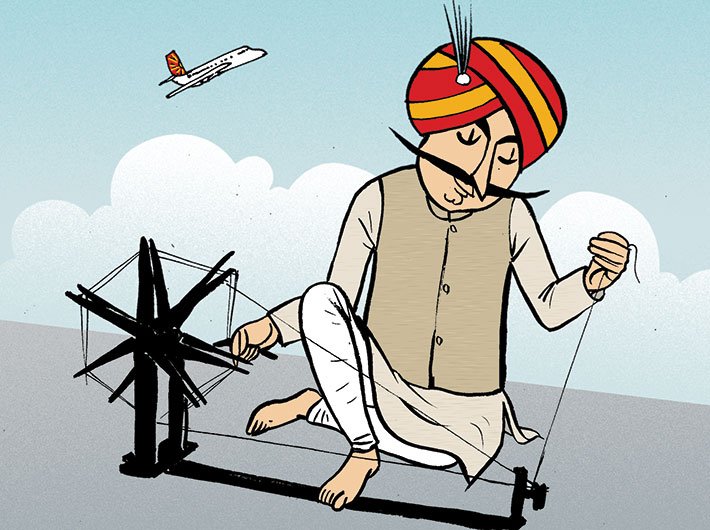
Now, prime minister Narendra Modi has taken up the task of making khadi popular again. He himself has been a sort of brand ambassador for khadi, making his style of kurtas a fashion statement. His championing of khadi goes counter to the trend of even the political class giving up on khadi.

After Modi spoke of the virtues of khadi, Air India has adopted the fabric for its crew, and the government officers too may don khadi soon. For khadi lovers, it’s all good news.

In Gandhi’s days, khadi was a weapon of the swadeshi, against the imported cloth. After independence, its import should be no less. Gandhi promoted khadi because the hand-spun cotton cloth was at the centre of his vision for India’s self-reliant economy. In interior villages, where there are no job opportunities other than the rain-dependent agriculture, khadi-spinning and similar economic activities can give people a means of livelihood. That role of khadi remains as relevant today as ever, and it can help reduce the mass exodus to cities in search of jobs.

What the current push from the prime minister will do for khadi is to increase its demand. It will have to be complemented with a similar push to increase its supply from the grassroots. For that, the government, through the Khadi and Village Industries Commission (KVIC), should do more handholding for the struggling and barely surviving cooperative societies in the field of khadi production – their problems go well beyond the lack of demand for khadi.


Comments


Other News

When algorithms decide and children die

The images have not left me, of dead and wounded children being carried in the arms of the medics and relatives to the ambulances and hospitals. On February 28, at the start of Operation Epic Fury, cruise missiles struck the Shajareh Tayyebeh school – officially named a girls’ school, in Minab,

The economics of representation: Why women in power matter

India’s democracy has grown in scale, but not quite in balance. Women today are active participants in elections, influencing outcomes in ways that were not as visible earlier. Yet their presence in legislative institutions continues to lag behind. The Nari Shakti Vandan Adhiniyam was meant to addres

India will be powerful, not aggressive: Bhaiyyaji

India is poised to emerge as a global power but will remain rooted in its civilisational ethos of non-aggression and harmony, former RSS General Secretary Suresh `Bhaiyyaji` Joshi has said.   He was speaking at the launch of “Rashtrabhav,” a book by Ravindra Sathe

AI: Code, Control, Conquer

India today stands at a critical juncture in the area of artificial intelligence. While the country is among the fastest adopters of AI in the world, it remains heavily reliant on technologies developed elsewhere. This paradox, experts warn, cannot persist if India seeks technological sovereignty.

RBI pauses to assess inflation risks, policy transmission

The Reserve Bank of India (RBI) has begun the new fiscal year with a calibrated pause, keeping the repo rate unchanged at 5.25 per cent in its April Monetary Policy Committee (MPC) meeting. The decision, taken unanimously, reflects a shift from aggressive policy action to cautious observation after a signi

New pathways for tourism growth

Traditionally, India’s tourism policy has been based on three main components: the number of visitors, building tourist attractions and providing facilities for tourists. Due to the increase in climate-related issues and environmental destruction that occurred over previous years, policymakers have b


Archives

Current Issue

Opinion

Facebook Twitter Google Plus Linkedin Subscribe Newsletter

Twitter






