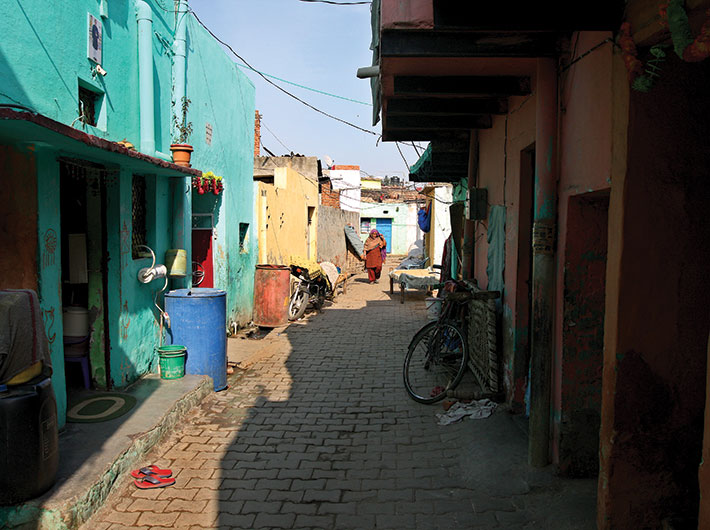
Disconnect with ground realities has resulted in failure of a housing project for the poor in Faridabad. The cost: crores, to be borne by the exchequer. Does it sound like a familiar pan-India story?
On a warm winter afternoon, Man Singh, an ailing sexagenarian, rested on the porch of his house in Kalyanpuri. Singh has been living in the slum cluster of this Faridabad locality for nearly four decades where, to accommodate his family of 12, he has built a two-storey house. But his comfortable retired life may soon be headed for an upheaval.
For decades, Singh and other residents of Kalyanpuri slum cluster have been living on land that belong to the municipal corporation of Faridabad (MCF). According to Satish Parashar, chief town planner at MCF, this land is illegally occupied and the MCF wants to vacate it for commercial purposes. The government wants to relocate these illegal dwellers: in 2007, the central government sanctioned the construction of housing for these people from economically weaker sections (EWS) under basic services for urban poor (BSUP), a sub-mission under the Jawaharlal Nehru national urban renewal mission (JNNURM).
Radheshyam Sharma, sub-divisional officer, MCF, said that funding for the project has been shared between the central government, the Haryana government and MCF in 50:20:30 ratio.
Unfortunately, the government did not do a ground-level survey before sanctioning the project. The assumption was that once the flats get ready, the people will readily move in. But the authorities did not consider the socio-economic, political or personal reasons that might prevent this relocation. The construction and identifying of beneficiaries, Radheshyam Sharma said, started simultaneously.
The construction of 1,968 EWS housing units in Dabua was completed in 2013 but only 202 families have moved in so far. “Political influence plays a big role. Some people do not want their vote banks to shift to a different constituency. Some have opened businesses, and if they shift their businesses will be jeopardized,” Sharma said. “One of the biggest obstacles is the house owners who have given their houses on rent – they are against tenants moving to the flats as it will lead to a loss in their income.”
At AC Nagar, the plan is to construct in situ flats through the PPP (public-private partnership) route. “The corporation does not have money to spend for construction. So we will give the contract to a private developer and provide it (the firm) plot for commercial purposes on the same land,” Sharma said. “The detailed project report (DPR) has been sent to the government and we are awaiting a response.”
The residents, meanwhile, will be provided temporary accommodation by the corporation.
Puneet Sharma, who owns a grocery store in AC Nagar, is worried about his livelihood. “This shop is my only source of income. If I am forced to move where I will find employment?” he rued.
At ground zero
In Dabua, save for a few families who have moved in, the flats lie vacant. Due to an absence of security measures, theft is a routine feature in the vacant flats: many doors have been stolen. Some of them have been taken off the hinges for safe-keeping. Corporation officials allege that taking advantage of the situation many people are occupying the flats illegally.
Yasmin Khatun had moved in one of the flats after her dwelling in Lakkarpur Khori (Khoregaon) was demolished. “My name was on the list of beneficiaries but I have not been allotted a flat yet,” she said. For the time being Khatun has rented the flat from one of the beneficiaries for a monthly '2,000.
Inadequate space is a major issue among the residents. The flats, each of which is of 25 square metres, are insufficient to accommodate large families, according to those who have moved in.
Kesar Devi and her family of 10, for instance, find it exceedingly difficult to manage within that small space. “My sons, their wives, grandchildren and daughter have to cramp into this small space. My younger son and his wife have occupied a vacant flat upstairs for the time being,” she said.
Devi’s husband and sons have to daily commute to Khoregaon for work.
The residents complain that due to a technical snag there has been no water supply for the last 15 days. “The tubewell water is not drinkable due to its high iron content. We had been buying drinking water all this while but now we have to buy water for domestic use as well,” Khatun said.
For residents of Kalyanpuri and AC Nagar, inadequate space is one of the primary reasons for their unwillingness to relocate. In Kalyanpuri, Panna Lal, who works as labourer, said he prefers to live in the house he built: “We can modify the house according to our convenience. It will be difficult for old people to climb the stairs to the flats. Besides, one family gets only one apartment irrespective of the number of family members. We are a family of seven. How will we accommodate in such a small space?”
One flat will be grossly inadequate for Man Singh and his family, too.
But corporation officials defend their move saying Singh’s house, spread over 700 square yards, came totally free of cost whereas the actual value of the land is around '1 lakh per acre. “These people did not have to pay for the land on which they built their houses and shops. They have it so easy here. No wonder they are opposed to moving,” said Radheshyam Sharma.
Stressing that MCF is losing land, property and resources because of these squatters, chief town planner Parashar said: “These people do not pay taxes and yet enjoy all facilities. Their burden is carried by the taxpayers.”
Neeraj Mavai, a resident of AC Nagar who runs a school and a coaching centre, said the residents are willing to pay the government and in return they want to be allowed to retain their houses.
The execution of the project was not smooth: the construction of 1,968 units in Dabua was completed in 2013, whereas only 928 units could be completed in Bapunagar by 2011, after which the construction was dropped. “The site of construction had encroachments and it took a long time to vacate the place after which the cost inflation rendered the project infeasible,” Radheshyam Sharma said.
The cost of one dwelling unit is rupees one lakh ninety-six thousand. The total cost of the Dabua and Bapunagar projects is rupees 39 and 25.3 crores respectively. Out of the total cost of construction, 12.5 percent is supposed to be charged from the beneficiaries. “They will be charged '300 per month for 15 years,” Radheshyam Sharma said.
Parashar firmly believes that the land will be vacated: “We are giving them an opportunity to move out. If they refuse to budge, there are rules and regulations in place. We have given them ample time. The government has spent an obscene amount of money for the construction. The state might contemplate a strong policy decision.”
In future, he said, we really have to think before formulating policies.