NPC leads the way towards solar energy

NPC has the first building in the capital to have installed solar panels as part of their energy conservation drive

yoshika

Yoshika Sangal | August 7, 2015


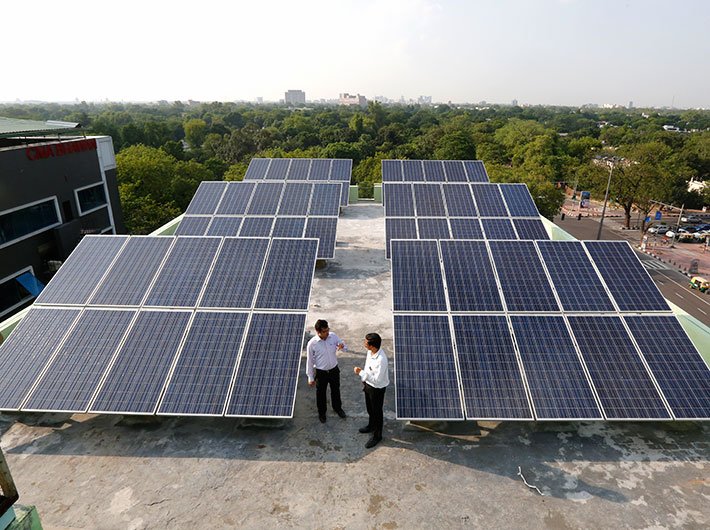
The headquarters of the national productivity council (NPC), under the ministry of commerce and industry, has become the first government building in Delhi to have installed HT-solar panels to meet a part of its electricity requirements.

NPC director general Harbhajan Singh proposed the idea of a solar rooftop power plant system for the council’s energy requirements as a part of the green initiative started by the government. The system was inaugurated last month.

Ten solar panels were installed on the roof of the building with a capacity of generating 30 kWp (kilowatt peak). Each panel has 10 modules producing 300 watts each.

Talking about the project, Singh says, “India receives a lot of sunlight throughout the year and we must utilise this for energy generation instead of importing fuel and spending on coal. We should promote such projects starting from government buildings, colleges and schools. People are apprehensive of the whole process due to lack of information and high costs. But a solar power plant is maintenance free and costs are recovered in a few years. We have 12 regional offices in India with the biggest one in Chennai with a five-acre institute and we are in the process of developing a similar solar power plant there.”

“The panels on an average generate 7.5-8 kW every day. Starting from 6 am, the maximum output is during 12-3 pm generating approximately 130-140 units in a day, depending on the position of the sun,” says B Pravin Bhandary, the director of energy management of NPC who was in charge of the project. “We are the first consumer to have installed an HT-Net-metered solar rooftop power plant in Delhi. The power supply is distributed on high tension (HT).  It covers 15 percent of the total electricity requirement which is around 600 units every day, and it meets the entire lighting load of the building. The rest is acquired from the electric grid. We save approximately 40,000 units per year.”

Vipin Rohilla, assistant director of the energy management of NPC, handled the operation. “On holidays when there is no consumption of electricity, the units produced by the solar plant are transferred to the transformer of the grid through a bi-directional meter. Hence, at the end of the month we get the net energy imported by the solar plant and the grid together. If the export is more than the electricity requirement, there is a net surplus of units,” he says. “We also monitor the regular generation through a system installed on the roof and a mobile app on my phone called ‘AE SiteLink’, a German company with a centre in Bengaluru which gives daily and monthly reports of power generation information and trends.”

The total cost incurred was Rs 21.75 lakh with a subsidy of 30 percent from MNRE. Apart from this, Rs 2.10 lakh was given as administration charges to the Solar Energy Corporation of India (SECI) under MNRE for implementation.

As an extension to their energy efficiency and management campaign, the council has also replaced the ordinary bulbs in the entire building with power-saving LED lights and has fixed double glass windows in the conference hall that prevents heat coming into the room, thereby reducing air-conditioning energy requirement from 13 tonnes to 6 tonnes.
 

Comments


Other News

A 19th-century pilgrim’s progress

The Travels of a Sadhu in the Himalayas By Jaladhar Sen (Translated by Somdatta Mandal) Speaking Tiger Books, 259 pages, ₹499.00  

India faces critical shortage of skin donors amid rising burn cases

India reports nearly 70 lakh burn injury cases every year, resulting in approximately 1.4 lakh deaths annually. Experts estimate that up to 50% of these lives could be saved with adequate access to skin donations.   A significant concern is that around 70% of burn victims fall wi

Not just politics, let`s discuss policies too

Why public policy matters Most days, India`s loudest debates stop at the ballot box. We can name every major leader and recall every campaign slogan. Still, far fewer of us can explain why a widow`s pension is delayed or how a government school`s budget is actually approved. That

When algorithms decide and children die

The images have not left me, of dead and wounded children being carried in the arms of the medics and relatives to the ambulances and hospitals. On February 28, at the start of Operation Epic Fury, cruise missiles struck the Shajareh Tayyebeh school – officially named a girls’ school, in Minab,

The economics of representation: Why women in power matter

India’s democracy has grown in scale, but not quite in balance. Women today are active participants in elections, influencing outcomes in ways that were not as visible earlier. Yet their presence in legislative institutions continues to lag behind. The Nari Shakti Vandan Adhiniyam was meant to addres

India will be powerful, not aggressive: Bhaiyyaji

India is poised to emerge as a global power but will remain rooted in its civilisational ethos of non-aggression and harmony, former RSS General Secretary Suresh `Bhaiyyaji` Joshi has said.   He was speaking at the launch of “Rashtrabhav,” a book by Ravindra Sathe


Archives

Current Issue

Opinion

Facebook Twitter Google Plus Linkedin Subscribe Newsletter

Twitter