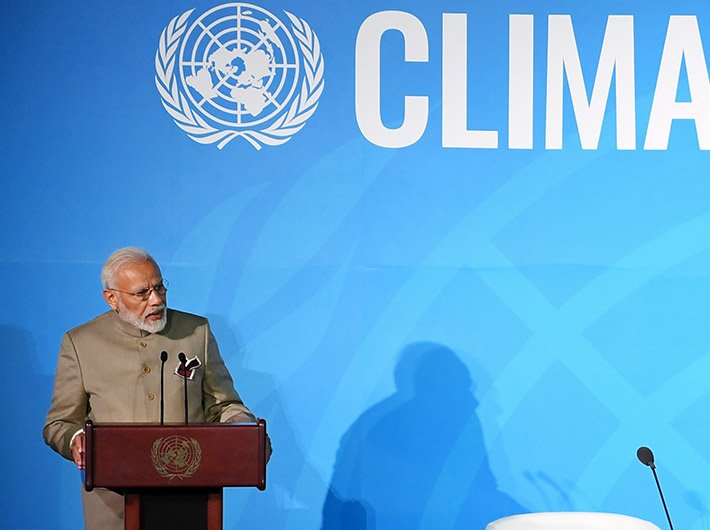
The time for talking is over; the world needs to act now. That was the message prime minister Narendra Modi delivered at the Climate Action Summit 2019 during 74th session of UNGA in New York.
“Various efforts are being made by different countries to fight climate change. We must accept that if we have to overcome a serious challenge like climate change, then what we are doing at the moment is just not enough. What is needed today is a comprehensive approach which covers everything from education to values, and from lifestyle to developmental philosophy. What we need is a global people’s movement to bring about behavioral change,” the prime minister said in Hindi.
“The respect for nature, the judicious use of resources, reducing our needs and living within our means have all been important aspects of both our traditions and present day efforts. Need, not greed, has been our guiding principle,” he said.
Presenting “a practical approach and a roadmap” from India’s experience, he highlighted the following developments:
* India is going to increase the share of non-fossil fuel, and by 2022 we plan to increase our renewable energy capacity to much beyond 175 GW, and later till 450 GW.
* In India we have made plans to make our transport sector green through e-mobility.
* India is also working to considerably increase the proportion of the biofuel blend in petrol and diesel.
* We have provided clean cooking gas to 150 million families.
* We have launched the Jal Jeevan mission for water conservation, rainwater harvesting and for the development of water resources. India is going to spend approximately 50 billion dollars on this in the next few years.
* On the International forum, almost 80 countries have joined our International Solar Alliance campaign. India and Sweden together with other partners are launching the Leadership group within the Industry transition track. This initiative will provide a platform for governments and the private sector with opportunities for cooperation in the area of technology innovation. This will help to develop low carbon pathways for industry.
* In order to make our infrastructure disaster resilient, India is launching a Coalition for Disaster Resilient Infrastructure. The PM invited member states to join this coalition.
Modi also referred to his latest campaign against the single-use plastic. “This year on the occasion of India’s Independence day on 15th August, we called for a people’s movement to end the use of single use plastic. I hope that this will create awareness at a global level about the harmful effects of single use plastic.”
He also announced that he was going to inaugurate solar panels on the roof of the UN building, funded by India at a cost of 1 million dollars, on Tuesday.
Meanwhile, a new initiative was launched at the Summit to help guide the world’s heaviest greenhouse gas emitting industries toward the low-carbon economy.
India and Sweden together with Argentina, Finland, France, Germany, Ireland, Luxembourg, the Netherlands, South Korea and the UK, as well as a group of companies including Dalmia Cement, DSM, Heathrow Airport, LKAB, Mahindra Group, Royal Schiphol Group, Scania, SpiceJet, SSAB, ThyssenKrupp and Vattenfall, announced a new Leadership Group for Industry Transition that will drive transformation in hard-to-decarbonize and energy-intensive sectors.
In a statement Modi said that “each one of us has to discharge climate responsibilities based on our situations and capacities. I hope that work under the industry transition track will facilitate early diffusion of technology and support to developing countries in this journey”.
Addressing a press conference, environment minister Prakash Javadekar said that the last two days had seen major takeaways including the decision that heavy industries who are doing their bit on their own, without any external help, have decided to have a low carbon path.