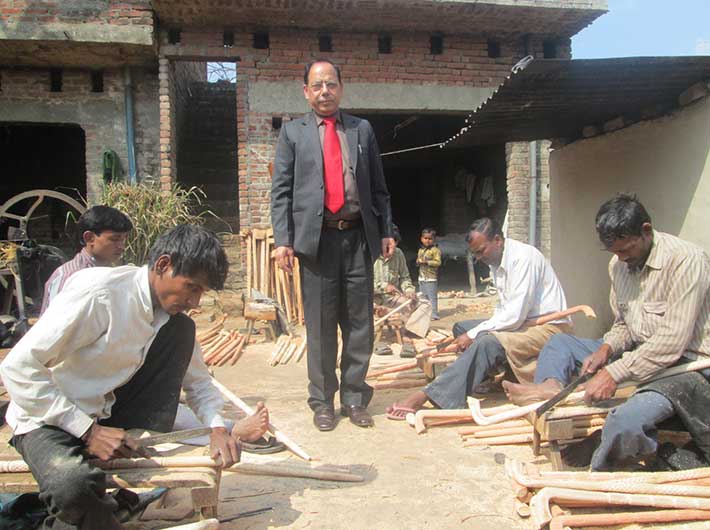
Financial inclusion was not a word the locals of nondescript Nainpura Sarai village in UP’s Bijnore district had heard of – till PNB came calling to adopt the village, and change lives of its inhabitants
Every time a walking stick saves an old man from falling over, somebody in this small village in Bijnor district of Uttar Pradesh receives silent blessings. Hands that tremble over the sturdy stick travel in a mirage of time to draw reassurance from the hands that had crafted it.
Nainpura Sarai, a nondescript hamlet with a headcount of 4,000, has been a village of stick-makers for decades. According to village elders, 40 years ago the craft of stick-making was practised by a single family here which spread to all others in the course of time. However, Bijnor district has been known for its wood craftsmen for centuries.
But these stick-makers were themselves on the verge of a fall and needed support only two years ago. Facing lack of education, entrepreneurial skills and neglect of policymakers, the cottage industry here faced closure and needed to be rescued. Financial assistance was hard to come by. Moneylenders chipped in and made a killing at the cost of workers’ profit. For political leadership, reviving the moribund industry was nothing more than a poll promise to be repeated every five years. Craftsmen were reduced to labourers who were paid just Rs 3 for making a stick which involved a lengthy, strenuous procedure. All this led to a sharp decline in the fortunes of inhabitants in this Muslim-dominated village.
Take the case of Mohammed Iqrar who until two years ago worked as a labourer in a stick-making unit and could earn a maximum of Rs 150 on a favourable day. Being a third-generation stick-maker, he knew the tricks of the trade on the back of his hand. However, lack of ready capital prevented him from starting his own venture. Then one day, he saw a camp of Punjab National Bank (PNB) set up in his village and visited it. The bank, as part of the financial inclusion programme, had decided to adopt Nainpura Sarai along with three other villages in the district and give fillip to the sinking stick-making industry here.
In fact, in a meeting between the state-level bankers’ committee (SLBC) and state administration, it was decided that banks will adopt several such villages two years ago. In the meeting, seniors of all the public sector banks sat with the state administration and discussed ways to improve financial inclusion in the unbanked areas. Since PNB is the lead bank in the district, it was asked to adopt Nainpura Sarai. Once the bank adopted the village, it set up a camp there to disseminate information about banking facilities. Villagers asked questions about loans and opening accounts.
At the camp, Iqrar received a flood of information. With gleam in his eyes, he listened to every minute detail. His dream of becoming an entrepreneur seemed a step away. Under the central government’s poverty alleviation porgramme, Iqrar got a loan of Rs 1 lakh, which included a subsidy of Rs 35,000 from the government. The bank people helped him set up his own stick-making unit. He quit his job as labourer and was soon up on his feet cantering to success. Today, Iqrar earns more than Rs 500 a day. His annual turnover has gone up to Rs 3 lakh and he has begun repaying the bank’s loan in monthly instalments.
Iqrar is now a valued customer for the bank. “We decided to adopt this village because this village just needed monetary support. After getting finances from the bank, most of the villagers are now working on their own,” says RP Jairath, the chief lead district manager (LDM) of PNB in Bijnor.
Nainpura Sarai is 45-minute drive away from Bijnor city. From the logs of wood, villagers here conjure up beauty and grace. They split and shape the timber until it begins to gleam. The raw material, mostly eucalyptus and sheesham wood, is available in abundance here. Stick-making involves a complicated process with more than a dozen steps spanning over a full day. Craftsmen spit each log lengthwise into narrow wooden shafts which they shape, design and afterwards dry on fire. Finally, the pale, white wood is polished to the texture of wood.
Iqrar is not alone to benefit from the bank’s presence in the village. “There were a total of 73 persons who benefited from PNB’s loan scheme. Out of 73, 53 villagers were having artisan cards,” says Jairath. Like Iqrar, Amir Ahmed, who too had set up his own business with bank’s assistance, begins his day early. By the time, Ahmed breaks for lunch he has already made two dozen sticks. “Four decades ago, just one person was involved into this business here. Today, every household is into stick-making,” says Mohammed Akram, gram pradhan of the village. At least, 3,000 sticks are made here daily – more than 10 lakh annually. Orders are received from all parts of country. Even some of sticks are exported; however, that part is not handled yet by the villagers.
The artisans here are now connected well with the market and PNB which also acts as their mentor in complicated business matters. The initiative has been fruitful for the bank as well. “There are 900 households in the village. Now, every household of the village has an account with the bank,” Jairath adds.
The success is a matter of pride for the bank. “The bank has now taken initiative of business correspondents (BC). There are 112 BCs of PNB active in the district. In Nainpura Sarai, there is also a BC who makes small transactions up to Rs 10,000,” says Jairath.
Other schemes in the village
A sewing machine training centre has also been opened in the village with the help of PNB. The bank has provided 10 sewing machines at the centre where young women come and learn stitching. The trainer’s monthly salary of Rs 3,000 is paid by PNB.
(This story appeared in the March 1-15, 2013 issue of Governance Now)