
One UPA idea NDA is not pursuing: women’s bank

Bharatiya Mahila Bank, launched in 2013, to merge with SBI

GN Bureau | March 21, 2017

#public sector   #Bharatiya Mahila Bank   #State Bank of India   #finance ministry   #NDA   #UPA   #Banking  
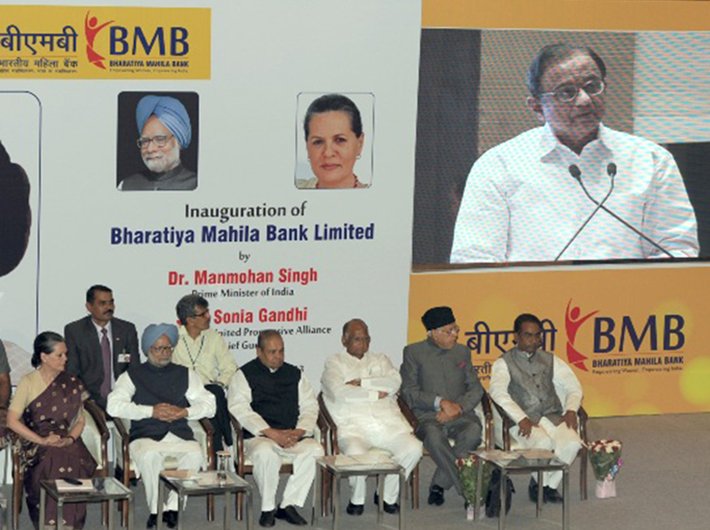
UPA inaugurating Bharatiya Mahila Bank in 2013

NDA has smartly appropriated a slew of UPA initiatives that it had opposed when in the opposition – from Aadhaar to DBT and financial inclusion. However, here is one initiative the government has decided to do away with: the women’s bank.

P Chidambaram had announced setting up of a bank catering exclusively to women in his 2013 budget. Bharatiya Mahila Bank (BMB), the youngest public sector bank, was launched on November 19, 2013, with registered office in Delhi and nine branches.

For the UPA government, BMB was part of its efforts to increase financial inclusion and empower women – and try out this one vote bank as well.

“The vision of the Bank has been empowering women financially. Hence our tagline - Empowering women, Empowering India. Keeping this in view, the Bank has developed a lot of women-centric products to suit to all categories of women right from a hawker at the roadside to a CEO of a big Corporate,” says the bank on its website.

And it has not done badly either. Over its three years, the bank set up 103 branches, covering almost all the states. Its total business reached a figure of about Rs 1,600 crore (Rs 1,000 core in deposits and Rs 600 crore of advances). When the whole public sector banking is suffering from the bad loan and NPA crisis, this bank was earning profit every year, and its NPA was less than one percent.

Usha Ananthasubramanian, its first CMD, had told Governance Now: “It is a huge societal transformation, because women who have been even shy to come out are able to come to a bank and ask for an account. In Indian society the man may earn and be the breadearner but ultimately it’s the woman who runs the household. It is the woman who aspires for improving the standard of living for the family. It is the woman who plans to send children to a better school, have better food, better clothing.

“I would say it is a blessing in disguise for the woman. All these years her money was kept in a masala box. She was hiding it from the man who would otherwise take it away. Only thing she did not know was that her money could multiply. Her Rs 100 can become Rs 105 or Rs 1,000. She never knew that a bank could help.”

However, on Monday, an official statement from the finance ministry said the government had decided to merge the BMB with the State Bank of India (SBI) “to ensure greater banking services outreach to a larger number of women, at a faster pace. The objectives of affordable credit to women as well as propagation of women-centric products need to be quickly achieved through a wider network and lower cost of funds”. 
The decision has been taken in view of the advantage of the large network of SBI among other things, the release said. In a way, the purpose of a women-centric bank is served better under the Pradhan Mantri Jan-Dhan Yojana (PMJDY), since it is increasing financial inclusion at a record-breaking pace. Under PMJDY, preference is given to women for overdraft facility. As many as 73 percent of the borrowers, under the scheme in previous financial year, were women.
 

Comments


Other News

Not just politics, let`s discuss policies too

Why public policy matters Most days, India`s loudest debates stop at the ballot box. We can name every major leader and recall every campaign slogan. Still, far fewer of us can explain why a widow`s pension is delayed or how a government school`s budget is actually approved. That

When algorithms decide and children die

The images have not left me, of dead and wounded children being carried in the arms of the medics and relatives to the ambulances and hospitals. On February 28, at the start of Operation Epic Fury, cruise missiles struck the Shajareh Tayyebeh school – officially named a girls’ school, in Minab,

The economics of representation: Why women in power matter

India’s democracy has grown in scale, but not quite in balance. Women today are active participants in elections, influencing outcomes in ways that were not as visible earlier. Yet their presence in legislative institutions continues to lag behind. The Nari Shakti Vandan Adhiniyam was meant to addres

India will be powerful, not aggressive: Bhaiyyaji

India is poised to emerge as a global power but will remain rooted in its civilisational ethos of non-aggression and harmony, former RSS General Secretary Suresh `Bhaiyyaji` Joshi has said.   He was speaking at the launch of “Rashtrabhav,” a book by Ravindra Sathe

AI: Code, Control, Conquer

India today stands at a critical juncture in the area of artificial intelligence. While the country is among the fastest adopters of AI in the world, it remains heavily reliant on technologies developed elsewhere. This paradox, experts warn, cannot persist if India seeks technological sovereignty.

RBI pauses to assess inflation risks, policy transmission

The Reserve Bank of India (RBI) has begun the new fiscal year with a calibrated pause, keeping the repo rate unchanged at 5.25 per cent in its April Monetary Policy Committee (MPC) meeting. The decision, taken unanimously, reflects a shift from aggressive policy action to cautious observation after a signi


Archives

Current Issue

Opinion

Facebook Twitter Google Plus Linkedin Subscribe Newsletter

Twitter






