
Protests against Citizenship Act across country

Yogendra Yadav, Ramachandra Guha, Prashant Bhushan among many detained

GN Bureau | December 19, 2019

#Prashant Bhushan   #Yogendra Yadav   #Afghanistan   #Bangladesh   #Pakistan   #Citizenship Amendment Act   #Citizenship Amendment bill   #Harsh Mander   #Ramachandra Guha  
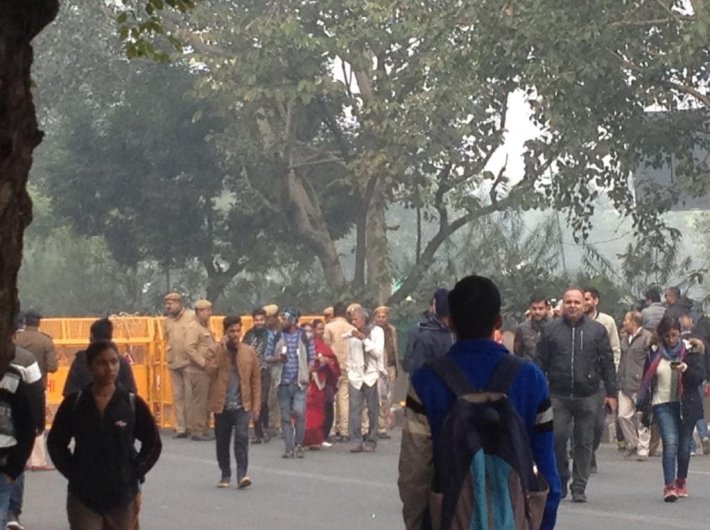
Delhi police clamped down prohibitory orders against protest demonstration on Thursday (GN Photo)

In a coordinated action, protesters against the new Citizenship (Amendment) Act held demonstrations in many cities and towns across the country on Thursday, though in most places police prevented them from staging marches. Section 144 was clamped in some parts, even as telephone and internet connectivity and metro services were affected for a while in select places.

Various organisations had given the call for protest demonstrations on December 19, marking the day when freedom fighters Ashfaqulla Khan and Ramprasad Bismil were hanged in 1927. Authorities in the BJP-ruled, however, pre-empted them by putting key places under Section 144.

In Delhi, Yogendra Yadav and Prashant Bhushan of Swaraj India had announced plans to take out a march from Red Fort to Shaheed Park, police denied them permission for protest, and detained them. They were released by evening. Moreover, Delhi Metro stations in the vicinity were closed, and telephone as well as internet services in parts of the capital were stopped for a few hours.

Elsewhere in Delhi, students of various universities tried to stage demonstrations in Mandi House, where the Left parties had announced their joint protest, and later at Jantar Mantar. Activist Harsh Mander was among those detained by police.

In Bangalore, the police had ordered Section 144 from 6 am Thursday. Historian-commentator Ramachandra Guha was detained when he was addressing a crowd of protesters.
From Mumbai to Kolkata, many cities and towns witnessed protests.

Earlier this week, a section of the students of the Jamia Millia University as well as of other educational institutions had held street protests. Sections of the faculty and students of many IITs and IIMs across the country have also lent their support to the snowballing agitation.

The amended citizenship law aims to grant citizenship to the religious minorities of the three neighbouring countries, Pakistan, Bangladesh and Afghanistan. Critics oppose the granting of citizenship on religious basis and also fear the law can have far-reaching ramifications when clubbed with the proposed exercise of the National Register of Citizens (NRC).

The move triggered demonstrations in Assam in particular, and the northeast in general. The government has maintained the minorities of the country has nothing to fear in the new law, and that the Congress is stoking the protests with misinformation.

Comments


Other News

How Rafi, Raj Kapoor helped pave the way for a great uranium deal

There`s a certain moment in diplomacy that`s too personal to be captured in a communiqué, too small to make the front page, but more revealing than the front page. This week, prime minister Narendra Modi reached Tashkent and, amid the pomp of state visits, managed to evoke the old Bollywood tunes

Distinguishing Fish 1 and Fish 2: The pragmatism behind India’s WTO ratification

 India became the 123rd WTO member to ratify the multilateral Agreement on Fisheries subsidies (AoFS) when it deposited the Instrument of Acceptance for Phase 1 on July 20, 2026. The ratification is restricted to disciplining Illegal, Unreported and Unregulated fishing (IUU), protection for overfished

The 7% growth problem: Why the next 7% will be harder

India has become accustomed to hearing the 7% growth number. It is now less a milestone than an expectation. Yet the paradox is becoming clearer: maintaining 7% growth may be considerably harder than achieving it once. India’s real GDP grew 7.7% in FY2025–26, following growth of 6.5% in FY202

The Constitution cannot be altered: Justice Abhay Oka

Justice Abhay Oka, who retired from the Supreme Court in May 2025, has said that the Constitution of India cannot be altered. Explaining the landmark Kesavananda Bharati judgment (1973) on the basic structure of the Constitution, he said, “This is one judgment that has saved democracy in India.&rdq

How the flora and fauna evolved in the Indian subcontinent

Mammals of India  By A.J.T. Johnsingh and P.O. Nameer HarperCollins India in association with Bombay Natural History Society  

India`s renewable race is moving beyond megawatts

When Shell bought Sprng Energy in 2022, India`s renewable energy market appeared to offer precisely what global energy majors were seeking: scale, growth and a place in one of the world`s largest energy transitions. Four years later, Shell is selling the same business to Aditya Birla Group for an enterpris

Upcoming Conferences


-->

Archives

Current Issue

Opinion

Facebook Twitter Google Plus Linkedin Subscribe Newsletter

Twitter






