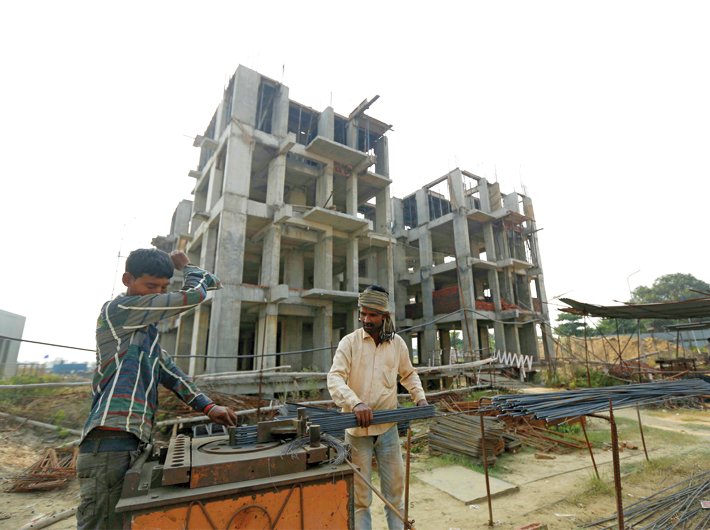
One in every three Indians live in a city but urban housing continues to be a nightmare. Can the real estate regulation bill, 2013 help?
More than 32 percent of India resides in cities. And many more Indians are expected to shift to cities. According to estimates, in 20 years the country’s urban population will equal its rural numbers. Rapid urbanisation, which is the root cause of this malady, has created another problem – huge gaps in urban housing. There is a shortage of 18 million housing units in urban areas, 95 percent of which affects the economically weaker sections and low income groups. On the other hand, as of June 2014 there was combined unsold inventory of 765 million sqft (equivalent to 760,000 two-bedroom apartments), according to real estate reasearch firm Liases Foras. Also, thousands, if not lakhs, of middle and upper middle class families are estimated to be waiting to get the possession of their dream houses – delayed by as many as five years, or more, in some cases. To ensure that people get to buy residential property minus the stress of late possession, legal hassles and fraud by builders, the United Progressive Alliance (UPA) government introduced the real estate (regulation and development) bill, 2013. Aimed at spurring growth in the housing sector, the bill, and the subsequent law, would be crucial to meeting the promises made by the Narendra Modi-led NDA government to provide houses to all by 2022.
In more than six decades of independence, prior to introducing the bill, had legislators never thought of problems that might arise in the real estate sector? They most certainly did. But so far states, and the centre, have failed to protect the rights of the consumer. Had they been effective in curbing corruption by builders, there would have been no need for a national regulatory authority.
Even with a national regulatory authority – the bill proposes to set up one – the lacunae are likely to remain. There are some unanswered questions surrounding the proposed authority. Will the authority have enough qualified people and manpower to dispose of cases quickly, or will it, too, start functioning like Indian courts with high pendency of cases? How can it be ensured that the authority won’t be riddled with corruption? Builders have amassed a great deal of wealth, and, by association, power. Is there any guarantee that they won’t hold sway over the members of the authority?
Also, only residential properties have been included in the 2013 draft bill, even though the parliamentary standing committee on urban development recommended that commercial real estate should also be brought under the ambit of the bill. With commercial projects going largely unregulated, how far will the bill go in its reach? The bill states that the onus would be on the regulatory authority to make recommendations on affordable housing initiatives to the concerned state governments. However, the policy formulation powers being vested in the state government, how much weight would such a recommendation carry?
The problems of the real estate sector are manifold. A clause of the bill stating that the developer has to complete projects in a time-bound manner loses all meaning if the government cannot ensure smooth supply of basic construction material, like cement and sand, which have been in perpetual short supply. The solution would be to use alternative building material, which, in turn, will increase the cost.
Moreover, real estate does not only relate to high-end, affordable or social housing. Slum redevelopment and heritage conservation are equally important aspects of real estate regulation. The authorities are trying to redevelop urban slums that have sprouted over the decades, but, going by recent examples, redevelopment has proved to be a real challenge.
It is yet not clear whether state regulatory bodies will come under direct control of the central regulator, but the bill covers a lot of grey areas that have been left out by most state apartment acts. Also, the bill has met with lukewarm response from builders who are wary that it might be too sympathetic towards buyers. But the minister of housing and urban poverty alleviation, M Venkaiah Naidu, has sought to dispel the fear of over-regulation. “The government does not intend to add one more ‘table’ to the many that already exist in the trail of obtaining necessary approvals. Speaking at the ‘Stakeholders Consultation on Real Estate (Development and Regulation) Bill and Single Window Approval System’ in September, Naidu asserted that the bill did not aim at over-regulation of the sector.
The previous UPA government had tabled the real estate bill in the Rajya Sabha, and it was later referred to the standing committee. In its original form, the bill was strongly opposed by industry. The NDA government now plans to introduce the revised bill in the winter session of parliament.
Amid disconcerting reports of buyers being harassed by builders, the bill shows a silver lining. Not choking the builder community and drying up the sector in the process will, however, be the biggest challenge before the proposed real estate regulator.
Pros
- Timely delivery of flats to buyers
- Builders to spell out accurate project details
- Specifying actual carpet area mandatory
- All clearances compulsory before launching a project
- Separate bank accounts for each project
- Mandatory after-sales service due to structural defects
- Licence compulsory for realty brokers
- Cancelling a sale difficult
- Misleading buyers to invite punishment
Cons
- Past real estate projects excluded from the bill
- Delay in completion mostly due to delayed approval from govt agencies
- No mandatory regulation for projects less than 4,000 square metre
- New project launches expected to be delayed
- No deadline for project approvals
- Registration only for projects over 4,000 sq m
The story appeared in November 1-15, 2014 issue