Modi’s visits to Indonesia, Australia and New Zealand reflect a broader strategic recalibration rather than a series of isolated diplomatic engagements
India appears to be investing fresh dynamism in its Indo-Pacific strategy. At the time when the US, under president Donald Trump, has adopted a conciliatory approach towards China and has changed the name of America’s Indo-Pacific Command to just Pacific Command, India has quietly moved towards consolidating its defense and maritime cooperation in countries around the Indo-Pacific.
Prime minister Narendra Modi’s just concluded Indonesia, Australia and New Zealand visits are a clear indication to this regard. Yet, what has added a new dimension to India’s plan to checkmate China’s growing assertiveness in the region is New Delhi’s firm and bold move to strengthen maritime cooperation with countries in the Indian Ocean Region (IOR) and beyond.
In this context, India’s interest in developing Indonesia’s Sabang Port, a strategically important harbour near the Strait of Malacca, assumes high significance.
Importance of Indonesia’s Sabang Port
Located around 160 km away from India’s Great Nicobar transshipment Port, Sabang Port lies at the Southeast Asian nation’s northern tip of Sumatra Island overlooking the Strait of Malacca. More important than the Strait of Hormuz which caters to only 20% of global trade, the Strait of Malacca is a chokepoint through which 40% of international trade passes.
For China, the Strait of Malacca is considered as the lifeline as around 80% of Beijing’s oil and other shipments pass through this waterway, which serves as the shortest maritime route between the Indian and Pacific Oceans.
Once India and Indonesia sign finer points of their participation in the joint development of the Sabang Port (Jakarta has also evinced interest in participating in India’s mega Great Nicobar project), it will herald a new phase in India’s strategy in the region, say experts.
In fact, together with the Great Nicobar project, which aims to strengthen India’s presence in the Andaman Sea, New Delhi’s planned participation in Sabang Port’s development will give the country a significant elbow room in the area near the Strait of Malacca. Foremost, it will facilitate the country by allowing it to keep a close eye on one of the world’s busiest maritime chokepoints.
Moreover, when China is expanding its footprint across the Indian Ocean Region by constructing a network of commercial and military ports in countries such as Sri Lanka, Pakistan, Myanmar, Kenya, Djibouti, Sudan, Tanzania and Egypt, India’s planned move around the Sabang Port holds immense strategic importance for the country.
Experts say along with the development of the Great Nicobar project, India’s desire to enhance its footprint in Southeast Asian nations like Indonesia, the Philippines and Vietnam through defence and maritime cooperation, aims at building a major shield against China’s aggressive design in the Indo-Pacific region.
To this regard, India and Indonesia’s decision to elevate their existing defence relations through cooperation on the BrahMos missile system, together with an agreement on air-to-air missile cooperation, marks a significant step in strengthening India’s move in the region.
Strengthening strategic partnership in Indo-Pacific
Prior to his visit to Indonesia, Australia and New Zealand, Modi made a trip to Seychelles, an African country which holds immense significance in the world due to its location in the Indian Ocean. Situated near vital Sea Lanes of Communication (SLOCs), Seychelles, an archipelagic nation of 115 islands, is considered as a maritime highway connecting East Africa and West Asia with South Asia and the wider Indo-Pacific.
During Modi’s three-day visit to Seychelles, from June 27 to 29, his second since 2015, India announced providing a special economic package of $175 million, while in conjunction with its broader defence diplomacy, offered a fast patrol vessel, 10 utility vehicles and five laser radial boats to the Seychelles Defence Forces.
Earlier, India gifted and installed six coastal surveillance radar systems to Seychelles. In Seychelles, New Delhi’s eyes are still focussed on Assumption Island. India wants to develop a military base in Assumption Island, but due to protests from local population, the plan has not been converted into a reality so far.
Despite this, India’s continued efforts to enhance its presence in Seychelles through capacity building and other measures, hints at its aspiration to become a key determinant of the geo-strategic future of the Indo-Pacific. Significantly, the region accounts for around 65% of the global population, nearly 63% of world GDP, and more than 50% of global maritime trade. Nearly 95% of India’s trade by volume and around 70% by value is conducted by sea.
Maritime security as bedrock of external engagement
Given these realities, maritime security has become a central pillar of India’s external approach. Against this background, the India-Australia Joint Declaration on Defence and Security Cooperation, undertaken during Modi’s recent visit to Melbourne for the annual summit, assumes considerable strategic significance.
Referring to this, foreign secretary Vikram Misri said, “They constitute recognition that the partnership must evolve to meet changing strategic circumstances, and they reflect a commitment to advancing our defence and security partnership.” Significantly, the 2026 Joint Declaration on Defence and Security Cooperation is seen as a replacement of the 2009 India-Australia Joint Declaration on Security Cooperation.
It commits both countries to consult on defence-related developments in the Indo-Pacific, increase the complexity of their defence exercises, accelerate interoperability and information sharing between defence forces, expand aircraft deployment from each other’s territories, deepen connection between defence personnel through exchanges, education, training and liaison roles and explore opportunities for recruitment of skilled defence workforces.
In addition, the India–Australia Roadmap provides for enhanced information sharing, capability development, and operational coordination. The Indian Coast Guard and Australia's Maritime Border Command have also signed a Memorandum of Understanding (MoU) on maritime law enforcement and maritime domain awareness, further strengthening bilateral maritime cooperation.
The placement of an Indian military instructor at the Australian Defence College during 2028–29, coupled with Australia's hosting of the fourth General Rawat India–Australia Young Officers' Exchange Programme, institutionalised a defence training partnership that had previously been absent.
Arguably, India wants the Indo-Pacific as an area where peace, security and stability must prevail. It does not want the emergence of any bully that could trigger instability and disrupt economic security on its whims and fancy. Just before Prime Minister Modi was to take his Indonesia, Australia and New Zealand trip, China on July 6 launched a ballistic missile deep into the Pacific Ocean.
It created a ripple in the region, as for the first time a Chinese submarine launched a ballistic missile into international waters in a near-full-length flight. China called it a “routine arrangement of the annual training of the PLA Navy.” However, by conducting ballistic missile tests, China sent a loud message to the international community that it intends to shape the Indo-Pacific according to its own wishes and plan. Australian prime minister Anthony Albanese reportedly expressed his concern over this development during Modi’s visit.
In this view, India and Australia’s efforts to firm up strong defence and maritime cooperation between them, underscores their broader strategy to preserve a stable, secure and rules-based Indo-Pacific.
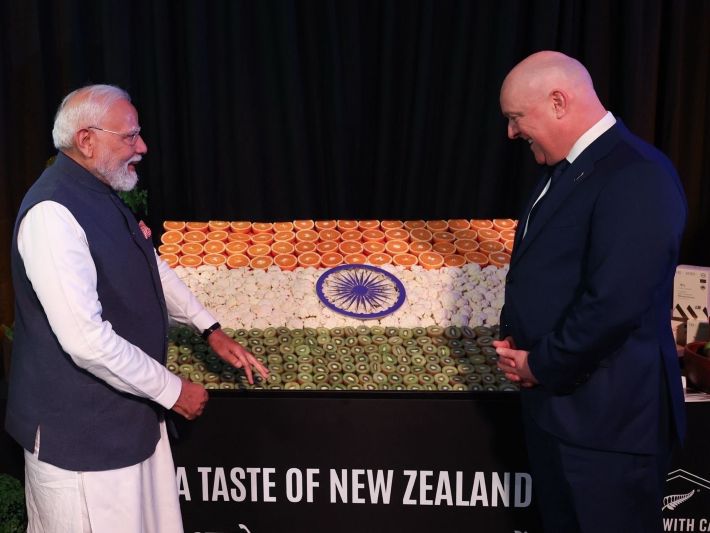
This was apparent when India and New Zealand, during the first prime ministerial visit from India to the Pacific country in 40 years, decided to elevate their bilateral partnership to a strategic partnership. “The decision to elevate the bilateral relationship to a strategic partnership is of course that we are intensifying ties in all tracks of our relationship, but in particular in the defense and security field, and at the political level,” secretary (east) in the ministry of external affairs Rudrendra Tandon said while briefing journalists on the PM’s visit to New Zealand.
Conclusion
Overall, Modi’s visits to Indonesia, Australia and New Zealand reflect a broader strategic recalibration rather than a series of isolated diplomatic engagements. When the regional balance of power is undergoing significant change, India is quietly but steadily expanding its strategic footprint across the Indo-Pacific through a combination of maritime partnerships, defence cooperation, capacity-building initiatives and infrastructure connectivity projects.