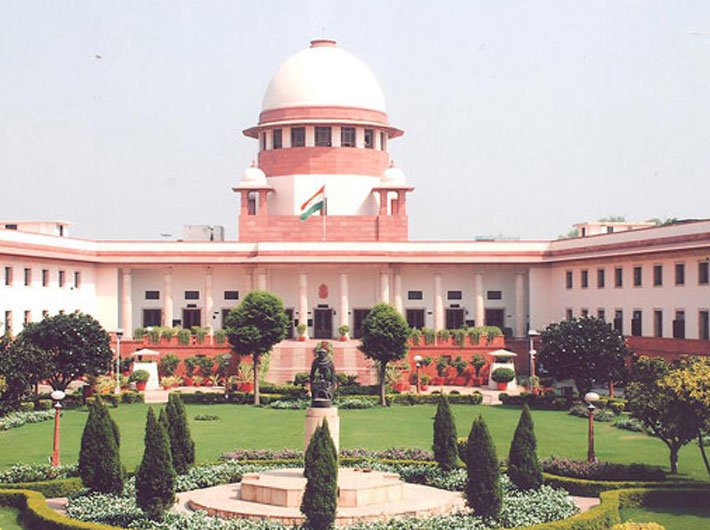
It was a supreme court order on triple talaq that set the ball rolling for the parliament to take up the contentious issue.
The Lok Sabha on Thursday passed a bill that criminalises instant triple talaq and makes it punishable by up to three years imprisonment for the husband.
“We have arrived at the conclusion, that the legal challenge raised at the behest of the petitioners must fail, on the judicial front. Be that as it may, the question still remains, whether this is a fit case for us to exercise our jurisdiction under Article 142, “…for doing complete justice …”, in the matter. The reason for us to probe the possibility of exercising our jurisdiction under Article 142, arises only for one simple reason, that all concerned are unequivocal, that besides being arbitrary the practice of ‘talaq-e-biddat’ is gender discriminatory.”
“A perusal of the consideration recorded by us reveals, that the practice of ‘talaq-e-biddat’ has been done away with, by way of legislation in a large number of egalitarian States, with sizeable Muslim population and even by theocratic Islamic States. Even the AIMPLB, the main contestant of the petitioners’ prayers, whilst accepting the position canvassed on behalf of the petitioners, assumed the position, that it was not within the realm of judicial discretion, to set aside a matter of faith and religion. We have accepted the position assumed by the AIMPLB. It was however acknowledged even by the AIMPLB, that legislative will, could salvage the situation. This assertion was based on a conjoint reading of Articles 25(2) and Article 44 of the Constitution, read with entry 5 of the Concurrent List contained in the Seventh Schedule of the Constitution. There can be no doubt, and it is our definitive conclusion, that the position can only be salvaged by way of legislation. We understand, that it is not appropriate to 270 tender advice to the legislature, to enact law on an issue. However, the position as it presents in the present case, seems to be a little different. Herein, the views expressed by the rival parties are not in contradiction. The Union of India has appeared before us in support of the cause of the petitioners. The stance adopted by the Union of India is sufficient for us to assume, that the Union of India supports the petitioners’ cause. Unfortunately, the Union seeks at our hands, what truly falls in its own.”
“We are satisfied, that this is a case which presents a situation where this Court should exercise its discretion to issue appropriate directions under Article 142 of the Constitution. We therefore hereby direct, the Union of India to consider appropriate legislation, particularly with reference to ‘talaq-e-biddat’. We hope and expect, that the contemplated legislation will also take into consideration advances in Muslim ‘personal law’ – ‘Shariat’, as have been corrected by legislation the world over, even by theocratic Islamic States. When the British rulers in India provided succor to Muslims by legislation, and when remedial measures have been adopted by the Muslim world, we find no reason, for an independent India, to lag behind. Measures have been adopted for other religious denominations (see at IX – Reforms to ‘personal law’ in India), even in India, but not for the Muslims. We would therefore implore the legislature, to bestow its thoughtful consideration, to this issue of paramount importance. We would also beseech different political parties to keep their individual political gains apart, while considering the necessary measures requiring legislation.”
“Till such time as legislation in the matter is considered, we are satisfied in injuncting Muslim husbands, from pronouncing ‘talaq-e-biddat’ 272 as a means for severing their matrimonial relationship. The instant injunction, shall in the first instance, be operative for a period of six months. If the legislative process commences before the expiry of the period of six months, and a positive decision emerges towards redefining ‘talaq-ebiddat’ (three pronouncements of ‘talaq’, at one and the same time) – as one, or alternatively, if it is decided that the practice of ‘talaq-e-biddat’ be done away with altogether, the injunction would continue, till legislation is finally enacted. Failing which, the injunction shall cease to operate.”