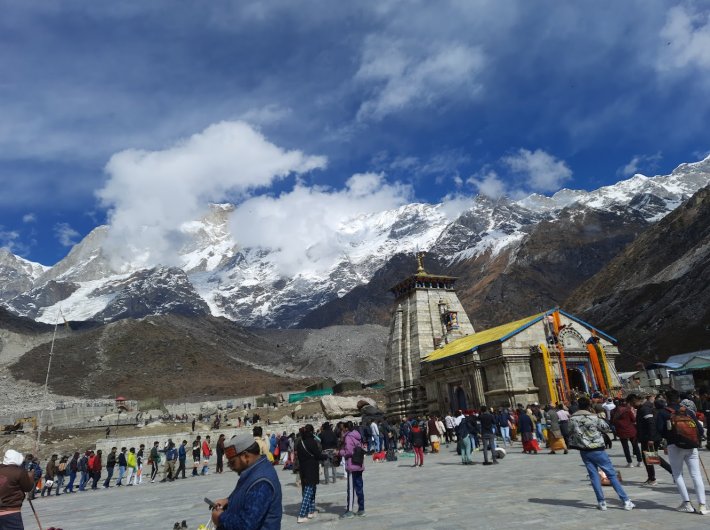
Prime minister Narendra Modi Friday laid the foundation stone of road and ropeway projects worth more than Rs 3,400 crore in Mana village near Badrinath in Uttarakhand. Earlier in the day, he visited Kedarnath and performed darshan and pooja at the temple. He also visited the Adi Guru Shankaracharya Samadhi Sthal and reviewed the work in progress along Mandakini Asthapath and Saraswati Asthapath. The Prime Minister also visited Badrinath and performed darshan and pooja at Shri Badrinath Temple. He then reviewed the work in progress along the Alaknanda riverfront.
Addressing the gathering, the PM expressed his feeling of bliss after performing darshan and pooja at the shrines. “My life became blessed, the mind became happy and these moments became alive,” he said. Recalling the words that he spoke during his earlier visit that the decade will belong to Uttarakhand, Modi said that he has full faith that Baba Kedar and Badri Vishal will bless those words. “Today, I am here among you to reiterate the same resolve with these new projects,” he said.
Noting that Mana village is known as the last village along India’s international border in this part of the country, the PM said, “For me, every village at the border is the first village of the country and the people residing near the border make for the country's strong guard.” The Prime Minister recalled his long association with the area and his continuous espousal of its importance. He also noted their support and confidence. He thanked the people of Mana for their continuous love and support.
Mentioning the two ropeways planned – the Kedarnath-Gaurikund and Govindghat-Hemkund ropeways, the PM credited the inspiration and progress to the blessings of Baba Kedarnath, Badri Vishal and Sikh Gurus. He said devotees all over the world will rejoice in this unprecedented initiative.
The PM prayed for the safety of shramjeevis and other personnel involved in these projects and acknowledged their devotion in these difficult working conditions. “They are doing the work of God, you care for them, never consider them just paid workers, they are contributing to a divine project,” he said.
Recalling his appeal to the nation from the ramparts of the Red Fort to break free from the colonial mindset, the PM explained the need to make this appeal after 75 years of independence and underlined that mentality of slavery had shackled the nation so profoundly that some people in the country considered the work of development in the country as a crime. “The dilapidated condition of these shrines was a clear sign of the slavery mentality,” Modi said.
He further added that even the paths that led to these shrines were in an extremely poor state. “The spiritual centres of India remained neglected for decades,” he continued. “And it was due to the selfishness of the previous governments.” He pointed out these people had forgotten what these spiritual centres mean to crores of Indians. “Today, Kashi, Ujjain, Ayodhya and many more spiritual centres are reclaiming their lost pride and legacy. Kedarnath, Badrinath and Hemkund Sahib are holding the faith while connecting the services with technology. From Ram temple in Ayodhya to Maa Kalika temple in Pavagadh, Gujarat to Devi Vindhyachal Corridor, India is announcing its cultural and traditional upliftment.” He further added that pilgrims will find it easy to reach these centres of faith and the services that are being introduced will make the lives of the elderly easy-going.
The PM underlined another aspect of rejuvenation of these places of faith – aspect of Ease of Living of people in the hilly areas and employment opportunities for the youth of these areas. “Rail, roads, and ropeways bring employment with them and make life easy and empowered. These facilities enhance tourism and make transportation easy in the hilly area. Drones are also being planned to be deployed to improve logistics in these difficult areas,” Modi added.
Praising the local products and efforts of the local self-help groups, he made an appeal to the people of the country to take out 5 percent of their travel budget to buy local products when they go for tourism in any part of the country. “This will give a big push to local products and will give immense satisfaction to you too.”
Background
The ropeway to Kedarnath will be around 9.7 Km in length and will connect Gaurikund to to the temple town, thereby reducing the travel time between the two places from 6-7 hours at present to 30 minutes. The Hemkund ropeway will connect Govindghat and Hemkund Sahib. It will be around 12.4 Km in length and will reduce the travel time from more than a day to only about 45 mins. This ropeway will also connect Ghangaria, which is the gateway to Valley of Flowers National Park.
To be developed at a cumulative cost of around Rs 2,430 crore, the ropeways will be an environment-friendly mode of transport making the journey safe, secure and stable. This major infrastructure development will give a boost to religious tourism, thereby providing a fillip to the economic development in the region and leading to the creation of multiple employment opportunities.
The foundation stones of road widening projects worth around Rs 1,000 crore will also be laid during the visit. The two road widening projects - from Mana to Mana Pass (NH07) and from Joshimath to Malari (NH107B) - shall be another step towards providing last-mile all-weather road connectivity to our border areas. Apart from boosting connectivity, these projects will also prove beneficial from a strategic point of view as well.
Kedarnath and Badrinath are one of the most important Hindu shrines. The area is also known for one of the revered Sikh Pilgrim sites - Hemkund Sahib. The connectivity projects being undertaken show the Prime Minister’s commitment to ease access and improve basic infrastructure in places of religious significance.