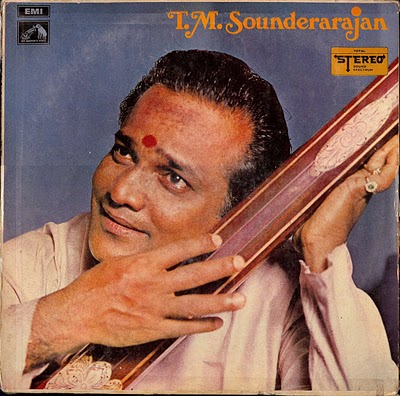
Recounting TM Sounderarajan, called TMS by one and all, the doyen of Tamil music who died on May 25, quietly mourned by lakhs of fans across the globe and ignored completely by Bollywood-obsessed national TV media
To me, TM Sounderarajan goes way beyond the cinema mania that lies latent in the psyche of almost everyone. He was a phenomenon that pervaded and penetrated all aspects of post-independence Tamil Nadu.
His was not just another voice in a huge chorus of singers over the years. While every singer had his own individuality and intrinsic worth, TMS stood out of the crowd in several respects. First, no one reigned as the monarch of music as he had. His dominance was total and lasted the longest. The sheer immensity and intensity of his output is unmatched. Again, his was the voice that made and moulded the careers of many actors; any replacement was a risky compromise.
His voice defied replication, too. While every singer has a close clone in the industry, TMS remains a tough act to follow. Really, he is the gold standard in playback singing.
TMS’s core strength was a god-gifted great voice. But his smartness lay in making his metallic, magnetic timbre malleable as well. His booming baritone could melt like butter. He could elevate and he could depress. He could switch from classical to the colloquial in a jiffy. The versatility, vitality, vigour and vivaciousness of his voice are astounding. His capacity to alter his voice to suit the heroes was legendary.
But a greater skill was his ability to reflect the character of those actors, as also those characters’ changing moods and fortunes within a movie. Even in the span of a three-minute song he could deliver the same lines or words with different effects that daunted the likes of Sivaji. The latter walked into a role only after TMS had already done his bit of ‘voice acting’. MGR perforce had to raise hands and exult to TMS’s peppy prodding.
A vocal gymnast
TMS brought into singing a lot of style and a slew of bold variations at a time when film music was shackled by strict rules. He made the man on the street a music connoisseur. Thanks to his sound training and absolute command over the language, TMS’s could confidently stride into vocal gymnastics that endeared him to legions of listeners.
I have marvelled at the way he rolled words on his tongue, giving them a lilt and tilt that made one an addict. Or over how he could deliver deep meanings straight into your soul just with a nuanced shift in tone. Be it the profundity of philosophy, the pangs of passion, the pensiveness of pathos, a political pitch or plain profanities, all emotions got full justice in his flawless renditions. The BBC once rated his as the most powerful voice.
TMS not only dominated but also defined life in the state for over three decades from the fifties, a period during which communication modes and gadgets remained static and nascent. Since he straddled both cinema and spirituality, twin obsessions of people in Tamil Nadu, his songs formed the musical background to daily chores.
A typical day for thousands in the state began with the devout ‘Karpagavalli Nin’ and ended with the nightly dose of ‘Katti Thangam Vetti’ on Madras A from 10 to 11 pm. In between, he would catch up with you at any and every listening post, from temples to wedding halls to political platforms to tea shops and right down to roadside speakers.
AIR, Ceylon radio and gramophone record companies rode on his rollicking voice.
The voice of nascent Tamil cinema
TMS’s long reign ran in sync with the evolution of Tamil cinema. Starting off in the late forties, he was the foremost pioneer and practitioner of playback singing, then tentatively emerging from the shadows of singer-actors. The advent of MGR and Sivaji placed him on a perfect platform. The mixed milieu of mythological, historical, social and family movies provided him a range of playgrounds.
The treasure trove of Tamil literature and lyrics – from Kamban to Kannadasan – paraded his pronunciation skills. Many a composer found in him an ideal foil to deliver both pristine Carnatic and modern mellisai. His voice heralded movies and hitched them to public memory long after the run. TMS was indeed a grand link between generations, genres and the giants of filmdom.
TMS’s career also makes for some interesting and often tragic contrasts. Both rationalism and religion found articulation through him. His songs gave much political thrust to the Dravidian movement. Paradoxically, it was also his popular devotionals that neutralised the atheistic orientation of that movement. He raised MGR and Sivaji, two opposing poles, to great heights with his voice, but had to lapse into subdued silence and lose his identity to them.
The professional blessing was also a personal bane. The genius who carried the glory and grandeur of Tamil all over the globe had always to fight for recognition back home. The man who lent his vocal service to many hardly had any to speak for him, often rendering him an unsung singer in his prime, unlike the publicity savvy Kolaveri crowd with just fractions of a song to its credit.
The national TV media that run retrospectives on few-film-wonders from Hindi, however, failed to take note of the demise of TMS, who has rendered over 15,000 songs and ruled the hearts of millions for decades. Neither the diehard Tamil champions nor the very vociferous Tamil film fraternity here bothers to set right this wrong note.
Thankfully, his fans more than made up, in person and online. After all, TMS’s pact with posterity was sealed in their hearts!
e-mail the writer at [email protected]