As journalism moves beyond newsrooms and press cards, the state is struggling to recognise who gets to tell the public what happened.
When I read the Delhi Police affidavit saying that reel makers are not "press" and should not get the protection that comes with the word, my first thought wasn't about reels. It was about those people who’ve done the job of a journalist or what they are expected to do without having the distinction or designation of being a journalist. I thought of the stranger in a small town who sends the first pictures of a flood, the passer-by who films a lathi-charge because no reporter was there, the person who first captured the Air India flight that crashed in Ahmedabad, and the source who hands over documents that newsrooms then spend years reporting on.
None of these people carry a press card, and many of them have broken stories that did not come out of a traditional newsroom or from reporters carrying a press card. The affidavit has no room for any of them, and to understand that better, it’s important to first accept how the practice of journalism itself has changed over the years. And in this context, why India might be too far behind in accepting this change.
The sharpest change in journalism came with the internet. When people outside newsrooms could put information in front of the public with no editor in between, it changed how news was disseminated and perceived. Two cases show that moment more clearly than any other.
In 2010, a website run by an Australian activist Julian Assange published a classified video of a US helicopter attack in Baghdad. The months that followed, it released hundreds of thousands of US military logs from Afghanistan and Iraq and around a quarter of a million diplomatic cables. Assange had no newsroom job and no press card. However, both The Guardian and The New York Times built months of reporting on what he released and provided to the media. India was not oblivious to it either. The Hindu ran its "India Cables" series from the same material in 2011.
Three years after WikiLeaks, Edward Snowden, a contractor working for the US National Security Agency, handed reporters documents showing mass surveillance by the US and its allies. Snowden wasn't a journalist either. However, he was the reason journalists had a story. The Guardian and The Washington Post shared the 2014 Pulitzer Prize for Public Service for that coverage, and the files are still being cited more than a decade later.
Neither man fits the traditional definition of a journalist and both changed journalism more than most accredited reporters ever will. Journalism has always been shaped by whatever technology was new at the time. At each of these points, it has been debated whether it is true journalism. In 2020, a 17-year-old named Darnella Frazier filmed the killing of George Floyd on her phone in Minneapolis. Now, by any official definition she wasn't a journalist. But her video set off protests across the world. The impact was so huge that in 2021 the Pulitzer board gave her a special citation. In this case as well, we recognised what the footage did, not who she worked for.
Reels are the latest of these shifts. For a large number of Indians, a short vertical video recorded on a phone is now how they first learn that something has happened. This transition is just like any other that has happened in the past.
A press card, including the PIB accreditation issued by the central government, is a form of clearance and an assurance by the said news organization about its employee. It is in this case that person is then allowed into places where security matters. It could be a ministry briefing, Parliament, the visit of a foreign head of state. If a US President lands in Delhi, the card tells security that this person has been verified and is not a threat. It says nothing about the quality of their reporting.
The card follows the employer, not the work. A reporter who has spent six years at a large channel will usually have one. A reporter who left that channel and has covered stories independently on YouTube for twenty years probably won't. In this context, the question here isn’t about who’s a journalist and who isn’t but about how journalism itself has taken a new form.
We still haven’t accepted journalism has changed
What strikes me most about the affidavit is how dated its thinking is. The capacity of the state to not recognise the shift in this practice is truly shocking. It assumes news still comes from a fixed set of institutions with offices, editors and accreditation, and that anyone outside them is either doing it for monetary advantage or for entertainment.
India’s response to new media has mostly been to control it rather than understand it. The IT Rules of 2021 brought digital news publishers under the Ministry of Information and Broadcasting. In January 2023, the government used emergency powers to block clips of the BBC documentary on the Prime Minister. But this did not deter anyone from accessing the said documentary. Students organised screenings on campuses, links went around on WhatsApp and Telegram, and in all reality, far more people ended up watching it than would have otherwise.
The affidavit on reel makers will probably go the same way. Refusing to call someone a journalist doesn't stop them from filming. And as for protection, that’s the job of the police and a constitutional right. In this case, even a journalist with a PIB card can be reprimanded in an event of misbehavior or misdemeanor. And as such, this does not apply to reel makers alone.
Senior journalist Qamar Waheed Naqvi drew the distinction that the affidavit doesn't. "They shouldn't be called reel-makers. Reel makers are those who shoot themselves and talk about their lives. But anyone who is using the medium to expose the police, authorities, or simply bringing attention to an issue is a journalist. Or a citizen journalist. In this aspect, Delhi Police's statement is absolutely wrong and their failure to distinguish between reel makers and journalists shouldn't deter anyone from questioning the government." He said.
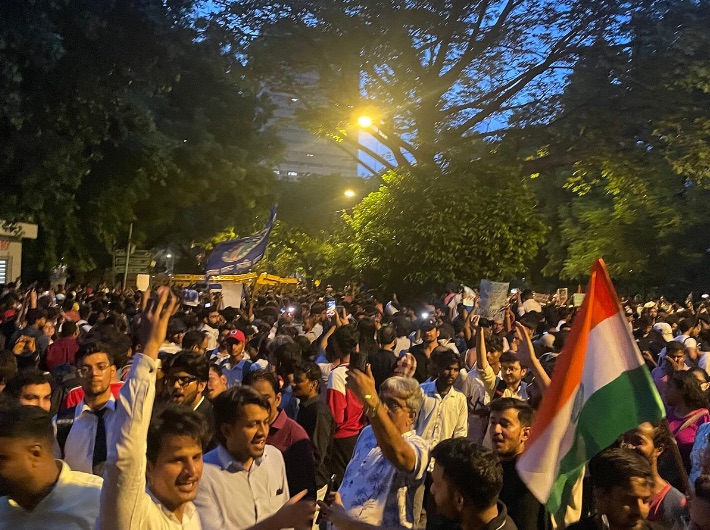
He also pointed out that none of this is new. “Police cannot decide whether a person is a journalist or not. It's not the job of the police. Citizen journalism has existed long before social media where established media houses would request the public to record themselves and help them talk and bring attention to issues. What happened during the Delhi protest was something similar.” Now, none of this means everyone with a phone is a journalist. Most reels are not journalism, and plenty of them spread misinformation. The way to deal with that is to look at the work and not at the device or the employer.
If India needs a definition, it should come from those who understand the profession, such as the Press Council of India, the Ministry of Information and Broadcasting and media organisations. And not from the Police. By the affidavit's reasoning, Assange wasn't a journalist, and neither was the teenager who filmed George Floyd. Newsrooms around the world have spent years reporting on what they put out. The Indian state can either catch up with what journalism has already become or keep losing the argument and make redundant statements about who’s a journalist and who isn’t.