The SIR has already removed about 13 crore names from India’s voter rolls, many of them Muslims, women and the poor. A union minister’s plan to use voter IDs for welfare could cost the same people their benefits too
On October 30, panchayati raj minister Rajiv Ranjan Singh, better known as Lalan Singh, told a national workshop in Delhi that Aadhaar would no longer be the basis for government schemes. His argument seemed simple enough. Aadhaar centres are now in every locality, and anyone can get a card made for anybody within five minutes. Hence, he feared that this could be misused to avail government benefits. Instead, he suggested that beneficiaries would be identified by biometrics plus their EPIC number or the number on the voter ID card. He repeated the idea in Gangtok on November 3. After the backlash, he clarified on November 6 that Aadhaar alone would not be the basis, and that the voter ID card would be “added” alongside it.
It is still unclear exactly which benefits he meant. Some have argued he was referring specifically to the Pradhan Mantri Viksit Gram Swaraj Yojana, which replaces the Rashtriya Gram Swarajya Abhiyan. As of November 16, no formal order had been reported. But even as a suggestion, it raises an uncomfortable question. At a time when the SIR is being criticised for striking names and exclusion, what happens to the people who are still struggling to get their names on the voter rolls?
Rahul Gandhi, leader of the opposition in the Lok Sabha, called the proposal a “conspiracy”. On X, he wrote, “A poor person’s pension cannot be enslaved to their voter card.”
It is hard to disagree, and the argument is fairly simple. Voting is one right, and rations, pensions, and work guarantees are others. Tying one to the other doesn’t strengthen either. It only multiplies the ways a citizen can lose both.
Lalan Singh did not take the criticism lightly. He called Gandhi a “restless soul” who links everything to the SIR, and reminded the Congress of Rajiv Gandhi’s admission that only a fraction of every rupee reached the poor. Under the current government, he said, the full amount reaches the needy. And in this context, he reminded that his suggestion is to make sure real beneficiaries get paid without middlemen.
To see why the suggestions fall apart, it is important to remember what Aadhaar was meant to do. The Aadhaar Act, 2016, describes itself in its very first line as a law for the “targeted delivery of subsidies, benefits and services” to individuals residing in India. Welfare was not a side use of Aadhaar. It was the reason Aadhaar exists.
“If you read the preamble to that, the objects and intent, it’s very clear that Aadhaar was introduced mainly to identify beneficiaries under government welfare schemes,” EAS Sarma, former secretary in the finance ministry, told Governance Now. “This has been going on for quite some time. Aadhaar linkage has been insisted upon, and people are getting their benefits across the country.”
“Suddenly overnight, the minister cannot make a statement and say Aadhaar will not be the basis hereafter, and whoever has a voter ID card will be eligible for these benefits,” he said. “This is wrong, illegal. And actually, it’s a violation of the Aadhaar Act itself.”
If Aadhaar is too easy to get, whose fault is that?
Lalan Singh’s complaint is that Aadhaar has become too easy to obtain. He is not entirely wrong. UIDAI’s own saturation reports have, for years, shown more Aadhaar numbers than people in several states and union territories. In 2015, Delhi stood at 128 percent of its adult population. UIDAI has blamed outdated census figures and migration. But it has also been slow to retire the Aadhaar numbers of people who have died.
None of this is the fault of the pensioner in Surat or the daily-wage worker in Murshidabad. UIDAI is a statutory body that functions under the Union Ministry of Electronics and Information Technology. It decides who runs enrolment centres, how documents are verified, and when numbers are cancelled.
“If spurious cards are issued, which is probably the case in many states, the number of Aadhaar cards is more than the population, but who is responsible for that?” Sarma asked. “It is the government of India. UIDAI acts under the government of India. They make the appointments. They’re responsible.”
The government has also widened Aadhaar’s reach well beyond the welfare beneficiary it was originally designed for. Non-resident Indians with Indian passports can now enrol without waiting out the 182-day residency rule. OCI cardholders and foreign nationals who have lived in India for 182 days in a year can also get one through designated centres. Sarma calls the extension to NRIs “a wrong step”, because the Aadhaar law “is a very specific legislation” meant for welfare.
So here’s how things stand right now. The government built Aadhaar for welfare, loosened its enrollment, opened it to people who are not in line for any welfare, and failed to clean up its own database. After this, it now proposes to fix the problem by adding a second document so Aadhaar cannot be misused for government benefits. It is clear that the leak is in the system, but the cost is being passed to the public.
Aadhaar is not the only government document that has been easy to misuse. Gangster Chhota Rajan, once an aide of Dawood Ibrahim, obtained an Indian passport in the name of a fictitious “Mohan Kumar” from the Bengaluru passport office in 1998. He did this with forged documents and the help of passport officials. He had it reissued at the Indian consulate in Sydney, travelled on it for years, and was finally arrested in Bali in 2015. In 2017, a special court sentenced him and three retired passport officials to seven years in prison.
Faster passports are a welcome change. But when it comes to passports, the state’s answer to fraud has been to tighten its own verification and prosecute its own officials. It’s not making every honest applicant produce a second document. Aadhaar deserves the same logic. If enrollment is broken, fix enrollment.
Why voter ID for welfare schemes doesn’t make sense
Aadhaar and the voter ID are built for different purposes. Aadhaar is meant for every resident, including children. The voter ID is meant only for adult citizens, and is tied to a single constituency on a roll that keeps changing. Swapping one for the other does not guarantee the same rights since both are built for different purposes.
If EPIC is added on top of Aadhaar rather than replacing it, a beneficiary now has to pass both checks. Anyone whose fingerprint won’t scan, whose name is missing from the roll, or whose name is spelled differently on the two records gets stopped.
A voter card is also tied to one constituency, usually the home village. A construction worker from Bihar living in Surat may find he cannot draw the benefits he is entitled to. And children and young people under 18 don’t hold voter IDs at all. “They enjoy social security benefits and welfare schemes, and they cannot get a voter ID card. What will happen to them?” Sarma asked. “There is absolutely no thinking behind it. It’s just an off-the-cuff remark, but you cannot make such an irresponsible remark.”
By October 2026, the SIR had removed about 13 crore names, with a final national roll of about 88 crore expected. The Election Commission says this is a clean-up of the dead, the duplicated and those who have moved away. Independent analyses of who was removed tell a more uneven story. Since the Commission does not publish religion-wise data, most of them rely on name-recognition software. It is noted that Muslims, women and the poor were removed at a far higher rate. Under Lalan Singh’s proposal, this is the list that would also decide who gets money and food from the government.
Sarma goes further. “The SIR itself was very, very faulty and exclusionary, and sometimes I get the feeling it was also targeted very clearly,” he said.
Mistakes on the part of the government make matters worse. Bihar’s SIR marked living elderly voters as dead. On a voter list, that costs someone a vote. But you tie this to welfare, it becomes a stopped pension. Moreover, the burden of proving you are alive falls on the poor person who is least able to travel and argue. It means weeks and months of going from office to office, and sometimes to court, with no pension or ration in the meantime.
Welfare that depends on the electoral roll invites fear, and fear keeps people from raising their voices against injustice. Panchayat schemes are also run close to local power. Giving local officials one more document to question and one more list to check hands them an unjust advantage over whoever is on the wrong side of the sarpanch. This creates bias and a division in the society.
“They’ve used the SIR to exclude people first, and then try to extend that exclusion to welfare benefits. This is something very, very serious.” Even if some of those excluded were immigrants, he added, international human rights law does not let a state strip people of basic rights because of their nationality. Pushing ahead, Sarma believes, risks “triggering a huge humanitarian crisis across the country.”
Lalan Singh’s worry that Aadhaar is too easy to obtain is a real one. If anyone can get an Aadhaar in minutes, it is weaker as proof. But the fault lies with the agency that issues it and not the public. And the accountability here should fall on the government rather than the public. The people of India cannot bear the burden of a mistake made by the government.
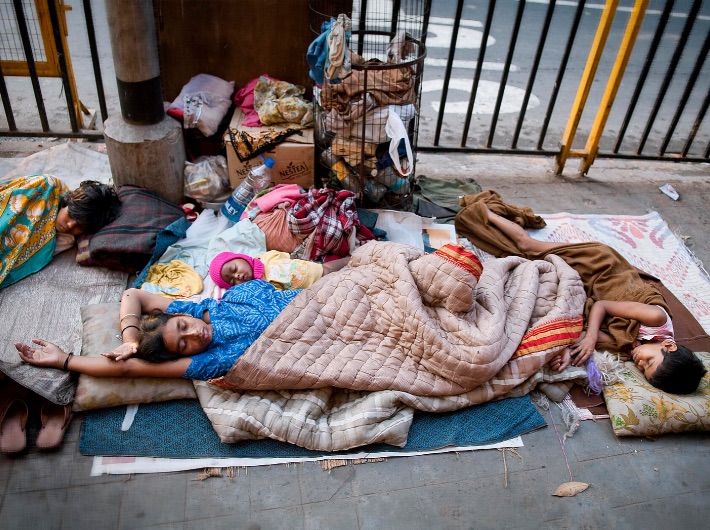
Photo: Courtesy File:Kolkata (4131122903).jpg - Wikimedia Commons