High literacy did not stop HIV. Care and concern are the need of the hour
In Mizoram, more than nine in ten people can read. Anyone there can find out how HIV spreads and how to protect themselves. Yet Mizoram has the highest rates of HIV patients in the country. If education were enough, this would’ve been solved long ago, but it was not. The answer tells us something about India’s northeast, and about how fear can do more damage than a virus.
India has the third largest population of people living with HIV in the world. Even then, the adult infection rate across the country is low. That is the paradox. The national figure hides an epidemic packed into one corner of the map. Mizoram, Nagaland and Manipur carry high infection rates. Meghalaya is also combating its rising numbers. In this region of hills and borders, the virus has travelled along several routes.
Why high literacy did not help
Literacy gives people the ability to learn, but it does not make sure the right message reaches them. Early messages about HIV were built on fear, with warnings that HIV/AIDS kills, and they did not explain how people could protect themselves or live well with the virus. They made people think that sex and drug use are also hard topics to speak about openly in close communities.
As a result, many families and schools avoided them. Homes and schools are exactly where these talks should begin, yet in many places they are the quietest spaces of all. Parents feel that speaking about sex or drugs will somehow push a child towards them, so they say nothing. Teachers skip the chapter, or rush through it with a blush and a hurried page-turn. Students learn very quickly that these are topics you do not ask about.
So, the questions do not disappear. They just move to friends, rumours, where the answers are often wrong. It is treated like a taboo. Good marks do not teach a person that testing is free, that treatment can give them a long life, or that there is nothing to fear from sitting beside someone living with HIV.
Two maps, one picture
If we look at two maps, the first shows the routes that drugs travel on which is the Golden Triangle, where Thailand, Laos and Myanmar meet. It runs through the hills and thick forest along the Myanmar border, through towns like Moreh in Manipur and Champhai in Mizoram.
The second shows where HIV is found in India.
If we lay one over the other, they are almost the same picture. That is no accident. A trade that was once about opium and heroin that now deals in synthetic drugs did not just pass through, it stayed in the towns along the way. Drugs became cheaper, easier to find, and closer to home. Young people began to use them. Many of them injected.
One shared needle is all it takes.
By the late 1980s and early 1990s, the virus had taken hold in Manipur. In the rest of India, HIV travelled mostly through sex. Here, it arrived through the needle first. From those who injected, it went to their partners. From their partners, to families. Then to women and children who had never touched a drug.
The real wall
You cannot catch HIV from a handshake. You cannot catch it from a shared meal or a shared cup either. Almost everyone in the Northeast knows this. The facts are easy to find, and people here can read them. And still, people pull their hands back.
Say the word ‘HIV’ in a small town, and many people think they already know the story. He must have been sleeping around. She must have been careless. It must be their own fault. It is a quick judgment. It is also very often wrong.
The label does real damage. A wife who is infected by her husband is often blamed, as if she brought it home. A mother is whispered about. A young man is told he has shamed his family. People start to sort those living with HIV into two groups, the innocent and the guilty. The innocent get pity. The guilty get silence.
This is why the stigma is so heavy even in a place where everyone can read. Facts can tell you how HIV spreads. Information alone does little to change the moral judgment attached to HIV, which is the belief that those who contract it are at fault. In close communities where family name and reputation matter a great deal, that belief can be even stronger. Nobody wants to be the family people talk about.
That is the answer to the puzzle. Stigma.
Education told people how HIV spreads. It did not take away their fear of the person who has it. For someone who tests positive, the virus is only part of the problem. The bigger one is what comes next. Families hide the diagnosis. Neighbours keep their distance. People living with HIV can be treated harshly at home, in school, at work, and sometimes even in hospitals, the one place where they should feel safe. Some lose their jobs. Some are pushed out of their homes.
Think about what this teaches everyone watching. It teaches them that the safest thing to do with HIV is to say nothing, to know nothing, and to be seen near nothing.
The test nobody wants to take
Imagine a young man who suspects he is infected. A test would give him an answer. It would also change how everyone looks at him, perhaps for the rest of his life. So, he decides he would rather not know.
It sounds like a personal choice, but it is not. Without a test, there is no treatment. Without treatment, the virus can keep passing from one person to the next, and no one sees it happening. One silence becomes a chain, and the virus keeps spreading.
The cruel part is that this was never necessary. A person on proper treatment can live a long and healthy life and can stop the virus from spreading. The help exists, but stigma stands in the doorway and keeps people from reaching it.
Why young people turn to drugs where liquor is banned
In states like Nagaland and Mizoram, strict alcohol prohibition has inadvertently collided with geography and economics, pushing a generation of young people toward a far deadlier crisis: illicit drugs. Situated along porous international borders with Myanmar on the edge of the notorious Golden Triangle, both states sit directly on major trafficking corridors where heroin and synthetic pills are cheap, abundant, and easier to source than smuggled liquor.
Public health experts point to a stark substitution effect while alcohol is bulky, odorous, and risky to transport across dry-state checkpoints, narcotics and pharmaceutical opioids are compact, easily concealed, and far more lucrative for traffickers. Inside these communities, the supply meets a growing demand fuelled by high youth unemployment, a lack of recreational outlets, and mounting mental health pressures.
Left with few economic prospects and cut off from regulated alcohol, many young people driven by peer influence and a desire to escape daily stress turn to easily accessible cough syrups, sedatives, and eventually injected heroin, turning dry states into frontline battlegrounds against substance abuse.
How the state agencies are doing on rehabilitation
As the drug problem escalates, the state governments of Nagaland and Mizoram are making attempts to transition from a policing style of disaster management to a public health rehabilitation model, which might yield some achievements but has big shortcomings at the systemic level.
Driven by the national programme, Nasha Mukt Bharat Abhiyaan, both governments are expanding detoxification services, while Mizoram has received national attention for its demand prevention efforts investing heavily in the construction of such facilities as the 200-bed Hulhliap center near Aizawl. Nagaland has introduced de-addiction units and policing efforts in the districts.
All the efforts seem to fall short on practical grounds as the authorities need to rely on religious institutions, tribes, and cash strapped NGOs in most cases when delivering long-term services. Despite some progress in treatment and rehabilitation offered by the towns of Dimapur and Kohima, the rural areas remain unattended when it comes to treatment. Nevertheless, even those with access to state rehabilitation services rarely receive any help once they finish detoxification as there is a shortage of vocational programs and jobs for recovering addicts.
The story of HIV in the Northeast is not one of ignorance. It is the story of a region where geography brought drugs close, where fear kept people quiet, and where help has not always reached those who need it most. Education has to go beyond facts and teach acceptance. Rehabilitation has to reach more people and support them after they leave. Most of all, a person living with HIV or struggling with addiction has to be seen as someone who needs care, not someone to avoid. Until that changes, the numbers will be slow to fall.
So the question is not whether people know. It is whether they will act on what they know. Whether a neighbour will sit at the same table, a family will keep a son at home, and a young man will walk into a clinic without fearing what comes after. All without thinking twice.
Chentiru Imchen is pursuing masters in Advertisement and PR at Sharda University.
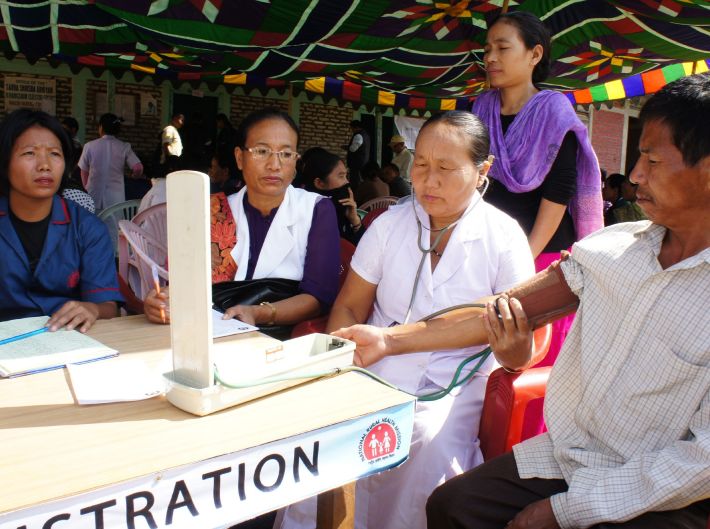
Photo: Couresy: https://commons.wikimedia.org/wiki/File:A_free_medical_camp_during_Bharat_Nirman_Public_Information_Campaign_organised_by_PIB,_Imphal,_at_Khangshim,_Chandel_district,_Manipur_on_October_30,_2013.jpg