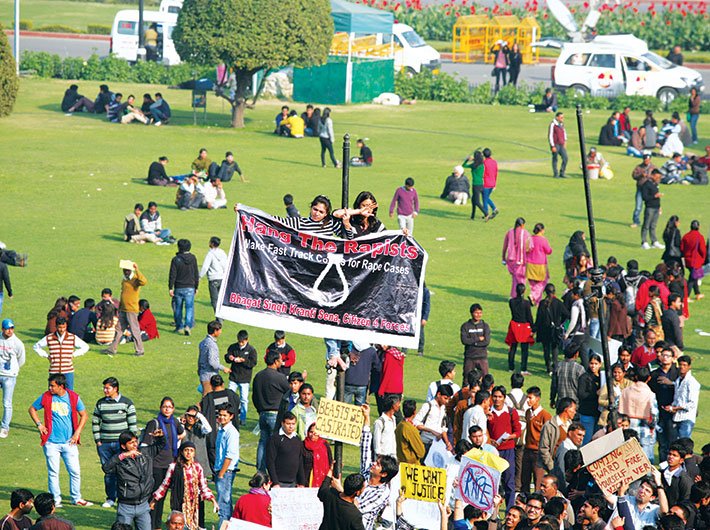
The rape of a girl by a cab driver in New Delhi has once again reminded us of Nirbhaya. For sure, the Nirbhaya rage and rallies had broken the culture of silence; however, repeated cases of coercion against women, either on the streets or in homes, indicate strain that arises due to failure of good governance in an unequal society. The extent and form of coercion is a reflection of bad governance. Either by an individual or a political party, it is always unfair, avoidable, and cannot be overcome without public action. Reforms or solutions, thus, lie in understanding the paradigm of bad governance that percolates a culture of silence.
Politicians have disgraced themselves with remarks on changing lifestyles of women as cause of violence against them or naming religious conversion as mainstreaming. These consistent and coherent voices of the powerful elite have perturbed the good governance discourse. The most common opinion suggests that the act of rape is the patriarchal backlash to growing feminism and women’s emancipation.
It is important to understand why irrespective of the place, violence against women is common and increasing every day. According to the National Crime Records Bureau (NCRB), every day 93 women are raped in India. The number of reported cases of rape increased from 24,923 in 2012 to 33,707 in 2013. Violence or violation occurs when a sense of impunity prevails among the perpetrators due to ineffecive police and judiciary. Secrecy and stigma, on the other hand, exacerbate inter-related cultural impediments among the victims.
Therefore, a more systemic approach would be to recognise rally and rage as a source for reform. Increasing police numbers may not help in a nation of one billion. One cannot wait to sensitise the police system to be gender-neutral, which is a long-term solution. And weeklong trainings may not transform their notion of masculinity. The strategic task is to find out more sustainable solutions.
As Albert Einstein said, “The significant problems we face cannot be solved at the same level of thinking we were at when we created them.”
In the police system, the following areas need urgent change. The police system is more like a stratified caste and class system. Its priority has been to resolve murder and other high-profile cases. The police need to revamp their stratified priority for crime.
The police till date tends to be an exclusive, closed system. Control through police cannot be preventive till it institutionalises social collateral. Today, private guards are more in number than the police, however, there is no systematic attempt by the police to engage with these guards, except on a case-by-case basis termed as community policing when police seek information. This engagement with guards as mere bearers of information cannot prevent crimes; it can at most solve crimes. Police should instead spread ears, eyes and hands by evolving a strategic framework of engagement with these private guards. The framework can work on three ‘P’ principles: prevent, protect and promote safety. By building a system such as medical system where nurses, paramedics, and doctors work for a common and collective goal. These guards should be brought together within the information-and-investigation network. This might also stop perpetrators who gain confidence for nascent opportunities of crime.
Unlike small towns, where identities of people are well known, metros are vulnerable with a floating population. With the increasing numbers, it is difficult to check every cab. Very often, cars are sub-contracted on lump sum basis. The crime can be curtailed by creating a regulatory control for providers such as MERU, EasyCabs, Uber, and individual cab service providers. Depending on the nature of crime, negative points system should be created. Heinous crimes, such as rape, must automatically freeze one’s right to drive forever. Similarly, accidents, jumping red lights, over-speeding must lead to accumulation of points resulting in time-bound curb on the offenders’ right to drive. Like it happens in many countries, an offender on every violation loses points and accumulation of predetermined threshold freezes the right to drive for fixed number of years. Ultimately, regulation must be tied with financial loss to the perpetrator.
Overall, there is a need for the conception of a responsive society or institutions which could be tightly knitted with series of interlocking relationships, mutually respecting each other and contributing to social-support system. Due to over-dominant individualistic accumulation of wealth and limited priority to collective value of social exchange, shared values and social pressures have evacuated. Divergent thoughts exist, conflict of values persist, and social collateral diminishes. In such a state of transformation, the role of the government is pivotal in promoting public action, be it freedom, dignity or security to its citizens.
Nirbhaya died in silence – a silence that spread the consonance of ‘strain’ across the nation. Her death still has the potential to reduce the vacuum that propels violence against weaker sections. The goal of the Nirbhaya mission is freedom and dignity for every individual in society. For promoting the good-governance paradigm, people in power must focus to create a society of Nirbhayas. Good governance is an endeavour where the powerless citizen becomes an official, i.e., a person with duties and obligations – not to forego private interests in the name of public duty, but also to get the rulers to do what they should do.
Despite the BJP’s phenomenal national success, and more recently in Jharkhand and Jammu and Kashmir, if anything has the potential to diminish its popularity, it would be its action or inaction on ‘coercion’, be it the issue of a woman’s safety or religion of an individual. The past liabilities of the BJP constantly remind it that young India is not silent anymore. If it can give majority, it has the potential to convert it into a minority. The support to majority was born to improve the state-and-society relationship – implying that the role of the government is to create a national ethos. The recent state election results are a testimony to an outcome of repeated endeavour to instill good governance.
Any deviation from the agenda of good governance will make BJP unsustainable.
The coming elections of Delhi will be a testimony to good governance as a source of political power. Any deviation that goes against the principles of good governance may cost the BJP heavily. On every failure of the BJP and AAP, the Congress and independent candidates are expected to rise. Therefore, the BJP must refrain from politics of coercion or conversion, while AAP should rise above collision and reactive politics. Populist parties such as BJP and its allies adopting religious revivalist options; AAP advertising on FM radio to install one security guard in every bus to help women, will not work anymore. Every political party must understand that the irony of the current governance paradigm is that those who refrain from and are scared of the judiciary and police are the weak and vulnerable; the rich and powerful anyway know their way! Creation of parallel architecture of police or religious conversion is not a solution in today’s complex society. Rather, creation of opportunities for income and conversion of problems related to safety and dignity will be a sustainable solution for the desired political remittance - a remittance to instill and install Nirbhaya.