
Laura Spinney’s ‘Proto’ is an exciting, accessible story of the birth and spread of Indo-European languages
GN Bureau | July 7, 2025
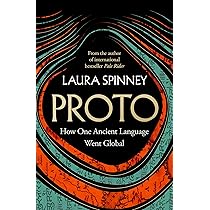
Proto: How One Ancient Language Went Global
By Laura Spinney
Distributed in India by HarperCollins India, 352 pages, Rs 599
 India is home to more than 1,600 languages that belong to, exceptions apart, four major language families. Hindi, Punjabi, Gujarati, Marathi, Bangla and Odia, among others, come from the Indo-Aryan family. Dravidian includes the four major languages of the south, the Austro-Asiatic languages such as Munda are spoken in many parts of the central as well as south and east India, while the Sino-Tibetan languages are the ones spoken mainly in the northeast.
The Indo-Aryan (IA) family, the largest by the number of native speakers, was once represented by Sanskrit, the subject of many tall claims on social media. Many wish to believe it is the oldest language in the world. It cannot be – it’s too recent in the scale of language evolution. The IA is part of a larger family, Indo-European (IE), which of course includes most of the major languages of Europe today.
There are several language families in the world – the count ranges from 140-odd to 400-plus, but what is noticeable is that the IE covers nearly half the world population. Now, IE too would have a predecessor. That goes back in time for which no direct records can be available, but linguists have been researching a hypothetical language (or languages) that was the mother to this family. It is called Proto Indo-European (PIE). That is the reason why we come across well-known family resemblances between, say, Sanskrit and English – the words for mother, daughter and so on.
Born in the Ukrainian steppes some thousands of years ago, PIE expanded its footprint in east and west with the migration of its original speakers. The language has been dead for long, and researchers today can only reconstruct parts of it. But this is the source of our civilization, our culture.
Laura Spinney, an acclaimed science journalist, tells the fascinating and exciting story of the PIE and how it came to dominate the world. Her previous works include ‘Pale Rider: The Spanish Flu of 1918 and How it Changed the World’. ‘Proto’, with its sweeping but reader-friendly narrative, is an ideal introductory book on this subject. She retraces the Indo-European odyssey across continents and millennia, taking the reader along on travelling the length of the steppe, navigating the Caucasus, the silk roads and the Hindu Kush. She retraces the epic journeys of nomads and monks, warriors and kings – the ancient peoples who carried these languages far and wide (including to India).
These voyages are interwoven with her talks with experts on their latest findings. Earlier, this was the domain of linguists and archeologists, but now geneticists have joined to find the missing pieces of the puzzle. Advances in various technologies have also helped in this interdisciplinary confluence. Spinney too brings together cutting-edge genetic research (like ancient DNA sequencing) with traditional linguistic reconstruction methods.
Along the way, ‘Proto’ also weaves together cultural threads, exploring how PIE-speaking peoples shaped mythology, trade, and governance across regions. It has a contemporary relevance too, as the author draws parallels between the language spread in ancient times and linguistic globalisation, especially of English, today. The linguistic detective work – a deep dive into how PIE is reconstructed through sound laws, grammar comparisons, and etymological patterns – is of course the most gripping part of the narrative.
Readers in India would be interested in the part Sanskrit plays in this saga. ‘Proto’ places Sanskrit as one of the earliest Indo-European languages, alongside Mycenaean Greek and Hittite. It thus has a central role in reconstructing PIE, as it has a rich textual corpus dating back to the Rigveda (roughly 1500 BCE), preservation of its grammatical features and systematic phonology. Such readers might wish ‘Proto’ offered more on Sanskrit. Yet, what it says is enough to provide a broader perspective to current identity politics in India, with languag being a key marker of identity.
While the book revisits the territory well explored by ‘The Horse, the Wheel, and Language’ by David Anthony, it takes into account a larger variety of evidence and arguments as well as most recent developments in the field. Also, ‘‘The Horse, …’ was meant for a specialised readership, whereas ‘Proto’ is more accessible for all curious readers – including linguists, archeologists and geneticists themselves who are not likely to be well versed in the other two branches of knowledge.
The extraordinary transaction volumes and value (₹29.82 Lakh crore in August 2026 alone) of the Unified Payments Interface (UPI) have made it not only an Indian success story, but a global one. In 2024, UPI accounted for nearly 49% of the world’s real-time payment transaction volume, with more th
Diplomacy is akin to an art, wherein the summitry, conflict resolution and negotiations form apt constituents of the entire context of deal making and “playing for keeps” in the international arena. The Xi-Trump summit in Washington last week, in which the American president broke all conside
Moving to Delhi-NCR for education can be an exciting experience for students from Northeast India. It gives us a chance to meet new people, experience a different culture and become more independent. But living away from home also comes with challenges that people who have not experienced them may not al
The government has reduced the Basic Customs Duty (BCD) on major imported crude edible oils with a view to moderating domestic edible oil prices, providing relief to consumers and mitigating inflationary pressures arising from the sharp increase in international edible oil prices.
In his opening address at the 18th BRICS Summit in New Delhi on September 12, prime minister Narendra Modi did something India`s diplomacy has been building towards for three years: he moved the ‘Voice of the Global South’ from a slogan to a work plan. Addressing the leaders, he argued that t
The Pradhan Mantri Jan Arogya Yojana (PM-JAY), a welfare scheme which covers approximately 45 crore beneficiaries across India, provides cashless health cover of Rs. 5 lakh per family per year. It is the largest health insurance scheme which helped crores of poor families by reducing out-of-pocket expend











