
Suraj Milind Yengde’s latest work broadens the scope of inquiry to ‘Dalit Universality’
GN Bureau | December 29, 2025

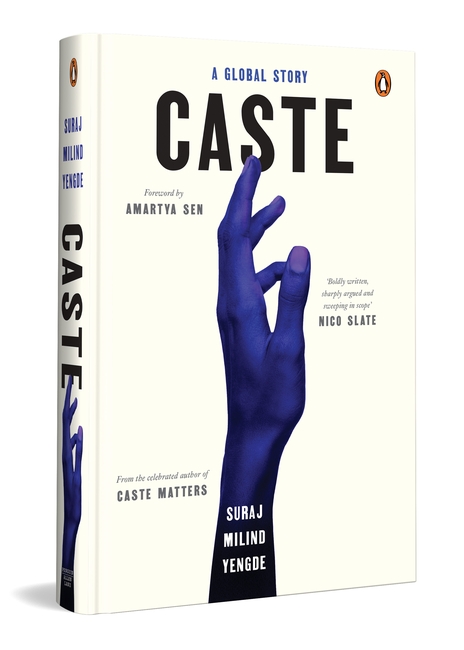
Caste: A Global Story
By Suraj Milind Yengde
India Allen Lane, 384 pages, Rs 899
 Suraj Milind Yengde, a first-generation Dalit scholar, reignited debates around the concept of caste with his ‘Caste Matters’ (2019). Then he completed his second doctorate, at Oxford, on the intellectual histories of caste and race. He now teaches at University of Pennsylvania.
“Caste: A Global Story” has already generated significant academic and critical interest. Amartya Sen, in a short foreword, says, “Yengde's work compels us to recognise caste not as an insular Indian institution but as a social form with global ramifications.” The new work is less of a personal polemic and more of an archival and ethnographic attempt.
While it builds on his previous work, Caste Matters, this book is much broader in scope, shifting the focus from the Indian subcontinent to the global South Asian diaspora and its intersections with other systems of oppression. The key point here is that caste and caste-based discrimination are not just Indian phenomena; they happen around the world, from Britain to Bahrain, Canada to South Africa. ‘Dalit Universality’ encompasses the experience of many, from indentured labourers in the nineteenth-century Caribbean to present-day migrant workers in the Middle East.
Yengde’s primary contribution with this volume is “globalizing” caste studies. He moves away from the traditional “village ethnography” model to show how caste travels. He documents how caste discriminations persist in the Indian diaspora in the UK, USA, and Australia, and even in the Caribbean (Trinidad and Tobago) and the Middle East. Upper-caste migrants often use their ‘model minority’ status to mask caste privilege, sometimes even labeling anti-caste interventions as “racist” to deflect scrutiny.
Another notable feature of the ambitious work is his methodological innovation. Given the subject matter, he rejects detached objectivity of academic treatises, and puts his felt experience to use. He justifies this swa-anubhuti approach by arguing that knowledge of caste must come from those who live it, not just those who study it from an elite, textual perspective. The result is a hybrid style – part memoir, part social commentary – to etch out a map of caste violence as it is faced, experienced.
Yengde also takes up the oft-discussed race-caste analogy, and explores the Dalit-Black solidarity movement. He analyses Dalit activism in the light of the Black Lives Matter (BLM) movement in the US. Though coming from different historical arcs, the two have a lot in common in terms of the exclusion faced by the two communities.
The book concludes with a nearly exhaustive list of Dalit organizations around the world.
The government has reduced the Basic Customs Duty (BCD) on major imported crude edible oils with a view to moderating domestic edible oil prices, providing relief to consumers and mitigating inflationary pressures arising from the sharp increase in international edible oil prices.
In his opening address at the 18th BRICS Summit in New Delhi on September 12, prime minister Narendra Modi did something India`s diplomacy has been building towards for three years: he moved the ‘Voice of the Global South’ from a slogan to a work plan. Addressing the leaders, he argued that t
The Pradhan Mantri Jan Arogya Yojana (PM-JAY), a welfare scheme which covers approximately 45 crore beneficiaries across India, provides cashless health cover of Rs. 5 lakh per family per year. It is the largest health insurance scheme which helped crores of poor families by reducing out-of-pocket expend
Every pregnancy requires two people. Yet India`s family planning programme continues to ask only one of them to bear almost all of its medical consequences. The newly released National Family Health Survey-6 (2023-24) confirms just how entrenched this asymmetry remains: 36.5% of currently married women a
Delivering the IXth Chief Justice M.C. Chagla Memorial Lecture on ‘Human Rights and Sustainable Development Goals’, in Mumbai Friday, former Chief Justice of India Bhushan R. Gavai questioned whether conventional economic indicators such as gross domestic product (GDP), national income,
Seventeen years after the centre first approved the widening of National Highway 66 between Mumbai and Goa into a four-lane highway, a fresh RTI reply has revealed a sharp escalation in the project`s sanctioned cost. According to the RTI reply obtained by activist Jeetendra











