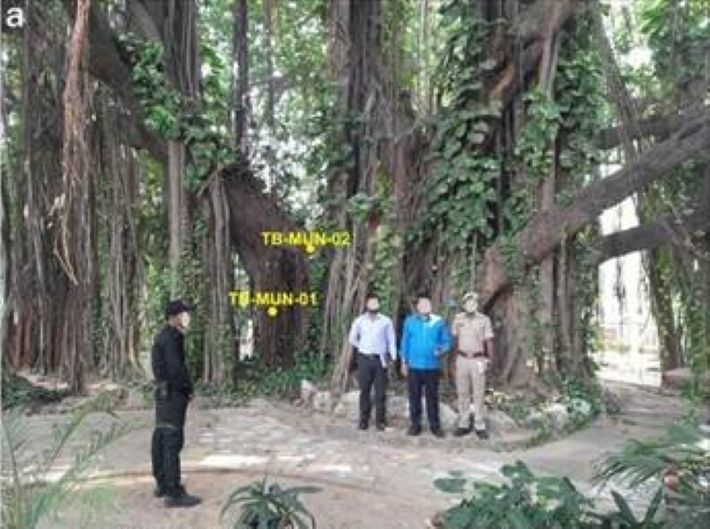
A banyan tree in Munger, Bihar, estimated to be around 700 years old, has been identified as the oldest accurately dated banyan tree, Ficus benghalensis, using radiocarbon dating, a method that relies exclusively on scientific evidence rather than historical records or local lore.
Banyan trees, with their intricate root and branch networks, provide habitats for a variety of wildlife, including birds and insects. They have also played a significant role in Indian social and cultural life for centuries. Traditionally, estimating their age relied on folklore, local stories or historical records, which were often inaccurate. These living representations of history were not scientifically dated previously due to a lack of a clear protocol. Field sampling and laboratory analyses revealed that the absence of distinct annual growth rings in most tropical broadleaf trees limited the application of conventional dendrochronological techniques, emphasising the need for alternative high-precision dating methods, including radiocarbon dating.
When Dr. Trina Bose from the Birbal Sahni Institute of Palaeosciences, Lucknow, an autonomous institute under the Department of Science and Technology (DST), was invited by the Bihar Forest Department to investigate and determine the age of the Munger Banyan tree, she recognised the limitations of conventional dating approaches for tropical broadleaf species. To address this challenge, she initiated the development of a new scientific approach for age determination. Dr. Bose led a research team comprising Dr. Mayank Shekhar and Dr. Akhilesh K. Yadava, who collaboratively developed and applied an innovative methodology to establish the age of the tree.
The research team, led by Dr. Bose and comprising Dr. Shekhar and Dr. Yadava, extracted alpha-cellulose, the most stable primary component of plant cell walls, from wood samples collected near the pith of a secondary trunk and an ancient primary branch. The pith is particularly important because it represents the earliest wood formed during the juvenile stage of secondary growth. The extracted cellulose samples were subjected to high-precision radiocarbon dating using Accelerator Mass Spectrometry (AMS), followed by calibration against the latest IntCal20 calibration curve and OxCal software, enabling the team to establish a robust, reliable estimate of the tree's age.
This finding refutes earlier assumptions that the Munger Banyan was planted in front of the historic 'Burra Bunglow', which, based on architectural style, dates to the late Mughal-Early British period (~300 to 350 years old), as a venue for dialogue between rulers and common citizens, village assemblies, religious ceremonies, and cultural exchanges. It establishes that the approximately 700-year-old tree is likely a surviving remnant of a natural forest that once existed in the region, and that it witnessed the construction of the building. Hence, this analysis redefines the order of historical events in this region.
The research, published in the journal
Quaternary Research (
https://doi.org/10.1017/qua.2026.10086), provides a scientific method for accurately dating heritage trees, helping governments, forest departments, and conservation agencies identify and protect culturally and ecologically important trees. It strengthens the preservation of natural and cultural heritage by replacing uncertain age estimates with reliable scientific evidence. The methodology can also be applied to other ancient tropical trees worldwide and can help biodiversity conservation, heritage management, environmental education, and research on past climate and historical landscapes.
This research represents a major breakthrough in the scientific dating of ancient trees in tropical regions, especially those of cultural significance, such as the Banyan, and will not only help determine the age of such trees more accurately but also support efforts to preserve natural, historical, and cultural heritage throughout South Asia and beyond, according to an official release of the science and technology ministry on Friday.