Why cities aren’t able to give good quality life to people

Urban local bodies need to improve the collection efficiencies of their own revenues like property tax, says Janaagraha

GN Bureau | December 7, 2017


#municipal finances   #urban local bodies   #cities   #Janaagraha   #CAG  
Ashish Asthana
Ashish Asthana

We now know why people are not getting a good quality of life in cities. Janaagraha Centre for Citizenship and Democracy analysed the financial management of urban local bodies (ULB) and presented key insights on the state of municipal finances based on the audit reports of the CAG on their audits of ULBs in 21 states.
The brief is a precursor to the Annual Survey of India’s City-Systems (ASICS) that evaluates the quality of city systems in India across 18 states and analyses the financial management of Urban Local Bodies.
 
Urban planning & design, urban capacities & resources, empowered political leadership and transparency, accountability & public participation are the four city-system components covered under ASICS. The ability of Urban Local Bodies (ULBs) to invest adequately in providing infrastructure and services to its citizens is one of the key diagnostic parameters assessed by ASICS, said Janaagraha
 
Here are the highlights:
 
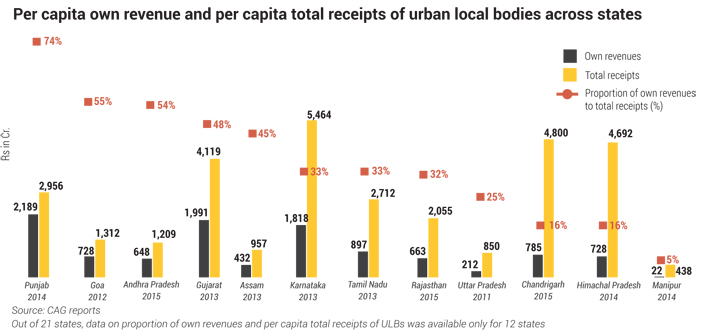
Insight 1: Own revenues on average contribute to less than 37% of the total receipts of ULBs, ranging from a low of 5% in Manipur to a high of 74% in Punjab; only 3 states record > 50% share of own revenues.
Impact: Total receipts Proportion of own revenues to total receipts (%) ULBs depend on State and Central grants to a significant extent, constraining their ability to make capital investments to improve infrastructure services and other investments to improve their functioning.
Recommendation: • ULBs need to improve collection efficiencies of own revenues, mainly, property tax, advertising tax and parking fees. • Buoyant sources of revenues such as stamp duties and entertainment taxes should be devolved to ULBs. • States needs to embark on systematic fiscal decentralization
 

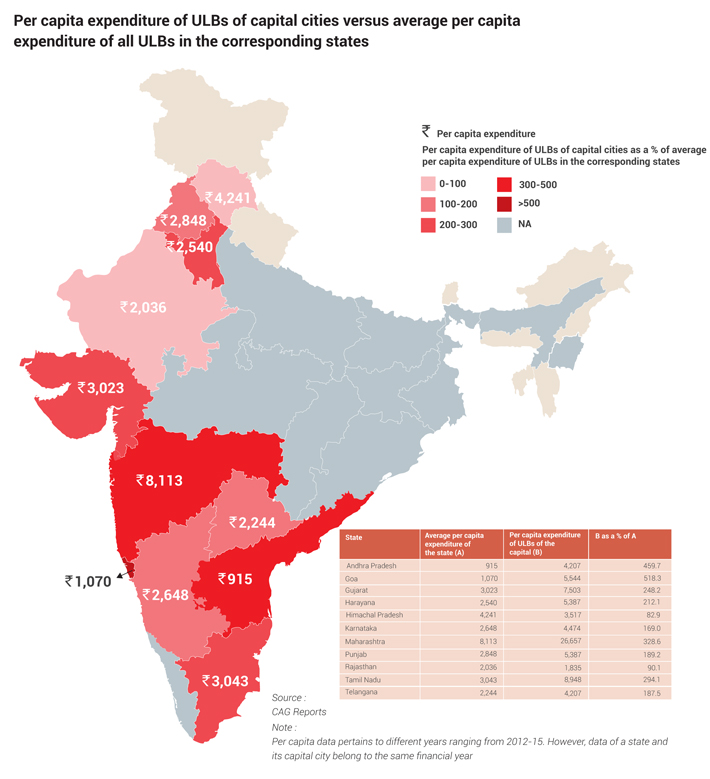
Insight 2: On average (across 12 states), ULBs of capital cities spend 253% higher per capita, on infrastructure and services, as compared to average per capita spend by all ULBs in the corresponding states
Impact: This indicates lower per capita spend across smaller cities, resulting in poorer quality of life in such cities
Recommendation: The focus, currently concentrated only to large cities, must also shift to the smaller cities and towns in order to bridge the gap in per capita spend, by - • improving collections of own revenues of the ULBs in smaller cities and towns • devolving buoyant sources of revenue such as stamp duties and entertainment taxes should be devolved to ULBs, and • increasing grants devolved to smaller cities and towns to meet the infrastructure needs.
 

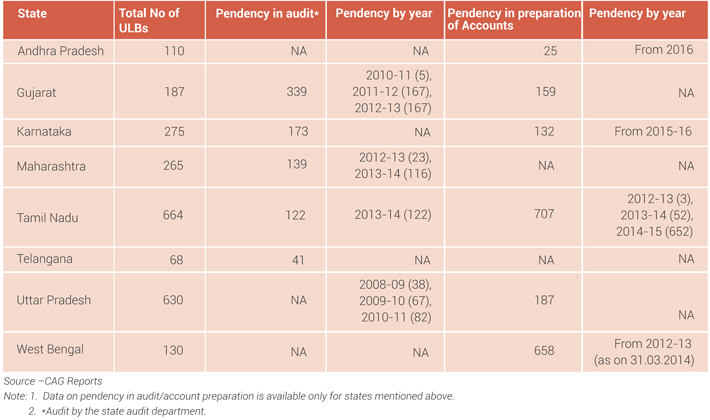
Insight 3 Significant delay in preparation of Accounts and Audit of ULBs across states, inability to ascertain accurate financial position and performance of ULBs
Impact: Constraining the ability of state governments to hold ULBs accountable and of ULBs themselves to take informed decisions or raise funds from the capital markets.
Recommendation: To clear the pendency in accounts and audit, States should actively consider empanelling Chartered Accountants. Karnataka, Bihar, Chhattisgarh, Gujarat, Odisha and Rajasthan are among the states that have empanelled Chartered Accountants to clear the backlog in audit and accounts.

 
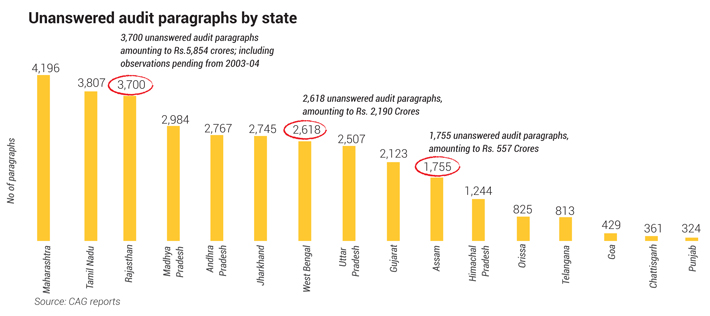
Insight 4:  Over 33,198 unanswered audit observations from CAG Audits across 16 states, relating to several thousand crores in financial terms; no implications for open audit observations.
Impact: Open audit observations are a sign of weak internal controls and poor financial hygiene in ULBs, exposing them frauds and losses.
Recommendation: Time-bound, transparent responses to CAG audit observations to be mandated in Municipal Corporation Acts, central and state grants to be tied to performance in audits and responses to audit observations.

 
Insight 5: Significant backlog in CAG audits of local bodies undermining quality of TG&S by CAG
Impact: CAG audits are the last line of defence around internal controls in ULBs. Delays in CAG audit reflects lackadaisical approach to the audit process.
Recommendation: Fix accountability for submission of financial records of ULBs on time to CAG; make transparent time table of CAG audits and reasons for delays in CAG audits.
 

Comments


Other News

Not just politics, let`s discuss policies too

Why public policy matters Most days, India`s loudest debates stop at the ballot box. We can name every major leader and recall every campaign slogan. Still, far fewer of us can explain why a widow`s pension is delayed or how a government school`s budget is actually approved. That

When algorithms decide and children die

The images have not left me, of dead and wounded children being carried in the arms of the medics and relatives to the ambulances and hospitals. On February 28, at the start of Operation Epic Fury, cruise missiles struck the Shajareh Tayyebeh school – officially named a girls’ school, in Minab,

The economics of representation: Why women in power matter

India’s democracy has grown in scale, but not quite in balance. Women today are active participants in elections, influencing outcomes in ways that were not as visible earlier. Yet their presence in legislative institutions continues to lag behind. The Nari Shakti Vandan Adhiniyam was meant to addres

India will be powerful, not aggressive: Bhaiyyaji

India is poised to emerge as a global power but will remain rooted in its civilisational ethos of non-aggression and harmony, former RSS General Secretary Suresh `Bhaiyyaji` Joshi has said.   He was speaking at the launch of “Rashtrabhav,” a book by Ravindra Sathe

AI: Code, Control, Conquer

India today stands at a critical juncture in the area of artificial intelligence. While the country is among the fastest adopters of AI in the world, it remains heavily reliant on technologies developed elsewhere. This paradox, experts warn, cannot persist if India seeks technological sovereignty.

RBI pauses to assess inflation risks, policy transmission

The Reserve Bank of India (RBI) has begun the new fiscal year with a calibrated pause, keeping the repo rate unchanged at 5.25 per cent in its April Monetary Policy Committee (MPC) meeting. The decision, taken unanimously, reflects a shift from aggressive policy action to cautious observation after a signi


Archives

Current Issue

Opinion

Facebook Twitter Google Plus Linkedin Subscribe Newsletter

Twitter