
About 96% of the total income comes through donation
GN Bureau | April 10, 2018

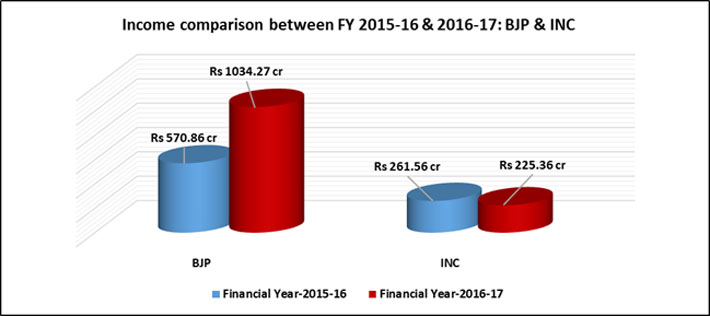
The Bharatiya Janata Party's total income has increased by 81.18% in one financial year. In 2015-16, the party's income was Rs 570.86 crores and this went up to Rs 1,034.27 crores during 2016-17. The party is the richest of all national parties.
At the same time, the income of INC has decreased by 14% from Rs 261.56 crore in 2015-16 to Rs 225.36% in 2016-17.
Association for Democratic Reforms (ADR), in its report, has analysed parties' income, expenditure and other details submitted to the Election Commission of India.
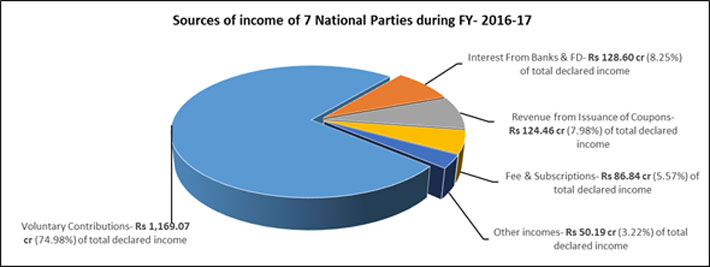
BJP and INC have declared donations/contributions as one of their three main sources of income. In BJP, Rs 997.12 crores comes through donations which forms 96.41% of the total income. Declaration of Rs 115.644 cr under Revenue from issuance of Coupons by INC forms the top most income of the party, contributing 51.32% of the total income of the party during FY 2016-17.
 The maximum expenditure for BJP during 2016-17 was towards election/general Propaganda which amounted to Rs 606.64 crores followed by expenses towards administrative cost, Rs 69.78 crores.
The INC spent the maximum of Rs 149.65 crores on elections followed by Rs 115.65 crores on administrative and general expenses.
Overall scenario of national parties.
Mumbai’s real estate market keeps growing, yet homeownership remains out of reach for much of its population. Three experts – urban researcher Hussain Indorewala, urban planner Vidyadhar Phatak and developer Kamlesh Thakur of NAREDCO Maharashtra, agree that simply constructing more apartments
US secretary of state Marco Rubio has said he was unfamiliar with the Wall Street Journal report suggesting Elon Musk had decided to throttle Starlink services in Ukraine, but rejected claims that Washington had ordered the restrictions to pressure Kyiv. “There was no
Breast cancer has become a public-health challenge in India. The greatest opportunity is to find cancers earlier. Artificial intelligence (AI) is opening a new era in breast cancer detection. AI systems can analyse mammograms and other breast-imaging studies, identify subtle abnormalities and assist radi
Indian agriculture is experiencing significant climate volatility, while the world economy seems to be in a highly volatile situation. Economic indices from various countries show that they need to recalibrate their strategies to withstand economic headwinds. In such a challenging situation, a country li
India’s southwest monsoon ended with a 13% rainfall deficit in 2026, its weakest performance in a decade, raising concerns over agricultural production, water security and the upcoming rabi season. With El Niño expected to persist into early 2027, experts warn that declining soil moisture, dep
For over a decade, India’s e-commerce story has rested on a simple premise: platforms connect buyers and sellers, while data fuels efficiency, personalisation, and scale. However, as the market matured, its structure has revealed a growing imbalance. E-commerce platforms, especially marketplace ent










