
After long wait of 86 years, Nobel Peace Prize goes again to journalists

In a world filled with half-truths and hatred, the award reiterates core values of freedom and fraternity

Hari Hara Mishra | October 9, 2021

#Nobel Peace Prize   #media   #news   #Journalism  
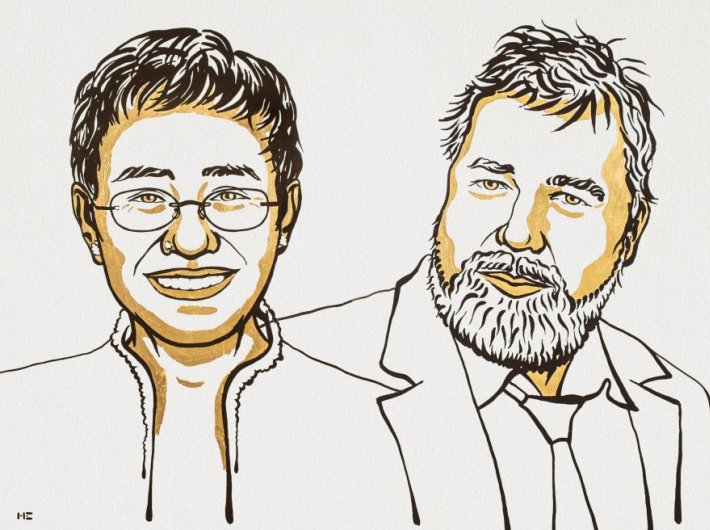
Maria Ressa of the Philippines and Dmitry Muratov of Russia (Image courtesy: nobelprize.org)

After almost a century, the Nobel Committee has decided to award the Nobel Peace Prize 2021 to two journalists, Maria Ressa of the Philippines and Dmitry Muratov of Russia. The last Nobel Peace Prize won by a journalist was way back in 1935, by a German named Carl Von Ossietzky for his “burning love for freedom of thought and expression” after revealing that the Nazi regime was secretly rearming in breach of the World War I peace accord.
 
The citation for the current award sums up the challenge before the humanity in noticeably clear and precise terms and drives home the eternal value of freedom and fraternity. “Free, independent, and fact-based journalism serves to protect against abuse of power, lies and war propaganda. Without freedom of expression and freedom of the press, it will be difficult to successfully promote fraternity between nations, disarmament and a better world.”
 
The importance of democracy and free speech was well articulated by Dan Smith, director, International Peace Research Institute. “Freedom of expression is a part of democracy. I think the important thing about a media that is truly free is that it not only acts independently but it respects the truth and that seems to be also an important part not just of democracy, but also work towards peace.”

The courage of the Russian journalist who dedicated the award to six contributors who had been murdered for their works exposing human rights violations and corruption and the Philippines journalist who is known for investigative reporting is exemplary and serve as a beckon of light to journalists everywhere across the globe.

The world at large is now passing through turbulent times. The world is more divided than ever since World War II, with diminishing importance and marginalisation of institutionalised  multilateral arrangements like the UN and socio-economic bodies. Might, of military or economy, is right and now determines the relationship and challenges in the comity of nations. Social media giants have grown super-powerful in influencing public perception and behaviour around ideology, beliefs and thought processes. Free flow of credible information is the first casualty and freedom of thought and expression is  under  threat, both directly and indirectly.

Media is popularly referred  as the fourth pillar of democracy and has a critical role to play for  the people at large by critical analysis of functioning of  three other  pillars of democracy –  legislature, executive and judiciary – and ensuring that their actions have necessary intent and drive to ensure good governance and development of the society. Unfortunately, large part of the electronic and social media is now focused on only half-truths to suit a particular narrative in pursuit of their partisan and divisive agenda.

Information is power. Citizen empowerment starts with access and unfettered right to quality information. The mantra from ancient Indian wisdom text,  Mundaka Upanishad, that we have accepted as our national motto is ‘Satyameva Jayate’, truth alone triumphs. For any journalist anywhere, that should be the driver – pursuit of truth to its logical end without bias, fear, or favour.

Mishra is a policy analyst and columnist.
 

Comments


Other News

Here’s an I.D.E.A. for career growth and success

Success in today’s professional organisation is no longer solely determined by academic qualifications, technical expertise or years of experience. While these attributes do matter, organisations increasingly value individuals who demonstrate the right mindset and behavioural qualities. The ability

PM interacts with CEOs, founders of space startups

Prime minister Narendra Modi interacted with CEOs and Founders of 20 Space Startups at Seva Teerth on Friday.   CEOs of leading companies in the space sector working in diverse fields ranging from building rockets and reusable semi-cryogenic launch vehicles, avionics, satelli

From one cow to a dairy business

In 2012, Anita Dash wasn`t dreaming of building a dairy brand. She wasn`t studying business models or planning market expansion. Like countless mothers across India, her focus was on something much simpler: giving her children a better future.   At the time, her most valuable

Ethanol blending: The two sides of a story

India`s crude oil consumption is estimated to be around 88.5% imported from abroad. This one single figure is also responsible for why ethanol has become both an economic strategy and fuel policy at the same time. In an economy like India, which depends so heavily on foreign oil, any increase in internat

Food inflation: Not a macroeconomic statistic but a developmental indicator

India`s retail inflation shows a reassuring picture at first glance. According to the latest data, Consumer Price Index (CPI) inflation edged up to 4.38% in June 2026 from 3.93% in May 2026, but continued to remain within the Reserve Bank of India`s (RBI) target band of 4% (+/- 2%). However, beneath this

Skin in the game or masterful market timing?

When a company founder opens their personal chequebook to buy shares in their own business, stock markets usually applaud. To the average retail investor, it feels like the ultimate vote of confidence, a sign that the people running the show have real skin in the game and believe brighter days are ahead.

Upcoming Conferences


-->

Archives

Current Issue

Opinion

Facebook Twitter Google Plus Linkedin Subscribe Newsletter

Twitter






