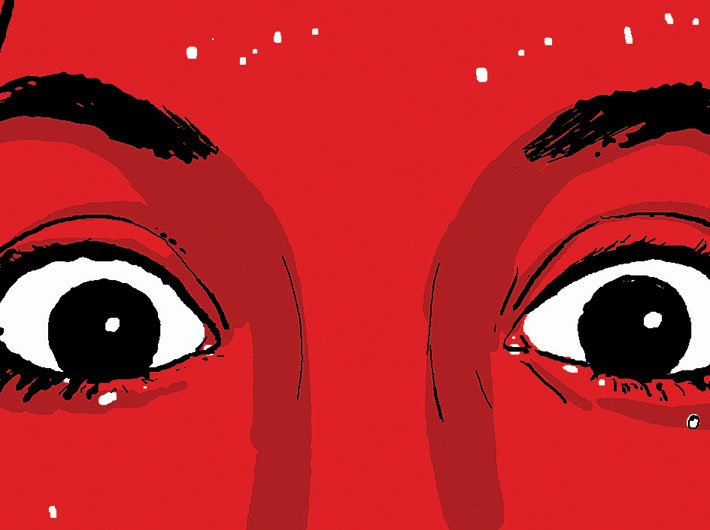
The new Afghan penal framework raises a question that extends far beyond the borders of a single country: Why does violence against women continue to endure in an age that prides itself on progress?
When violence becomes lawful in one place and tolerable everywhere else, the bruises are no longer Afghanistan’s alone; they belong to all of us.
Somewhere a woman walks in silence,
Counting the bruises no one will see.
The law may measure broken bones,
But who will measure broken dignity?
It is impossible, as human beings, not to feel a profound sense of anguish when reflecting on the condition of women in Afghanistan today, particularly in light of the recently introduced penal provisions that reportedly allow husbands to physically punish their wives so long as the violence does not result in severe injuries such as broken bones or open wounds. For some time, there had been a quiet hope in many quarters that the Taliban, after returning to power in 2021, might attempt to present themselves as a more pragmatic and modern regime. There were occasional signals suggesting moderation, and one wanted to believe that the realities of governance in the twenty-first century might gradually soften rigid ideological positions. But recent developments suggest otherwise. The persistence of deeply entrenched patriarchal attitudes continues to shape the legal and social order in Afghanistan, reinforcing a system in which women remain vulnerable to control and violence.
We are not speaking here of marginal communities or isolated traditions. We are speaking of women, who constitute half of humanity and without whom no society can exist and no civilization can survive. Without women, no child is born, no family is formed, and no nation endures. Yet across many parts of the world, women continue to be treated as subordinate beings whose autonomy remains negotiable and whose dignity is often conditional. The Afghan penal provisions therefore represent not merely a domestic legal issue but a disturbing reminder of how fragile women's rights remain even in the modern age.
Inside Afghanistan’s New Penal Code
Since the Taliban returned to power in 2021, Afghanistan’s legal system has been reshaped around strict interpretations of Islamic jurisprudence. Earlier decrees in 2024–25 emphasized male guardianship and family discipline, and the new penal code introduced in 2026 appears to formalize many of these principles. While the legal language does not always explicitly authorize domestic violence, interpretations by Afghan jurists and human rights observers suggest that husbands may use disciplinary force so long as it does not result in severe injury such as broken bones or permanent damage.
This framework effectively lowers the threshold for what is treated as domestic violence. Actions that would be considered criminal assault in most countries risk being dismissed as private family matters. At the same time, avenues for seeking justice have narrowed drastically. Courts are dominated by the same religious jurists who interpret and enforce these laws, women’s shelters have largely disappeared, and independent legal aid organizations function under severe restrictions. In such a system, the question becomes unavoidable: Where can a woman go to report violence when the institutions meant to protect her are shaped by the very ideology that permits it?
The implications for Afghan women are profound. Violence becomes harder to report, harder to prove, and easier to justify socially. When the law reinforces male authority within marriage, the household itself risks becoming a space where coercion is normalized rather than punished. The normalization of “disciplinary violence” also extends beyond Afghanistan, weakening global norms that seek to treat domestic abuse as a violation of fundamental human rights.
Violence Against Women: A Global Reality
Afghanistan’s situation is extreme, but it exists within a troubling global context. Violence against women remains widespread across both developed and developing countries.
According to the World Health Organization’s (WHO) 2021 global estimates, about 736 million women worldwide, that is nearly 30% of all women, have experienced some kind of physical or sexual violence at least once in their lifetime. Most of this violence occurs within intimate relationships. A United Nations Women global report (2023) found that one woman or girl is killed every 11 minutes by an intimate partner or family member, amounting to approximately 48,800 femicides annually.
Domestic violence increased in many countries during the COVID-19 pandemic. The UNDP Gender Social Norms Index (2023) showed that nearly 90 percent of people globally still hold at least one bias against women, including beliefs that justify male authority within households. Such attitudes often translate into tolerance of domestic abuse.
Even in countries with strong legal protections, enforcement gaps persist. According to World Health Organization estimates (2021) based on 2000-2018 data, around 20-23 percent of women in Europe (that is 1 in 5) and nearly 25 percent (1 in 4) in North America have experienced intimate partner violence during their lifetime, demonstrating that legal prohibition alone does not eliminate abuse.
Afghanistan, therefore, represents not an isolated anomaly but an extreme expression of a global problem.
The Indian Context
India, despite having a comprehensive legal framework against domestic violence, faces serious challenges in implementation.
The National Family Health Survey (NFHS-5, 2019–21) found that 29 percent of ever-married women aged 18–49 reported experiencing spousal violence at some point in their lives. In several states, the prevalence was significantly higher.
Crime data reflect similar concerns. According to the National Crime Records Bureau (NCRB, 2022), India recorded over 31,000 rape cases in a single year, an average of nearly 85 cases per day. Yet these figures capture only a part of reality, as stigma, fear of retaliation, and social pressures continue to prevent many women from reporting sexual violence.
Globally, estimates by the WHO suggest that only a fraction of sexual assaults are officially reported, with reporting rates in many countries believed to be below 10 percent. The gap between reported and unreported cases indicates the deep social barriers that prevent women from seeking justice.
These figures highlight an uncomfortable truth: while India may condemn regressive laws elsewhere, it continues to struggle with serious gender violence within its own borders.
India’s Diplomatic Dilemma, and Responsibility
Since the Taliban’s return to power in 2021, India has maintained cautious engagement with Afghanistan, balancing humanitarian assistance and strategic interests without formally recognizing the regime. Over the past two decades, India invested heavily in Afghanistan’s development by building institutions, supporting education, and funding hundreds of projects, thereby creating deep goodwill among ordinary Afghans.
Yet this engagement poses a deeper question: What does it mean for a democracy to engage with a regime that has systematically erased women from public life? We frequently invoke democratic values and gender equality in global discussions; does prolonged silence on Afghan women not risk normalizing their exclusion? Over time, what begins as diplomatic caution can start to resemble indifference. The real challenge for democracies is not engagement itself, but ensuring that engagement does not come at the cost of moral clarity.
India’s influence on Taliban policy may be limited, but it is not irrelevant. Afghanistan remains dependent on external assistance, and countries that continue engagement retain a voice, however modest, in shaping expectations and norms. Even restrained but consistent advocacy can signal that the exclusion of women from education and work cannot become normal.
India also carries a unique moral stake. For years, Indian universities educated Afghan students, including many young women who saw India as a place where education meant freedom and possibility. Many of those dreams have since been cut short. India may not be able to change Afghanistan’s course, but its voice carries weight precisely because of that shared history. Even a measured and consistent expression of concern would affirm that the rights and aspirations of Afghan women still matter.
A Wider Question for Humanity
The Afghan penal framework raises a question that extends far beyond the borders of a single country. Why does violence against women continue to endure in an age that prides itself on progress? We have international conventions, human rights commissions, and carefully drafted laws, yet millions of women still live with fear as a quiet companion within their own homes. The persistence of domestic violence reminds us that injustice does not always arrive dramatically; more often, it survives quietly in the spaces where the world chooses not to look.
If the world can watch Afghanistan adopt a penal framework that permits violence against women and respond with little more than concern and statements, then something deeper than law has weakened within us. This is not only about the women of Afghanistan; it is about what the rest of us are willing to accept as normal. When one society legitimizes the beating of women and the world adjusts to it, the injury is no longer confined to Afghan homes. It reaches into the dignity of women everywhere.
If we can live with such laws, the question is no longer what has happened to Afghanistan but what has happened to us!
Dr. Vaishnavi Sharma is a freelancer researcher and economist. She did her PhD from Indira Gandhi Institute of Development Research (IGIDR), Mumbai.
Dr. Akash Kumar Baikar is an Assistant Professor at the Manav Rachna International Institute of Research and Studies, Faridabad (Haryana).