
Beyond toilets: Why open defecation persists in rural India

It reflects the relationships among sanitation, patriarchy, social norms, and cultural beliefs about purity and gender

Shivendra Pratap Singh | June 23, 2026

#ODF   #Toilets   #Society   #Gender  
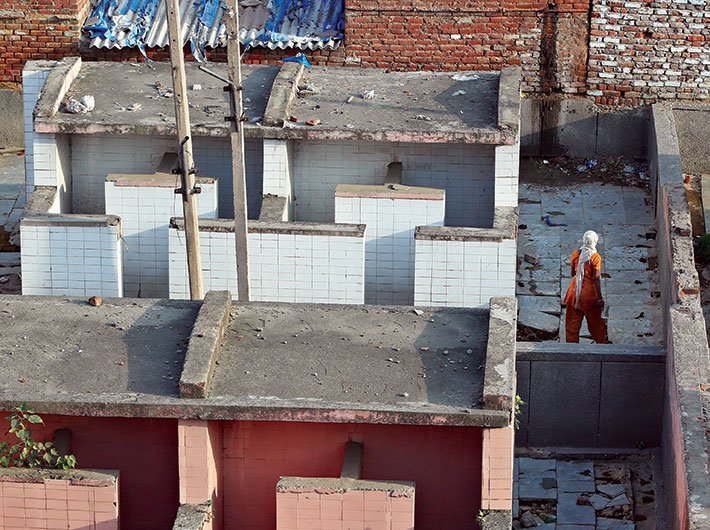
(Photo: Governance Now)

Despite the awareness campaigns on sanitation across India, open defecation (OD) is practised openly and widely in both rural and urban areas. Research shows that rural respondents are well aware of the negative impacts of OD, yet this awareness does not lead to toilet construction or use. In rural North India, studies on sanitation behaviour found that respondents widely agreed that OD is “bad, harmful, or shameful,” with belief scores averaging 0.83 across all respondents, and continued the practice because of deeply held cultural beliefs about sanitation. [1] This makes one thing clear: the problem is not a lack of information. [2]
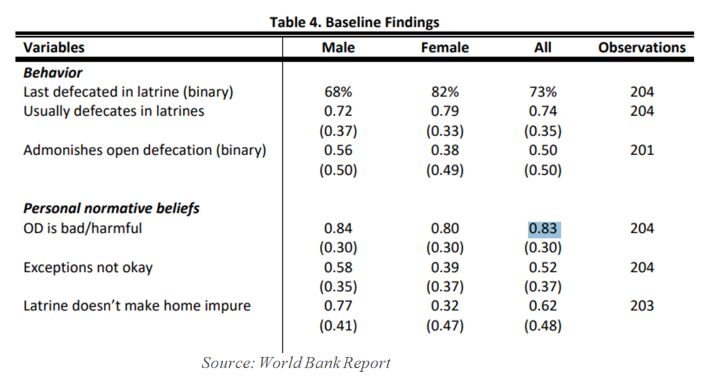
 
Source: World Bank Report
 
Why Toilets Alone Are Not Enough


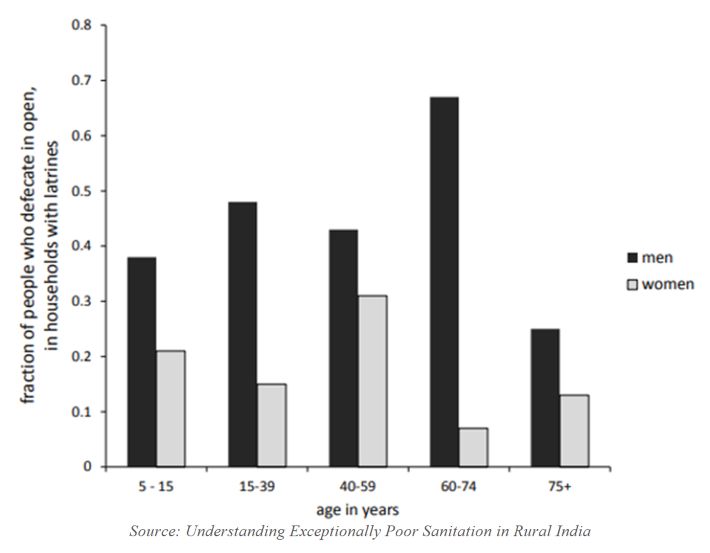
Source: Understanding Exceptionally Poor Sanitation in Rural India
 
The graph shows that even when latrines are available, both men and women continue to defecate in the open. [3] The highest incidence of open defecation being practised among men is observed between the age group of 60-74. Because older men often control household decisions regarding expenditure, construction, and daily practices, their continued preference for open defecation can influence sanitation choices across the household. So, if decision-making power continues to prefer defecating in the open, should OD be considered only an infrastructure deficit?
 
Research conducted in rural North India found that many respondents associate on-premise latrines with being “dirty” and “polluting,” believing that building one inside the home defiles the domestic environment. [4] One respondent, whose home contained both a temple and a kitchen, declined government support for toilet construction outright because a toilet would “pollute” the space. [5] While men's preferences are shaped by notions of purity and health, women's experiences are influenced by distinct social and practical constraints. [6] 
 
Women's experiences of sanitation are shaped by a different set of constraints. Women in the 39-59 age group correspond broadly to a period of marriage and intense domestic responsibilities, with little leisure time. They continue to practise open defecation despite the availability of latrines, as many value the brief social interaction and the temporary freedom it offers outside the household. [7] When water access is limited, women are also reluctant to build individual household latrines, knowing that the extra water needed to maintain them will fall entirely on them. The absence of toilets falls hardest on pregnant women and women who are menstruating, resulting in poor menstrual hygiene, undernourishment from restricting food and water intake, and higher rates of reproductive and bladder infections. [8] 
 
Open defecation in rural India is not simply a result of poverty or lack of awareness. It reflects the relationships among sanitation, patriarchy, social norms, and cultural beliefs about purity and gender. In many rural households, men often exercise greater influence over sanitation-related decisions, while women disproportionately bear the consequences in the form of increased health risks, restricted mobility, and unsafe practices imposed on women of the households. Rural sanitation, therefore, is not only about building toilets. It is about challenging the norms that keep open defecation in place and ensuring that women have a real voice in the decisions that directly affect their lives.
 
Shivendra Pratap Singh is a Master's Student of Cities and Governance at TISS, Hyderabad.
 
References:
1/ Coffey, D., Gupta, A., Hathi, P., Khurana, N., Spears, D., Srivastav, N., & Vyas, S. (2017). Understanding open defecation in rural India: Untouchability, pollution, and latrine pits. Economic and Political Weekly, 52(1), p. 59.
2/ World Bank. (2019). Shifting social norms to reduce open defecation in rural India, Table 4, p. 12.
3/  Coffey, D., Gupta, A., Hathi, P., Khurana, N., Spears, D., Srivastav, N., & Vyas, S. (2015). Understanding exceptionally poor sanitation in rural India. Rice Institute
4/  Coffey, D., Gupta, A., Hathi, P., Khurana, N., Spears, D., Srivastav, N., & Vyas, S. (2015). Understanding exceptionally poor sanitation in rural India. Rice Institute.
5/  Coffey, D., Gupta, A., Hathi, P., Khurana, N., Spears, D., Srivastav, N., & Vyas, S. (2015). Understanding exceptionally poor sanitation in rural India. Rice Institute
6/  World Bank. (2019). Shifting social norms to reduce open defecation in rural India.
7/  Coffey, D., Gupta, A., Hathi, P., Khurana, N., Spears, D., Srivastav, N., & Vyas, S. (2015). Understanding exceptionally poor sanitation in rural India. Rice Institute.
8/  Government of India. (2014). Safety, security and dignity of women. Swachh Bharat Mission.
 

Comments


Other News

What unpaid nation builders want from policymakers

The Supreme Court recently described homemakers as “nation builders” and fixed a notional monthly income of Rs 30,000 for them in motor accident compensation cases. The judgment was not about wages. It was about compensation. Yet it inadvertently raised a larger economic question: If a homemake

What the US–Iran peace deal means for India

After months of rising tensions, the United States and Iran have reached a memorandum of understanding called the "Islamabad Agreement." This agreement allows for the immediate reopening of the Strait of Hormuz without tolls and provides Iran with relief from sanctions, depending on its complianc

V. M. Tarkunde: A legal luminary par excellence

14 Lawyers: Portraits from The Bar By Raju Ramachandran  Juggernaut, 248 pages, Rs. 799  

The Cost of Obesity

The latest episode of Checks and Balances focuses on the ticking time bomb of obesity in India, and Geetanjali Minhas of Governance Now spoke with a panel of experts. You can watch the episode here: https://youtu.be/mH

US-Iran deal: Path to peace or prelude to deeper regional quagmire?

In the midst of deep mistrust, the US and Iran are reported to have reached a framework deal for ending the West Asian conflict. But whether it will result in any meaningful breakthrough or pave the way for any lasting peace in the region, is in the realm of speculation.   During

Lived life, philosophy, spirituality and other enigmas

The Ashes Are Warm: Memories of a Lifetime Spent with UG Krishnamurti By Mahesh Bhatt and Sunita Pant Bansal Rupa Publications, 384 pages, Rs 495  


Archives

Current Issue

Opinion

Facebook Twitter Google Plus Linkedin Subscribe Newsletter

Twitter






