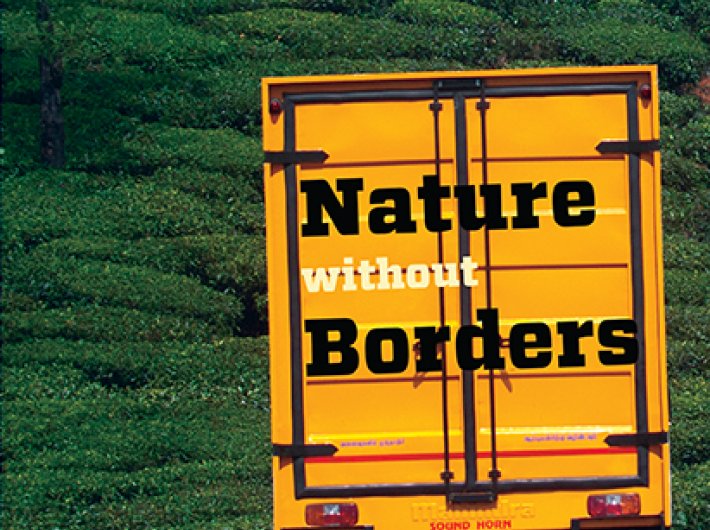
A collection of eight seminal papers that make compelling statements of the diversity and complexity of nature and its conservation
As I leaf through ‘Nature Without Borders’, I am reminded of my visit to the Velavadar national park in Gujarat a few years ago. For a small national park of only 29 sq km, Velavadar packs a punch. It harbours the endemic blackbuck, the endangered Indian wolf; is the largest roosting sight for Montagu’s harrier in the world and the finest place to see one of the rarest – and most charming – of birds, the lesser florican. But while the national park is essential as a core which provides strict protection, the surrounds are equally crucial for all its denizens. Floricans nest in the adjoining pastures and fields. The harriers dine outside too, benefiting the farmers as ‘organic’ pest-controllers by eating locusts, insects, etc. The blackbuck and the nilgai raid the crops as well, but are obviously not as welcome!
The fact that wildlife knows no barriers was evident on our way in, when the car ground to a halt to give way to a herd of blackbucks crossing over to a field; and a little ahead, we stopped to check on an inert jungle cat – the victim of a speeding vehicle.
It was clear that conserving wildlife called for focusing beyond the confines of the park, a fact the authorities recognised. Forest officials informed that farmers in the purlieu had been incentivised to grow organic wheat, which commanded a premium – and had an assured market. This benefited wild animals as well. But Velvadar, its wildlife, the fertile fields that surround the park, and indeed, a way of life were all imperilled by an upcoming special investment region, with industries, highways, airport, etc. in the immediate vicinity of the park.
Velavadar taught me many things – that solutions to conservation could not be straitjacketed, that wildlife was not restrained by boundaries that we ordain, and that threats transcended such borders as well. In short, the problem, and hence the approaches to conservation, are far more complex and nuanced than one imagined.
Which is why I was delighted when I came across this very aptly titled collection of eight fine essays which elucidate the complexity of this issue through practical conservation of a diversity of species and ecosystems – all authored by those who lead the effort.
The papers are preceded by a lucid, if lengthy, introduction which lays out the basic premise on which the book is centred: While protected areas (PAs) are vital, and have served as safe havens for rare flora and fauna, they are no panacea to conserve nature.
The reasons are many. PAs, carved out to protect wildlife and habitats, cover only a miniscule portion – five percent – of India. And a vast array of wildlife is found outside: forests which have higher density of tigers than some reserves, elephants and bears travelling vast distances between sanctuaries, leopards living, hunting, breeding in a patchwork of sugarcane fields, are just a few examples. Besides, the complex workings of nature within PAs are dependent on a number of factors, for instance, pesticides used outside the park are responsible for declining hatchling success of raptors nesting inside. Similarly, mining in its immediate vicinity isolates the reserve, genetically locking the wildlife within.
The reality is that PAs, demarcated by boundaries – often contested and undermined, are not isolated from their political, economic, and social realities.
While there can be no argument that ‘no-go’ PAs are the cornerstone of any conservation strategy, their viability is linked to the larger landscape. It follows that the approach to conserve must be holistic, diverse, dynamic, aware and sensitive to the ecological, social, economical and political milieu.
This is what ‘Nature Without Borders’ elucidates and illustrates through eight seminal papers – all compelling statements of the diversity and complexity of nature and its conservation. Set in vastly different terrains from the remote, snowy Himalayas to the urban metropolis of Delhi to paddy fields in the country’s most populated state Uttar Pradesh, to terrains and species few define as ‘wild’.
The latter is best illustrated in the first essay: ‘Trawling the Shorelines’, which focuses on marine species, rarely perceived as ‘wildlife’ and are instead, simply – and rather unfortunately – ‘seafood’. Authors Aaron Savio Lobo and Rohan Arthur observe, “We love fish, yet somehow in a slightly different way than we love other species of wildlife.” The chapter goes on to delve into how industrial fishing has caused the collapse of fishing stocks threatening rare marine life, and the livelihood of lakhs of artisan fishermen. The authors call for a ‘sea ethic’, and marine protected areas, which essentially ensure that you “enjoy your fish curry for decades to come”. The MPAs differ from conventional ‘no-go’ PAs, as they protect seed stock, spawning areas, yet allow harvesting though in a regulated manner.
It is such conflicts, coexistence, multidisciplinary approaches and resolution that run through the narrative.
These complexities are sharply represented in another neglected ecosystem, rivers. Strange how we abuse them, given how utterly we depend on them. Even rivers we hold sacred like the Ganga. This story is about the Gangetic dolphin, whose fragile future is closely interwoven with the “social, political, economic, geological, historical, hydrological, ethical strands” of the riverine landscape. Bihar has the only dolphin sanctuary in Vikramshila, but borders are fluid, more so in a riverine ecosystem, and they have failed to shield it from massive water usage and dams upstream to barrages downstream. Making the issue even more byzantine is the feudal panidari system, the abolition of which has led to further problems.
Another remarkable story is of the tallest flying bird, the globally threatened Sarus Crane which inhabits the human dominated – and highly modified – agricultural region of Mainpuri in Uttar Pradesh. It is the wet nature of the paddy crops and of course the positive attitudes of cultivators that have helped the cranes thrive. But are our conservation policies and paradigm inclusive of such landscapes, asks author Gopi Sundar. Unfortunately no, a worry as cropping patterns and land use change drastically, threatening the bird. In similar vein is the transforming pastures and grasslands of the Deccan on which are dependent both pastoralists and endemic grey wolves.
Two essays focus on saving natural spaces in densely populated metropolis: one takes us through citizens’ efforts to save the last of Bengaluru’s vanishing lakes; while the other offers an insight on how the ancient forests of the Aravalis – the Delhi Ridge – has been destroyed and protected for over a century.
A dramatic shift from such densely crowded cities comes from the remote vistas of the Himalayas, where roam the most elusive and beautiful of big cats – the snow leopard. The population density here is a meagre one person per square km, yet with scant resources man and beast are locked in conflict. Yash Veer Bhatnagar and Charudutt Mishra show us how a unique initiative with local villagers has preserved the leopard and its prey – and brought down livestock predation as well. While such solutions are creating a win-win situation for both nature and people, how does one deal with the rapacious predation of no-holds-barred development, in this case mega hydel and tourism projects?
The last chapter is set in the broken, and beauteous, landscape of the Western Ghats, a prime biodiversity hotspot. Divya Mudappa et al share their experience of conserving tigers, elephants and other megafauna, and managing human-wildlife conflict in a patchwork of fragmented forests and plantations.
Even for someone who has worked closely on the issues the authors espouse, the book is a revelation at many levels. It pushes the boundary on conventional conservation thought – from a shifting perception of forests and wildlife, innovative strategies to tackle threats and provides remarkable insights into some extremely contentious issues that dog conservation.
Never before has nature been so imperilled. In a rapidly changing India, so much that has secured and revered nature and varied life forms is fraying. It is this reality of “making space for nature” in an overcrowded, rapidly growing country with its needs and changing aspirations that the book confronts.
The subject is undoubtedly weighty and complex but the reading is easy, interesting and stimulating. I could have read it all in one go, but I took my time, mulling over and debating the new thinking the book ignites. One may not agree with all that the authors ascribe to, but it serves well to remove the borders within the mind, challenging, widening and enriching the discourse and approach to conserving nature. Timely and relevant, as nature becomes a flashpoint in the development vs. environment debate in India.