
Distinguishing Fish 1 and Fish 2: The pragmatism behind India’s WTO ratification

India strategically ratified Phase 1 (Fish 1) of the WTO Agreement on Fisheries Subsidies to target illegal fishing and boost its global sustainability credibility. At the same time, India retains full leverage for Phase 2 (Fish 2) negotiations to protect its small-scale fishers through Special and Differential Treatment

M. Krishnan and Badri Narayanan Gopalakrishnan | September 2, 2026

#Fishery   #Trade  


 India became the 123rd WTO member to ratify the multilateral Agreement on Fisheries subsidies (AoFS) when it deposited the Instrument of Acceptance for Phase 1 on July 20, 2026. The ratification is restricted to disciplining Illegal, Unreported and Unregulated fishing (IUU), protection for overfished stocks and unregulated fishing in the high seas. This ratification must not be misconstrued as encompassing the delicate issues targeting overcapacity and overfishing including state support for fuel, gear, ice, vessel manufacturing and modernisation which are covered under Phase 2 of the Agreement.
 
India has clearly confirmed its accent for bearing down on IUU while remaining committed to protect the domestic policy space for non IUU, small-scale and artisanal marine fishing. It is very clear that India has ensured that both inland fisheries and aquaculture are outside the gamut of the ratified agreement.
 
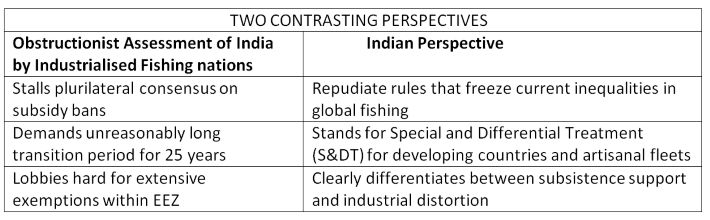
India stands firm in its demand for a 25-year transition period for developing countries within their EEZ and for per fisher subsidy to remain the governing benchmark in the ongoing Phase 2 negotiations. This triad of phases encompassing the WTO negotiations, global marine conservation and the domestic priorities of India are the two distinct tracks of the AoFS often referred to as Fish 1 and Fish 2. 
 
While Fish 1 addresses the most egregious reasons for ocean depletion which includes IUU fishing, unbridled overfishing without stock replenishment measures in place and unregulated fishing in international waters, this phase excludes inland culture and capture fisheries. This part of the AoFS has been ratified by two thirds of the 166 member countries and has come into force since September 2025.
 
Fish 2 seeks to control and eliminate broader subsidies that generate excessive fishing capacity or support overfishing like subsidised fuel, ice and vessel construction and modernisation. Seriously contested negotiations on these issues extended into the 14th Ministerial Conference (MC14) lobbying for carve-outs, transition periods and restrictions on distant water fishing.
 
Vested interests have portrayed India as a negotiator that disrupts consensus at WTO ministerial meetings. However, India has always stood for developmental equity and livelihood protection instead of opposing marine sustainability.


Therefore, India has engaged in a strategic realignment by ratifying Phase 1 of the AoFS. India has reiterated its commitment to plurilateral standards of sustainability against IUU fishing while standing for its principle-based pro environmental demands. The credibility of Indian seafood in premium markets like EU, USA and Japan has been strengthened by India underwriting the sustainability goals that govern strict environmental and labor traceability metrics.
 
Explicit standards insulate traditional and artisanal fishers by prohibitions of IUU fishing and overfished stocks under Phase 1 which has a blanket ban on vessels proven to engage in IUU fishing. Domestic maritime regulations and local co-management rules govern traditional and artisanal crafts operating within territorial waters (0-12 miles of the coast) and they do not engage in international IUU activities. This phase also does not include an overarching ban on operating subsidies given to fuel, gear and ice plants, since domestic management maintains stock conservation measures. Therefore, small-scale support continues unhindered.
 
The ratification is not a compromise on the 25-year transition period. This demand applies strictly to Phase 2 (Fish 2) and not Phase 1 (Fish 1). This deposition of the AoFS (Fish 1) has enhanced India’s goodwill by consenting to prevent IUU fishing and unregulated fleets in the high seas while retaining its full leverage to negotiate for S&DT. In this submission, India continues to retain its demand for per fisher subsidies. The small-scale fishers are defended on this metric, based on the argument comparing national expenditure to per-fisher support in the negotiations of overcapacity in Fish 2.
 
 
The annual subsidy per fisher in advanced industrial fleets of EU, US and China ranges from US$1000 to several thousands, while the government support for Indian small-scale and artisanal fishers is just US$15 per fisher. This automatically proves that this meagre subsidy is just livelihood support rather than capacity building. Submission of the Instrument of Acceptance of Fish 1 does not eliminate this argument. It only helps project India as a responsible maritime nation focussed on marine conservation. 
 
The ratification has neutralised critics who labelled India an obstructionist in international trade circuits. It safeguards small-scale fishers, inland fisheries and aquaculture and continues to retain all negotiating manoeuvres on the 25-year S&DT transition period and per fisher support systems before signing any agreement on Fish 2 overcapacity rules.
 
Dr. M Krishnan is former Principal Scientist & Head, ICAR – Central Institute of Fisheries Education, Mumbai. Dr. Badri Narayanan Gopalakrishnan is a fellow at NITI Aayog, New Delhi and a senior fellow at the European Centre for International Political Economy in Brussels.

Comments


Other News

The 7% growth problem: Why the next 7% will be harder

India has become accustomed to hearing the 7% growth number. It is now less a milestone than an expectation. Yet the paradox is becoming clearer: maintaining 7% growth may be considerably harder than achieving it once. India’s real GDP grew 7.7% in FY2025–26, following growth of 6.5% in FY202

The Constitution cannot be altered: Justice Abhay Oka

Justice Abhay Oka, who retired from the Supreme Court in May 2025, has said that the Constitution of India cannot be altered. Explaining the landmark Kesavananda Bharati judgment (1973) on the basic structure of the Constitution, he said, “This is one judgment that has saved democracy in India.&rdq

How the flora and fauna evolved in the Indian subcontinent

Mammals of India  By A.J.T. Johnsingh and P.O. Nameer HarperCollins India in association with Bombay Natural History Society  

India`s renewable race is moving beyond megawatts

When Shell bought Sprng Energy in 2022, India`s renewable energy market appeared to offer precisely what global energy majors were seeking: scale, growth and a place in one of the world`s largest energy transitions. Four years later, Shell is selling the same business to Aditya Birla Group for an enterpris

Nepal Floods: India keeps close watch on the situation

India`s central government has been keeping a close watch on the situation arising out of the flash flood in Nepal on Wednesday. Union home minister Amit Shah spoke with the chief ministers of Bihar and Uttar Pradesh, the two states that share the border with Nepal, regarding the disaster

UPI completes 10 years of digital payments revolution

The Unified Payments Interface (UPI), launched on August 25, 2016 by the National Payments Corporation of India (NPCI) under the regulatory oversight of the Reserve Bank of India (RBI), has completed 10 years of transforming digital payments in India. UPI has emerged as the backbone of India’s digi

Upcoming Conferences


-->

Archives

Current Issue

Opinion

Facebook Twitter Google Plus Linkedin Subscribe Newsletter

Twitter






