The biographer continues with the sequel on the afterlives of the Mahatma’s ideas
The Gandhian movement in India, after Gandhi’s death, failed, says Ramachandra Guha, and blames Vinoba Bhave for it. But the movement found new, fertile grounds around the world and succeeded in bringing about a change in South Africa, the US and elsewhere. It is high time it returned home. Of course, in the past few months, the movements led by the youth have given him high hopes.
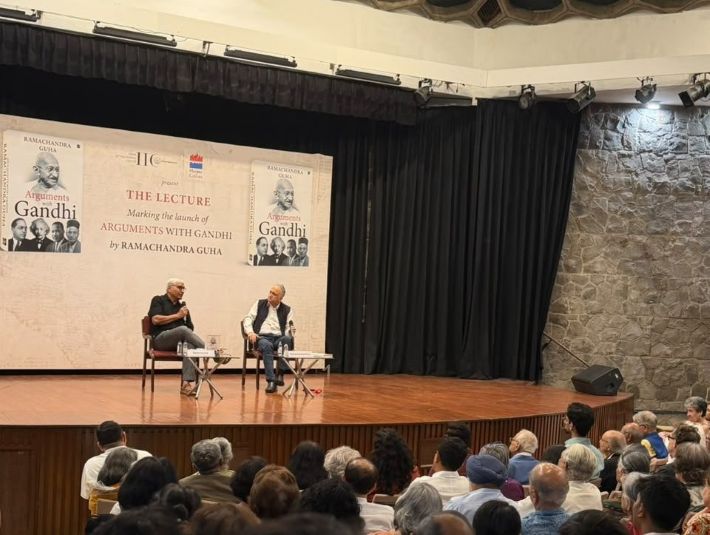
Guha was talking after launching his new book, ‘Arguments with Gandhi’ (Fourth Estate/HarperCollins India), here on Thursday. At the packed auditorium, he first gave a brief overview of the book, then had a freewheeling discussion with Apruvananand on the protagonist of the book, followed by answering the questions from the audience.
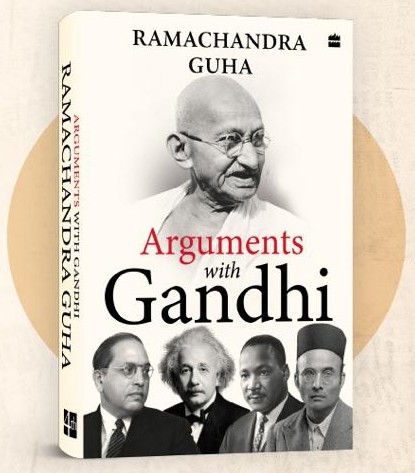
After his celebrated two-volume biography of Gandhi, this work is about, as it were, afterlives of Gandhi. The title is an attempt at pun: the book includes the arguments that Gandhi has with his adversaries, such as Savarkar, and the book is also an exercise in making arguments about a host of issues, with Gandhi as the reference point.
Guha has now written three books on Gandhi, and says he may write many more. Once Gandhi takes hold of you, as veteran Gandhi scholar Bhikhu Parekh had put it, it is difficult to free yourself from him.
As noted in the preface, the idea of this book came to the author in August 2019 when he read the news about his alma mater, Delhi University, where the busts of Savarkar, Bhagat Singh and Subhas Bose had come up surreptitiously (and were removed soon after). In this ideologically diverse trinity, the only common point was their advocacy of violence and strong differences with Gandhi on that count. That set the author thinking about the Mahatma’s legacy in his country and the fate of the values he lived and died for. He strove for equalities of many kinds (caste, gender) and against injustices of many kinds (economic). Above all, he advocated a less popular but empirically speaking more effective way of conflict resolution – nonviolence, that is, love.
Apurvanand mentioned that a Japanese delegation was upset when he told them that Gandhi was all about conflicts; they thought he was all about love. Guha said, yes, Gandhi sought out conflicts but sought to reduce them.
In the first part of the book, Guha follows Gandhi’s arguments with his interlocutors on nonviolence, and its success in the US via Martin Luther King, Jr and Africa via Nelson Mandela. In the second part, his views and practices on caste, gender and race are taken up, whereas the third part debates the faith question and pluralism. The fourth section reviews how intellectuals such as Bertrand Russell evaluated Gandhi. Economic inequality remains a missing piece, though.
When one thinks of the historic debates with Gandhi as a participant, one thinks of Savarkar, Ambedkar and Tagore in the other role. Tagore is another missing piece in this book. Guha concedes that Tagore guided Gandhi in enlarging his vision, and urged readers to consult ‘The Mahatma and the Poet’ by Sabyasachi Bhattacgharya (NBT).
Here are some more points from the author’s answers to questions, in no particular order:
* Was Gandhi shaped by the West?
Yes, mostly. Gandhi named three people as his mentors: Srimad Rajachandra (Gujarati), Gopal Krishna Gokhale (Marathi) and Leo Tolstoy (Russian), which shows a kind of expansion of a circle. The references he mentions in his key work, ‘Hind Swaraj’, have largely western sources. Had he succeeded as a barrister in Bombay, his life might’ve been spent among his Gujarati, or even Bania, community. South Africa placed him in close contact with people from other faiths, other views.
His Indianness is crafted. His inspiration for Satyagraha was as much in the age-old Indian practices of dharana and hartal [not to mention ‘tragu’] as in the Suffragettes movement in the West.
* Was the Poona pact a ‘good compromise’ or a ‘rotten compromise’?
The jury is still out. The author has not been able to make up his mind so far. Ambedkar himself described it variously at various points of time. As for the Gandhi vs Ambedkar polemics, Guha points to several Dalit intellectuals and activists, from D. R. Nagaraj to Abhijeet Dipke, who maintain that the two are not adversaries, they are indeed complementary for a Dalit movement today.
* Was Gandhi well-versed in history?
Not much, he had a broad-brush understanding of history, but neither Ashoka nor Akbar finds a mention in his writings. Yes, when it came to Kanaiyalal Munshi’s popular historical novels in Gujarati, he did criticise him for a negative portrayal of Muslims.
* Did Gandhi invite polemics?
He knew “how to disagree without being disagreeable”.
* How about Gandhi’s arguments with Gandhians?
The trouble started with Vinoba Bhave. The author arguably meant to suggest that after Vinoba the Gandhian movement stood depoliticised and ineffective, reducing its working field. He, however, singled out some exceptions like Sane Guruji as exemplary Gandhians.
* Can you deduce nonviolence from the Mahabharata?
Guha thought it was an eccentric reading. Curiously, it was in response to similar charges from his associates that he sat down to translate the Gita in Gujarati (‘Anasaktiyoga’).
* How can one begin to understand Gandhi?
The audience might have expected Guha to name a few titles, such as the autobiography. He gave them a demanding job: Read the 97 volumes of the Collected Works of Mahatma Gandhi (CWMG), which he of course has. There was more: “But do not end there.” To make full sense of, for example, Gandhi’s letters to various people, one needs to read what they wrote to him too. So, add that to the list.
But don’t forget that Gandhi did not attach much significance to reading. “Gandhi’s search for truth … comes [more] from his travels, conversations, experiences … and, unlike Nehru, less from books …”