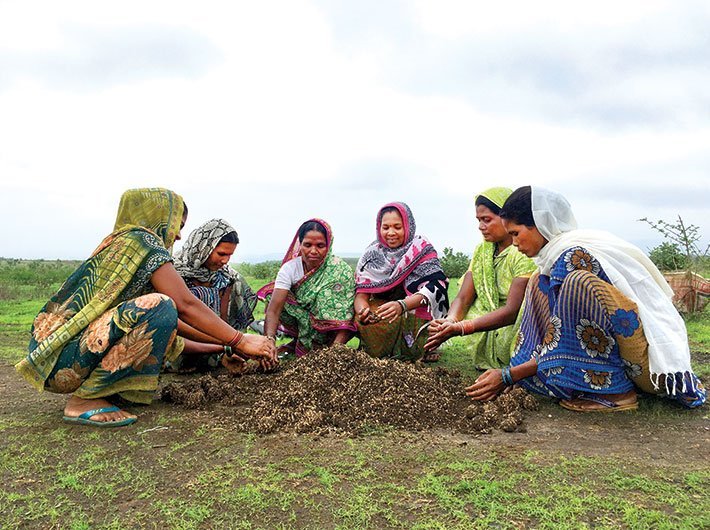
A collective effort by government, NGOs and corporates can go a long way in improving the employability factor of young women in rural areas across the globe
A movement of young women trained as ‘agricultural guides’ is now leading effective action on climate change through sustainable agriculture in rural Africa. More than 8,500 individuals, mostly young women, have been approached by these Agricultural Guides. These Guides are part of an initiative that was launched in 2013 to train young women from poor, marginalised farming communities across sub-Saharan Africa. As guides, these young women have become champions of sustainable agriculture. They have improved productivity, sustainability and profitability of their own smallholdings as well as encouraged wide adoption of practical, affordable and locally-relevant climate-smart techniques. This includes inter-cropping and drip irrigation using waste plastic bottles and technologies that value indigenous traditions.
Similarly, in Dodola district, about 300 km south of Ethiopia’s capital, Addis Ababa, more than 2,000 smallholder young women farmers are involved in a joint United Nations (UN) programme to boost sustainable agricultural production and rural women’s economic empowerment, through training and cooperatives. Such agricultural cooperatives, especially those established by young women in rural areas, play a crucial role in enhancing productivity through sustainable farming practices.
A UN report suggests that giving women the same opportunities as men can increase agricultural production by 2.5-4% in the poorest regions and the number of malnourished people can be reduced by 12-17%.
Notwithstanding the huge importance of women in food production, they are often regarded as assistants on the farm and not as economic agents or farmers in their own right. Rural women lack equality in terms of ownership of family land that they work on in most cases.
According to a research by the Food and Agriculture Organisation of the UN, in the Indian Himalayas, a pair of bulls works 1,064 hours and a man 1,212 hours, whereas a woman 3,485 hours in a year on a one-hectare farm – almost thrice as much.
On the other side, a 2018 study by the University of Maryland and the National Council of Applied Economic Research (NCAER) reveals that women are part of 42% of the agricultural labour force in India; yet own less than 2% of farmland. It is, therefore, imperative to improve these metrics at the national level. Furthermore, women have faced challenges in accessing financial services that can be attributed to low literacy levels among rural women, specifically in financial matters, lack of a formal trail of documentation, amongst others.
To cite an example close to home, a not-for-profit organisation TNS India Foundation (TNSIF) has been working with 1,500-plus mango farming households across the 14 villages of Talala block of Gir Somnath district of Gujarat, since October 2020. A crucial aspect of the programme, which is aimed at helping agricultural households (farmers) come together to establish farmer producer companies (FPC) in order to eliminate middlemen who buy from individual households and sell to an institutional buyer.
It was discovered that only four of the 1,100 FPC shareholders are women. And even in these cases, the women joined as their husbands had passed away and, they were the sole nominees. While all women FPCs are equally encouraged by the government through schemes like Support to State Extension Programmes for Extension Reforms, National Food Security Mission, National Mission on Oilseed & Oil Palm, and National Mission on Sustainable Agriculture, to name a few, they only have token power, which is quite unfortunate.
Challenges Faced by Young Women to Excel in Rural Economy
A 2022 UN report lists key challenges faced by women in rural economy. In many regions around the world, farming is the main source of livelihood and an important income source for the rural population. Rural women, who often struggle to secure their own land to farm in the first place, are facing heightened difficulties in the wake of global crises such as conflict and climate change. In many countries, rural women and girls spend most of their time on unpaid care and domestic work.
Lack of access to financial, government and other services is a common obstacle for rural women around the world. Gender inequalities, rooted in discriminatory patriarchal systems and social norms, mean that women are less likely to access agricultural extension services, markets, land and formal financial services despite their high participation in the agriculture sector. Other challenges that women face in the rural economy include a lack of information on job availability, as well as opportunities for training and education.
In addition, young rural women face restricted mobility after certain hours of the day and limited interaction with people outside their families. At times, mobility issues could also arise for women who are dependent on males for commuting between places.
On average, across countries, long-run gross domestic product (GDP) per capita would be almost 20% higher if gender employment gaps were closed, as per the World Bank report. Studies estimate global economic gains in the order of US$5-6 trillion if women started and scaled new businesses at the same rate men do. Addressing critical gender gaps is an opportunity to boost incomes and stimulate growth.
In this regard, governments and corporates through their corporate social responsibility (CSR) initiatives in terms of policy and awareness and funding have a bigger role to play.
Rural Economy Areas Where Women Contribute
According to the International Labour Organisation (ILO), a significant number of women in the rural economy work as subsistence farmers, small-scale producers, own-account workers, and in plantations and agro-industries, but women in rural economy are also employed in other sectors, such as education, tourism and domestic work.
To this effect, TNSIF has developed a programme to help the sustainable livelihoods of local farming households which aims to help their economic development by sustainably improving household incomes. In addition, the organisation has also developed a comprehensive mentoring program to push women to break social and cultural barriers and polish their entrepreneurial skills to establish and grow their own businesses.
Way Forward for Young Women in Rural Economy
By 2030, about 1.6 billion people will reach working age in low and middle-income countries—the number is lower in high income countries, but the need to stimulate job creation is just as urgent, as per the World Bank. Fifty percent of the world’s population is and will be female, but women currently comprise only about 39% of the labour force globally. Economies that discriminate against women—in entrepreneurship and labour force participation—undermine their own growth trajectory. As per a few researches, gender gaps cause an average income loss of 15% in the Organisation of Economic Cooperation and Development (OECD) economies and losses are estimated higher in developing economies.
In the Indian context, in rural communities, agriculture and allied sector is the primary source of livelihood that includes 80% of all economically active women, out of which 33% constitute agricultural labour force and 48% are self-employed farmers. Rural women are engaged at all levels of agricultural value chain, that is, production- pre-harvest, post-harvest processing, packaging, marketing to increase productivity in agriculture.
Taking all these factors into account, there is a need to invest in and make easily accessible affordable time- and labour-saving in technologies to reduce rural women’s and girls’ disproportionate share of unpaid care and domestic work. Also, it is essential to promote rural women and producer organisations by raising their capacity, skills and services and build linkages to new markets and existing services offered by governments or NGOs.
Going a step further, there is also the need to tackle discriminatory social norms, including through engaging men and boys in measures and programmes for rural women and gender equality. All such efforts can fructify into empowering women in the true sense, especially young individuals in the rural economy.
Rupa Bohra is Managing Director at TNS India Foundation.