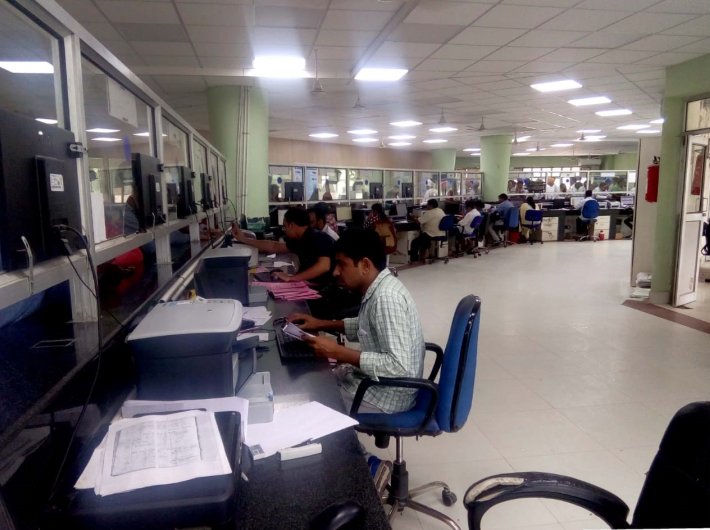
It has overhauled the government scheme and service delivery experience in the state. This has been done in a manner that aligns with the Digital India vision of a faceless, paperless and cashless service delivery model
From obtaining an electricity connection to a driver's licence, ration card, or old-age allowance, delivery of government schemes and services is an aspect of governance that impacts citizens at various points throughout their lives. The Haryana state government provides over 600 such schemes and services. However, lack of awareness, ambiguity around eligibility, complicated application processes, long queues, involvement of touts, and documentation hassles, become impediments to swift delivery of these schemes and services. Haryana's nearly 2.7 crore citizens used to face myriad such challenges and more.
Building a bridge between citizens and government
This dismal state of affairs prompted the state’s leadership to re-imagine the way citizens apply and avail government schemes and services. To this end, led by the Chief Minister’s Office (CMO), National Informatics Centre (NIC), 40+ concerned departments, 22 districts and Samagra, a mission-driven governance consultancy, worked together to design and implement Antyodaya Saral. The primary goal of Antyodaya Saral was to institutionalise an efficient and transparent service delivery framework that enables seamless citizen experience. The team worked on three focus areas to enable this, (1) Antyodaya Saral Online Platform, (2) Citizen touchpoints, and (3) Enablers.
One-stop platform for all governance related concerns
The Antyodaya Saral online platform has brought all the 600+ government schemes and services across 40+ departments to one online integrated platform. Citizens can file applications online, track the status of their application and also receive proactive status updates on their application processing through SMS.
The streamlining of citizen touchpoints aimed at providing schemes and services through three mediums: (1) Online through mobile/computer (2) Saral Kendras at district headquarters, subdivision and tehsil levels (3) common service centres (CSCs) across the state. 117 state-of-the-art Saral Kendras were either revamped or established at the district, subdivision, and tehsil levels. These Kendras act as a single-point interface for citizens to avail all government schemes and services. Each Kendra has a standardised citizen-centric layout adhering to 60+ quality parameters such as token system, adequate waiting area, clean washrooms etc. In addition to the Kendras, more than 6,000 CSCs were trained and enabled on Antyodaya Saral platform. The physical touchpoints also helped in facilitating equitable access to those without the internet or those who are unable to use digital devices.
Both the digital and the physical platforms were also equipped with enablers like helpline, dashboards, knowledge management systems,ticketing system, e-token system and feedback system to further streamline the process of service delivery.
From a CMO mission to becoming a Digital India vision
In the 3.5 years since its implementation, Antyodaya Saral has come a long way in realising the chief minister’s vision of overhauling the scheme and service delivery experience in Haryana. This has been done in a manner that aligns with the Digital India vision of a faceless, paperless and cashless service delivery model. It has resulted in over 15% increase in the number of applications in 150 highest footfall schemes and services; 85% out of approximately 5 crore applications received have been closed within Right to Service (RTS) timelines. 36% applications now directly come online, without assistance from CSCs or Kendras. In addition, the role of touts has significantly reduced. 100% schemes/services have an online approval process, and the citizen-government interface with local department officers has reduced significantly. Every month, 10,00,000+ applications are received through the Antyodaya Saral platform, 15 lakh+ update SMSs are sent to citizens, 54,000+ calls are received at the Saral Helpline Centre, and 4,000+ grievances are disposed, significantly cutting down the public dealing time for officials. These grievances have pushed departments to improvise and further simplify delivery from a citizen perspective.
When the Covid-19 pandemic hit, Saral enabled services like movement pass and reopening of industrial establishments within a day, with verifiable QR Code and real-time updates to citizens. It is now also being leveraged by the RTS Commission to penalize non-performing officials.
The way ahead
Antyodaya Saral has been a collaborative effort by the state's IT & 40+ departments, districts, NIC Government of India and NIC Government of Haryana with constant monitoring by the CMO. The Digital Haryana Cell, comprising Samagra team members, and the chief minister’s Good Governance associates were the catalysts driving this initiative.
Given the resonance of Antyodaya Saral, the Haryana government wants to further push the boundaries of seamless service delivery by moving from a system of reactive to proactive delivery. To this end, the state has created the Parivar Pehchan Patra (PPP), a unique Family ID for every family in the state. PPP has led to the pre-filling of application forms on Antyodaya Saral and significantly reduced documentary requirements (primarily needed to check eligibility) for almost 50% of services and schemes offered by the state. Going forward, as all residents get verified under PPP, the vision is to offer schemes and services instantaneously (over the counter) at the time of application itself, without the need for any backend processing.
Gaurav Goel is the Founder & CEO of Samagra, a mission-driven governance consulting firm.