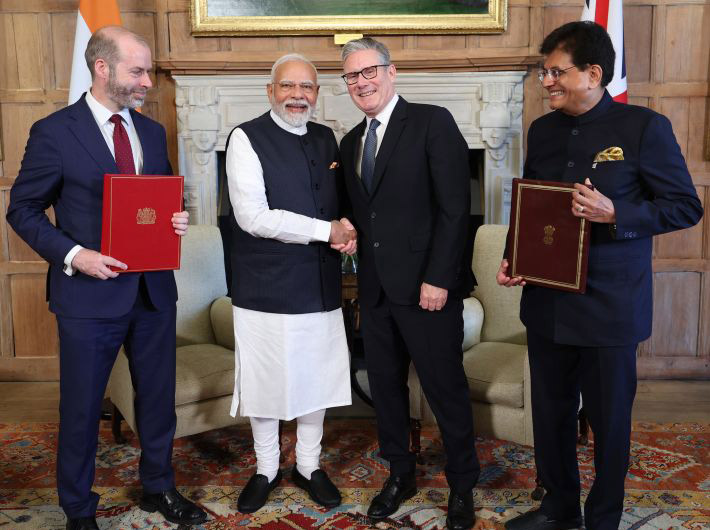
It is a comprehensive framework aimed at unlocking sectoral opportunities and positioning both nations more competitively in a shifting global trade order
The anticipated implementation of the India–UK Free Trade Agreement (FTA) around April 2026 marks a pivotal moment in the economic relationship between two historically connected yet strategically evolving economies. Signed on July 24, 2025, this agreement is not merely a tariff-reduction exercise, it is a comprehensive framework aimed at deepening trade integration, unlocking sectoral opportunities, and positioning both nations more competitively in a shifting global trade order.
At a time when global supply chains are being reconfigured, protectionism is rising, and countries are increasingly pursuing bilateral trade pacts, the India–UK FTA signals a forward-looking partnership rooted in mutual economic complementarity.
Trade Landscape: Setting the Context
India and the UK currently share a robust but under-leveraged trade relationship. Bilateral trade stood at approximately $20–25 billion annually, with ambitions to double this figure by 2030 under the FTA framework. The UK is among India’s top investors, while India ranks among the fastest-growing investment sources in the UK.
However, despite strong diplomatic ties and historical connections, trade barriers, particularly tariffs and regulatory bottlenecks, have limited the full potential of this partnership. The FTA directly addresses these gaps.
Tariff Liberalisation: A Game-Changer
One of the most significant outcomes of the agreement is the reduction or elimination of tariffs on over 90% of traded goods. This is expected to create immediate and long-term benefits across multiple sectors:
● Automobiles: Tariffs on UK-made vehicles, previously as high as 100%, are expected to be significantly reduced. This could make premium British cars more accessible in India while encouraging joint manufacturing and technology partnerships.
● Scotch Whisky: Currently taxed at around 150%, the reduction in duties will likely boost demand in India, which is already one of the world’s largest whisky markets. Industry estimates suggest the UK’s whisky exports to India could increase by over £1 billion in the next 5 years.
● Textiles and Apparel: Indian exporters stand to gain significantly, with duty-free access improving competitiveness against countries like Bangladesh and Vietnam. The sector could see export growth of 10–15% annually post-FTA.
● Pharmaceuticals: Streamlined regulatory approvals and mutual recognition agreements could accelerate market access for Indian generics, a segment where India already holds a strong global position.
Services and Talent Mobility: The Real Multiplier
While goods dominate headlines, the true long-term value of the FTA lies in services and mobility provisions.
India’s strength in IT, financial services, and consulting aligns well with the UK’s demand for skilled talent. The agreement is expected to:
● Ease visa norms for Indian professionals
● Expand opportunities in sectors like fintech, legal services, and healthcare
● Enable smoother cross-border data flows
India’s services exports to the UK, currently valued at over $10 billion, could witness double-digit growth annually, driven by digital transformation and outsourcing demand.
Investment Flows and Business Expansion
The FTA is also expected to catalyse two-way investments, particularly in emerging sectors such as:
● Renewable energy
● Electric mobility
● Fintech and digital infrastructure
● Advanced manufacturing
The UK has already invested over $30 billion in India, and this figure is projected to grow significantly as regulatory clarity and investor protections improve. Similarly, Indian companies in sectors like IT, automotive, and pharmaceuticals are expected to expand their footprint in the UK market.
Strategic and Geopolitical Significance
Beyond economics, the India–UK FTA holds strong geopolitical relevance.
For the UK, post-Brexit trade diversification is a strategic necessity. Strengthening ties with a high-growth economy like India helps offset reliance on European markets.
For India, the agreement aligns with its ambition to become a global manufacturing and export hub, while also strengthening partnerships with developed economies.
This deal could also serve as a template for India’s future FTAs with regions like the EU and North America.
Challenges and Considerations
Despite its promise, the success of the FTA will depend on effective implementation. Key challenges include:
● Regulatory alignment: Ensuring smooth compliance across sectors
● MSME readiness: Helping smaller businesses leverage new opportunities
● Trade imbalance concerns: Managing sectoral sensitivities, especially in agriculture and manufacturing
● Ratification processes: Timely approvals from both sides remain critical
Additionally, domestic industries in both countries may express concerns over increased competition, requiring calibrated policy support.
What This Means for Businesses
For businesses, the FTA is not just a policy shift, it is a strategic opportunity.
● Exporters should realign supply chains and pricing strategies to leverage tariff reductions
● Importers can explore cost advantages and diversify sourcing
● Startups and tech firms can tap into cross-border collaborations and funding
● Educational institutions and service providers can expand into new markets with fewer restrictions
Early movers will likely gain the most, as market dynamics adjust post-implementation.
Conclusion: A Defining Economic Milestone
The India–UK Free Trade Agreement represents a transformational shift in bilateral engagement, with the potential to reshape trade flows, boost investments, and unlock new growth avenues.
With an expected rollout around April 2026, businesses, policymakers, and industry stakeholders must proactively prepare to capitalise on this opportunity. If executed effectively, this agreement could not only double trade volumes but also redefine the economic trajectory of both nations in an increasingly interconnected world.
In essence, the FTA is not just about reducing tariffs, it is about building a future-ready economic corridor between India and the UK.
Gaurav Singal is Managing Director, Eastman IMPEX.